Climent Enric, Pelegri-Sebastia Jose, Sogorb Tomas, Talens J B, Chilo Jose
Sensors and Magnetism Group, Institut de Recerca per a la Gestió Integrada de Zones Costaneres, Campus de Gandia, Universitat Politècnica de València, 46730 Grao de Gandia, Spain.
Department of Electronics and Physics, University of Gävle, SE-80176 Gävle, Sweden.
Sensors (Basel). 2017 Aug 20;17(8):1917. doi: 10.3390/s17081917.
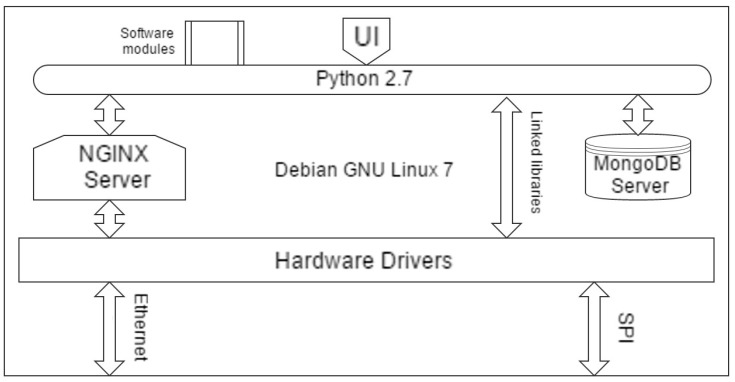
In this paper, we describe a new low-cost and portable electronic nose instrument, the Multisensory Odor Olfactory System MOOSY4. This prototype is based on only four metal oxide semiconductor (MOS) gas sensors suitable for IoT technology. The system architecture consists of four stages: data acquisition, data storage, data processing, and user interfacing. The designed eNose was tested with experiment for detection of volatile components in water pollution, as a dimethyl disulphide or dimethyl diselenide or sulphur. Therefore, the results provide evidence that odor information can be recognized with around 86% efficiency, detecting smells unwanted in the water and improving the quality control in bottled water factories.
在本文中,我们描述了一种新型低成本便携式电子鼻仪器——多感官气味嗅觉系统MOOSY4。该原型仅基于四个适用于物联网技术的金属氧化物半导体(MOS)气体传感器。系统架构包括四个阶段:数据采集、数据存储、数据处理和用户接口。所设计的电子鼻通过实验进行了测试,用于检测水污染中的挥发性成分,如二甲基二硫醚、二甲基二硒醚或硫。因此,结果表明气味信息能够以约86%的效率被识别,检测出水中的异味,并改善瓶装水厂的质量控制。