Xu Yonghui, Meng Ruotong, Zhao Xi
Institute of Automatic Testing and Control, Harbin Institute of Technology, Harbin 150080, China.
Sensors (Basel). 2021 Feb 25;21(5):1597. doi: 10.3390/s21051597.
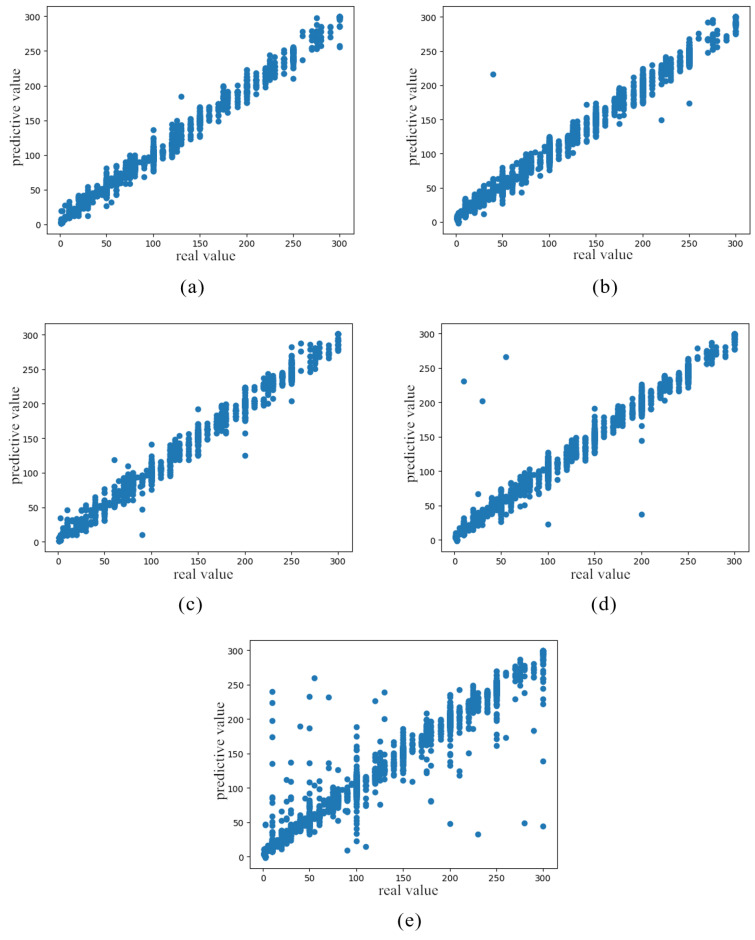
Machine learning algorithms play an important role in the detection of toxic, flammable and explosive gases, and they are extremely important for the study of mixed gas classification and concentration prediction methods. To solve the problem of low prediction accuracy of gas concentration regression prediction algorithms, a gas concentration prediction algorithm based on a stacking model is proposed in the current research. In this paper, the stochastic forest, extreme random regression tree and gradient boosting decision tree (GBDT) regression algorithms are selected as the base learning devices and use the stacking algorithm to take the output of each base learning device as input to train a new model to produce a final output. Through the stacking model, the grid search algorithm is studied to automatically optimize the parameters so that the performance of the entire system can reach the optimal parameters. Through experimental simulation, the gas concentration prediction algorithm based on stacking model has better prediction effect than other integrated frame algorithms and the accuracy of mixed gas concentration prediction is improved.
机器学习算法在有毒、易燃和易爆气体的检测中发挥着重要作用,并且对于混合气体分类和浓度预测方法的研究极为重要。为了解决气体浓度回归预测算法预测精度低的问题,当前研究提出了一种基于堆叠模型的气体浓度预测算法。本文选择随机森林、极限随机回归树和梯度提升决策树(GBDT)回归算法作为基础学习器,并使用堆叠算法将每个基础学习器的输出作为输入来训练一个新模型以产生最终输出。通过堆叠模型,研究了网格搜索算法以自动优化参数,从而使整个系统的性能能够达到最优参数。通过实验仿真,基于堆叠模型的气体浓度预测算法比其他集成框架算法具有更好的预测效果,提高了混合气体浓度预测的准确性。