Liu Ai Ling, Xie Hui Jun, Xie Hong Yan, Liu Jun, Yin Jie, Hu Jin Song, Peng Cui Ying
Institute of Biological Science, School of Pharmaceutical and Biological Science, University of South China, Hengyang, Hunan Province, 421001, China.
Hunan Province Cooperative Innovation Center for Molecular Target New Drug Study, Hengyang, 421001, China.
BMC Med Genet. 2017 Aug 21;18(1):89. doi: 10.1186/s12881-017-0452-1.
Up to now, numerous case-control studies have reported the associations between fat mass and obesity associated (FTO) gene rs9939609 A/T polymorphism and polycystic ovary syndrome (PCOS), however, without a consistent result. Hence we performed current systematic review and meta-analysis to clarify the controversial results.
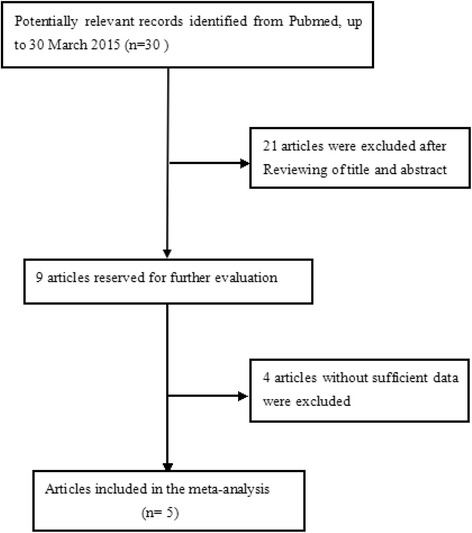
Case-control studies reporting the relationship of rs9939609 A/T polymorphism and PCOS published before April 2015 were searched in Pubmed database without language restriction. Data was analyzed by Review Manager 5.2.
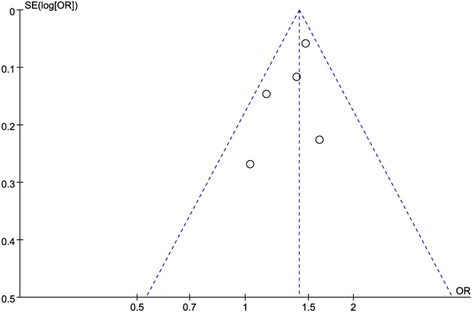
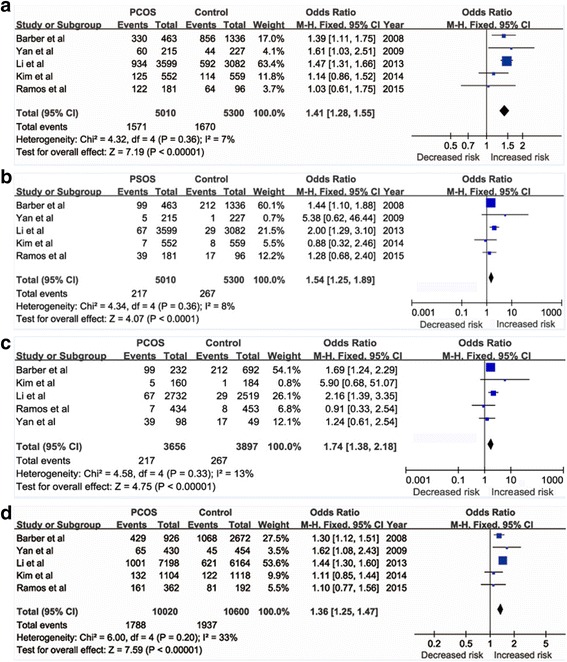
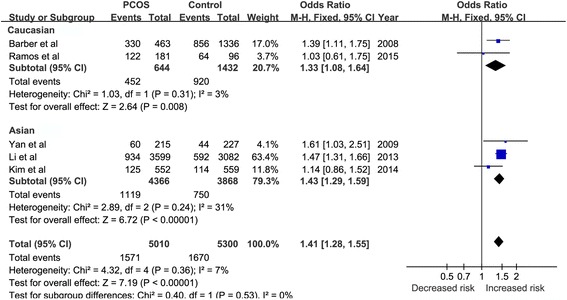
A total of five studies involving 5010 PCOS patients and 5300 controls were included for further meta-analysis. The results of meta-analysis showed that the FTO gene rs9939609 A/T polymorphism was significantly different between PCOS group and control group in different gene models (For AA + AT vs. TT: OR = 1.41, 95% CI = 1.28-1.55, P < 0.00001. For AA vs. AT + TT: OR = 1.54, 95% CI = 1.25-1.89, P < 0.0001. For AA vs. TT: OR = 1.74, 95% CI = 1.38-2.18, P < 0.00001. For A vs. T: OR = 1.36, 95% CI = 1.25-1.47, P < 0.00001, respectively) suggesting that A allele was a risk factor for PCOS susceptibility. Furthermore, subgroup analysis in Asian and Caucasian ethnicities also found significant association between rs9939609 A/T polymorphism and PCOS (In Asian subgroup: OR = 1.43, 95% CI = 1.29-1.59, P < 0.0001. In Caucasian subgroup: OR = 1.33, 95% CI = 1.08-1.64, P = 0.008) CONCLUSION: This meta-analysis suggests that rs9939609 A/T polymorphism of FTO gene is associated with PCOS risk, and that A allele is a risk factor for PCOS susceptibility simultaneously.
截至目前,众多病例对照研究报道了脂肪量和肥胖相关(FTO)基因rs9939609 A/T多态性与多囊卵巢综合征(PCOS)之间的关联,但结果并不一致。因此,我们进行了当前的系统评价和荟萃分析,以阐明这些有争议的结果。
在Pubmed数据库中检索2015年4月之前发表的报道rs9939609 A/T多态性与PCOS关系的病例对照研究,无语言限制。使用Review Manager 5.2软件进行数据分析。
共纳入五项研究,涉及5010例PCOS患者和5300例对照,进行进一步的荟萃分析。荟萃分析结果显示,在不同基因模型中,PCOS组和对照组之间FTO基因rs9939609 A/T多态性存在显著差异(AA + AT vs. TT:OR = 1.41,95%CI = 1.28 - 1.55,P < 0.00001;AA vs. AT + TT:OR = 1.54,95%CI = 1.25 - 1.89,P < 0.0001;AA vs. TT:OR = 1.74,95%CI = 1.38 - 2.18,P < 0.00001;A vs. T:OR = 1.36,95%CI = 1.25 - 1.47,P < 0.00001),提示A等位基因是PCOS易感性的危险因素。此外,亚洲和白种人亚组的亚组分析也发现rs9939609 A/T多态性与PCOS之间存在显著关联(亚洲亚组:OR = 1.43,95%CI = 1.29 - 1.59,P < 0.0001;白种人亚组:OR = 1.33,9%CI = 1.08 - 1.64,P = 0.008)。结论:本荟萃分析提示,FTO基因rs9939609 A/T多态性与PCOS风险相关,且A等位基因同时是PCOS易感性的危险因素。