Saunders Matthew J, Wingfield Tom, Tovar Marco A, Baldwin Matthew R, Datta Sumona, Zevallos Karine, Montoya Rosario, Valencia Teresa R, Friedland Jon S, Moulton Larry H, Gilman Robert H, Evans Carlton A
Section of Infectious Diseases and Immunity, Imperial College London, London, UK; Wellcome Trust Imperial College Centre for Global Health Research, London, UK; Innovation for Health and Development (IFHAD), Laboratory of Research and Development, Universidad Peruana Cayetano Heredia, Lima, Peru; Innovación Por la Salud Y Desarrollo (IPSYD), Asociación Benéfica PRISMA, Lima, Peru.
Section of Infectious Diseases and Immunity, Imperial College London, London, UK; Wellcome Trust Imperial College Centre for Global Health Research, London, UK; Innovation for Health and Development (IFHAD), Laboratory of Research and Development, Universidad Peruana Cayetano Heredia, Lima, Peru; Innovación Por la Salud Y Desarrollo (IPSYD), Asociación Benéfica PRISMA, Lima, Peru; Institute for Infection and Global Health, University of Liverpool, Liverpool, UK; Tropical and Infectious Diseases Unit, Royal Liverpool and Broadgreen University Hospitals Trust, Liverpool, UK.
Lancet Infect Dis. 2017 Nov;17(11):1190-1199. doi: 10.1016/S1473-3099(17)30447-4. Epub 2017 Aug 18.
Contacts of tuberculosis index cases are at increased risk of developing tuberculosis. Screening, preventive therapy, and surveillance for tuberculosis are underused interventions in contacts, particularly adults. We developed a score to predict risk of tuberculosis in adult contacts of tuberculosis index cases.
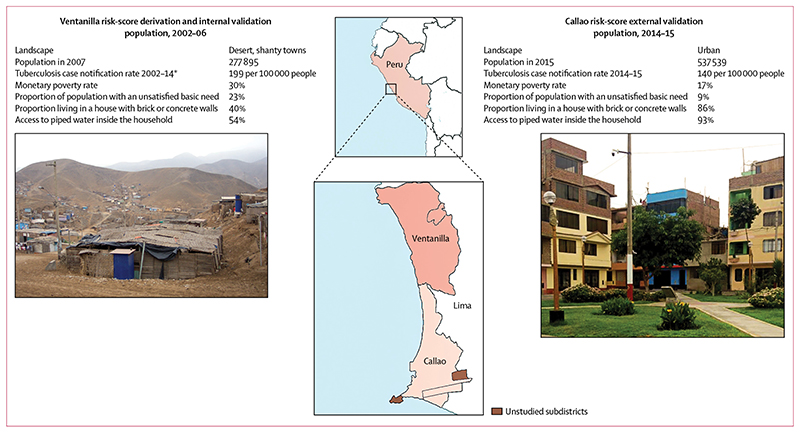
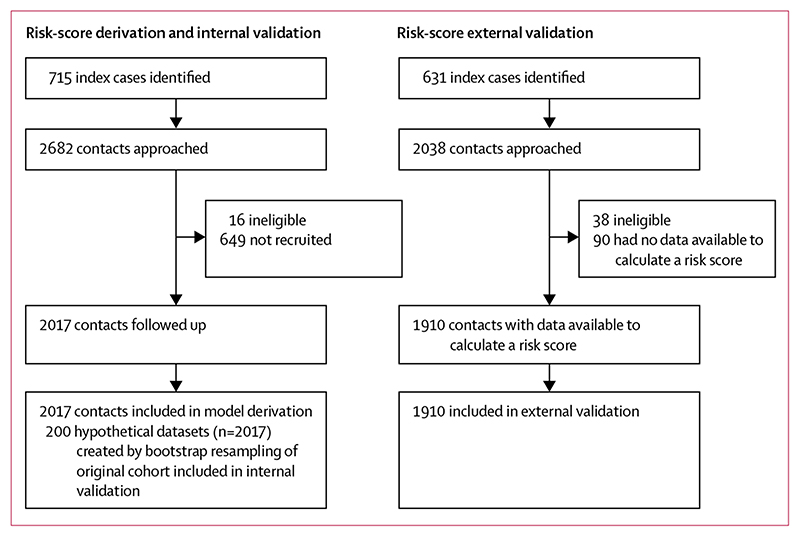
In 2002-06, we recruited contacts aged 15 years or older of index cases with pulmonary tuberculosis who lived in desert shanty towns in Ventanilla, Peru. We followed up contacts for tuberculosis until February, 2016. We used a Cox proportional hazards model to identify index case, contact, and household risk factors for tuberculosis from which to derive a score and classify contacts as low, medium, or high risk. We validated the score in an urban community recruited in Callao, Peru, in 2014-15.
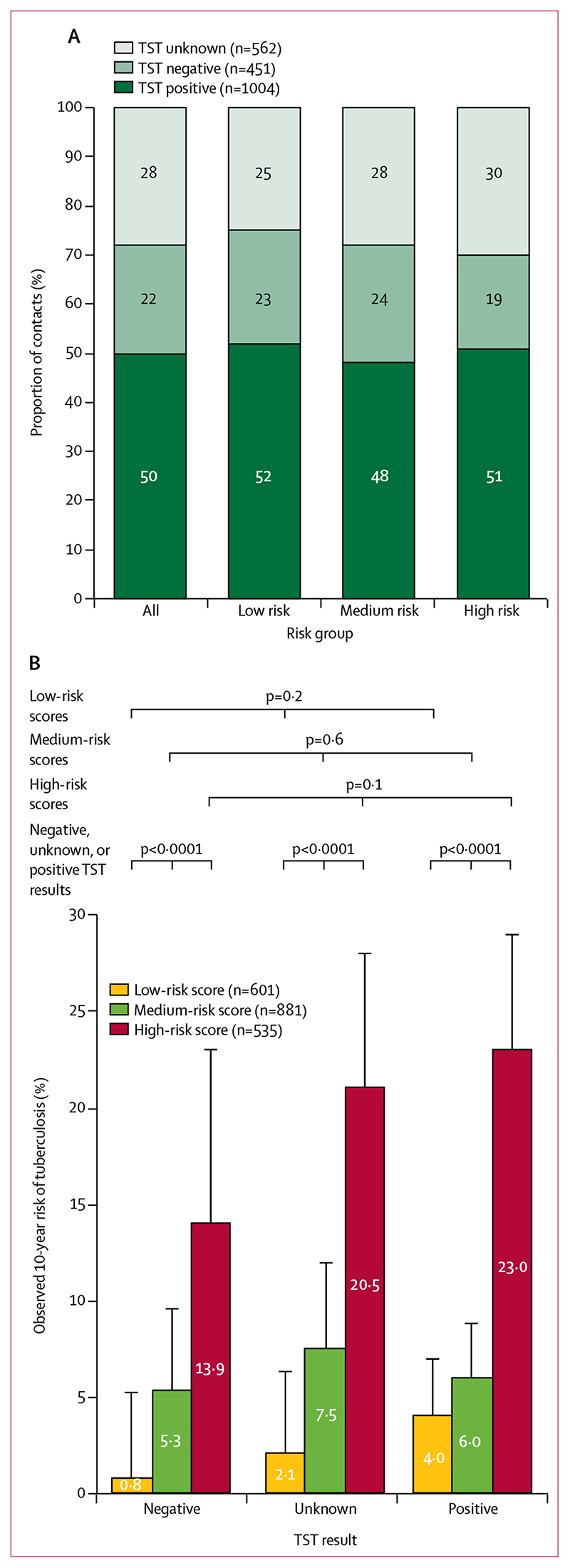
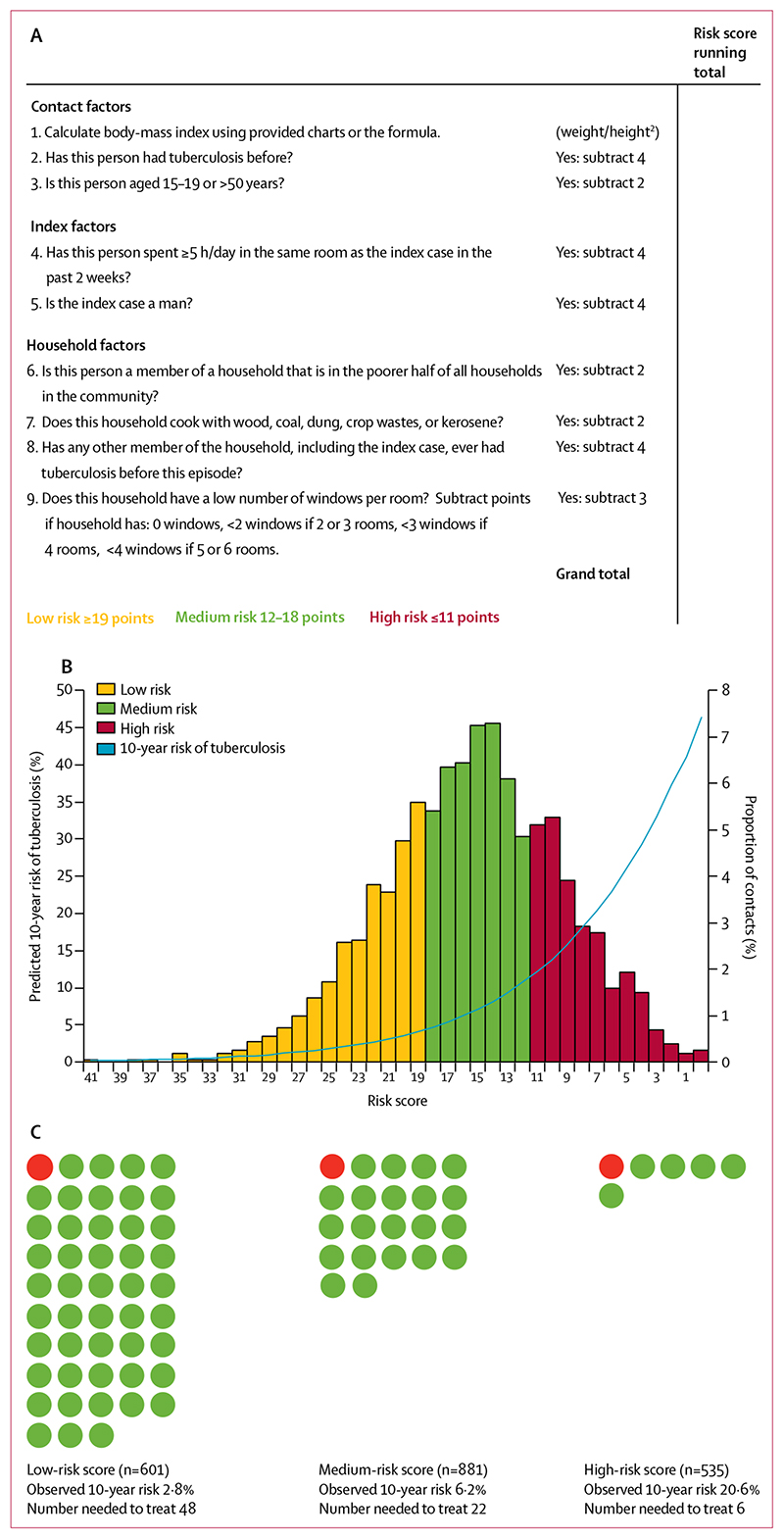
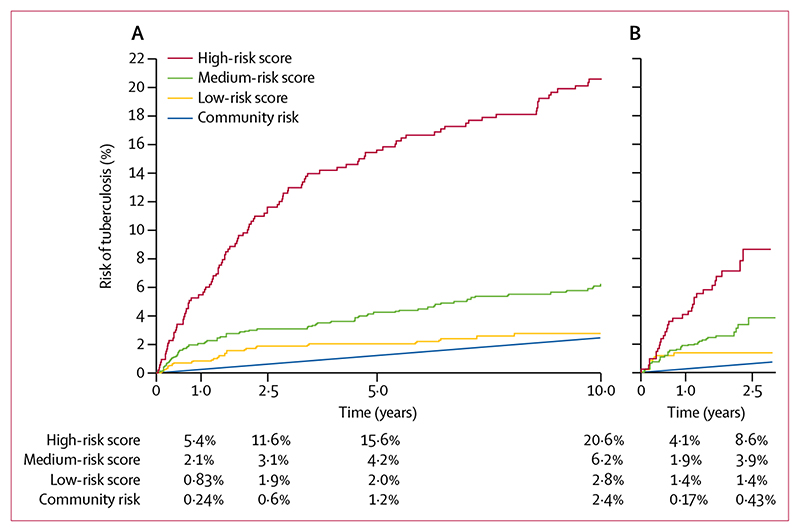
In the derivation cohort, we identified 2017 contacts of 715 index cases, and median follow-up was 10·7 years (IQR 9·5-11·8). 178 (9%) of 2017 contacts developed tuberculosis during 19 147 person-years of follow-up (incidence 0·93 per 100 person-years, 95% CI 0·80-1·08). Risk factors for tuberculosis were body-mass index, previous tuberculosis, age, sustained exposure to the index case, the index case being in a male patient, lower community household socioeconomic position, indoor air pollution, previous tuberculosis among household members, and living in a household with a low number of windows per room. The 10-year risks of tuberculosis in the low-risk, medium-risk, and high-risk groups were, respectively, 2·8% (95% CI 1·7-4·4), 6·2% (4·8-8·1), and 20·6% (17·3-24·4). The 535 (27%) contacts classified as high risk accounted for 60% of the tuberculosis identified during follow-up. The score predicted tuberculosis independently of tuberculin skin test and index-case drug sensitivity results. In the external validation cohort, 65 (3%) of 1910 contacts developed tuberculosis during 3771 person-years of follow-up (incidence 1·7 per 100 person-years, 95% CI 1·4-2·2). The 2·5-year risks of tuberculosis in the low-risk, medium-risk, and high-risk groups were, respectively, 1·4% (95% CI 0·7-2·8), 3·9% (2·5-5·9), and 8·6%· (5·9-12·6).
Our externally validated risk score could predict and stratify 10-year risk of developing tuberculosis in adult contacts, and could be used to prioritise tuberculosis control interventions for people most likely to benefit.
Wellcome Trust, Department for International Development Civil Society Challenge Fund, Joint Global Health Trials consortium, Bill & Melinda Gates Foundation, Imperial College National Institutes of Health Research Biomedical Research Centre, Foundation for Innovative New Diagnostics, Sir Halley Stewart Trust, WHO, TB REACH, and Innovation for Health and Development.
结核病索引病例的接触者患结核病的风险增加。对接触者,尤其是成年人,进行筛查、预防性治疗和结核病监测的干预措施未得到充分利用。我们制定了一个评分系统来预测结核病索引病例成年接触者患结核病的风险。
在2002年至2006年期间,我们招募了居住在秘鲁文塔尼拉沙漠棚户区、年龄在15岁及以上的肺结核索引病例接触者。我们对接触者进行结核病随访,直至2016年2月。我们使用Cox比例风险模型来确定索引病例、接触者和家庭的结核病风险因素,从中得出一个评分,并将接触者分为低风险、中风险或高风险。我们在2014年至2015年招募的秘鲁卡亚俄一个城市社区中对该评分进行了验证。
在推导队列中,我们确定了来自715例索引病例的2017名接触者,中位随访时间为10.7年(四分位间距9.5 - 11.8年)。在19147人年的随访期间,2017名接触者中有178人(9%)患结核病(发病率为每100人年0.93例,95%置信区间0.80 - 1.08)。结核病的风险因素包括体重指数、既往结核病、年龄、持续接触索引病例、索引病例为男性患者、社区家庭社会经济地位较低、室内空气污染、家庭成员中有既往结核病以及居住在每间房窗户数量少的家庭。低风险、中风险和高风险组的10年结核病风险分别为2.8%(95%置信区间1.7 - 4.4%)、6.2%(4.8 - 8.1%)和20.6%(17.3 - 24.4%)。被归类为高风险的535名(27%)接触者占随访期间确诊结核病的60%。该评分独立于结核菌素皮肤试验和索引病例药物敏感性结果预测结核病。在外部验证队列中,1910名接触者中有65人(3%)在3771人年的随访期间患结核病(发病率为每100人年1.7例,95%置信区间1.4 - 2.2)。低风险、中风险和高风险组的2.5年结核病风险分别为1.4%(95%置信区间0.7 - 2.8%)、3.9%(2.5 - 5.9%)和8.6%(5.9 - 12.6%)。
我们经过外部验证的风险评分可以预测并分层成年接触者患结核病的10年风险,并可用于为最可能受益的人群优先安排结核病控制干预措施。
惠康信托基金会、国际发展部民间社会挑战基金、全球卫生联合试验联盟、比尔及梅琳达·盖茨基金会、帝国理工学院国立卫生研究院生物医学研究中心、创新新诊断基金会、哈雷·斯图尔特爵士信托基金、世界卫生组织、结核病防治拓展项目以及健康与发展创新项目。