Neuroeconomics, School of Business and Economics, Freie Universität Berlin, 14195, Berlin, Germany.
Neuroeconomics, Markets and Choice, WZB Berlin Social Science Center, 10785, Berlin, Germany.
Sci Rep. 2017 Aug 21;7(1):8942. doi: 10.1038/s41598-017-06968-5.
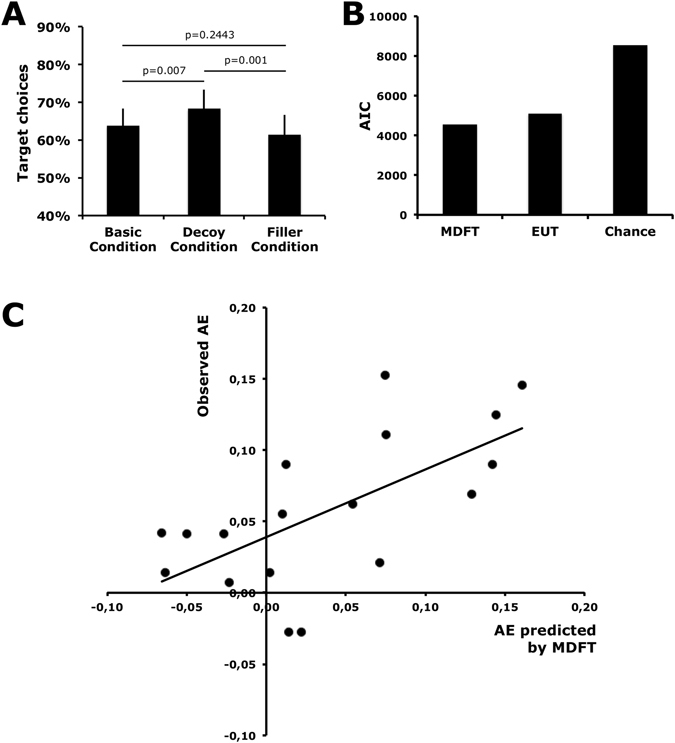
Individuals make decisions under risk throughout daily life. Standard models of economic decision making typically assume that people evaluate choice options independently. There is, however, substantial evidence showing that this independence assumption is frequently violated in decision making without risk. The present study extends these findings to the domain of decision making under risk. To explain the independence violations, we adapted a sequential sampling model, namely Multialternative Decision Field Theory (MDFT), to decision making under risk and showed how this model can account for the observed preference shifts. MDFT not only better predicts choices compared with the standard Expected Utility Theory, but it also explains individual differences in the size of the observed context effect. Evidence in favor of the chosen option, as predicted by MDFT, was positively correlated with brain activity in the medial orbitofrontal cortex (mOFC) and negatively correlated with brain activity in the anterior insula (aINS). From a neuroscience perspective, the results of the present study show that specific brain regions, such as the mOFC and aINS, not only code the value or risk of a single choice option but also code the evidence in favor of the best option compared with other available choice options.
个体在日常生活中会面临各种风险决策。经济决策的标准模型通常假设人们会独立评估选择方案。然而,大量证据表明,在无风险的决策中,这种独立性假设经常被违反。本研究将这些发现扩展到风险决策领域。为了解释违反独立性的现象,我们对多选择决策领域理论(MDFT)进行了改编,将其应用于风险决策,并展示了该模型如何解释观察到的偏好转移。与标准期望效用理论相比,MDFT 不仅能更好地预测选择,还能解释观察到的上下文效应大小的个体差异。正如 MDFT 所预测的,选择所依据的证据与内侧眶额皮质(mOFC)的脑活动呈正相关,与前岛叶(aINS)的脑活动呈负相关。从神经科学的角度来看,本研究的结果表明,特定的脑区,如 mOFC 和 aINS,不仅对单个选择选项的价值或风险进行编码,还对与其他可用选择选项相比,支持最佳选项的证据进行编码。