Hu Jianping, Yu Rongjun
School of Psychology and Center for Studies of Psychological Application, South China Normal University Guangzhou, Guangdong, China.
School of Psychology and Center for Studies of Psychological Application, South China Normal University Guangzhou, Guangdong, China ; School of Economics and Management and Scientific Laboratory of Economic Behaviors, South China Normal University Guangzhou, Guangdong, China.
Front Behav Neurosci. 2014 Aug 7;8:271. doi: 10.3389/fnbeh.2014.00271. eCollection 2014.
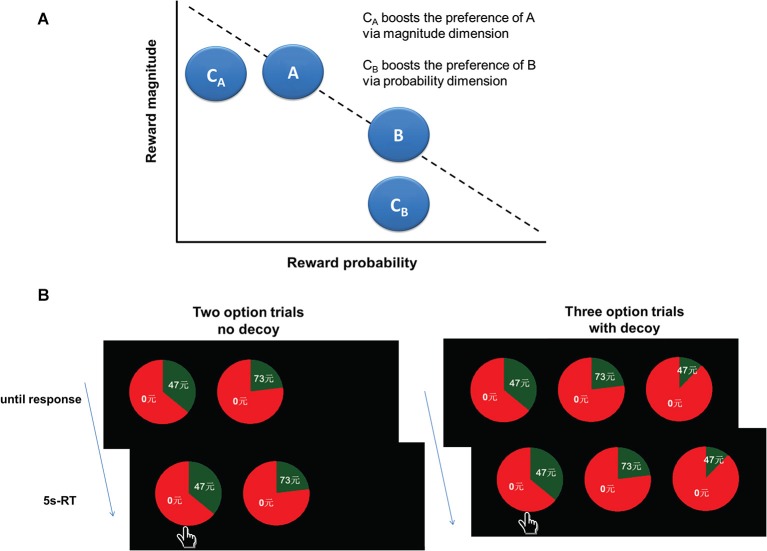
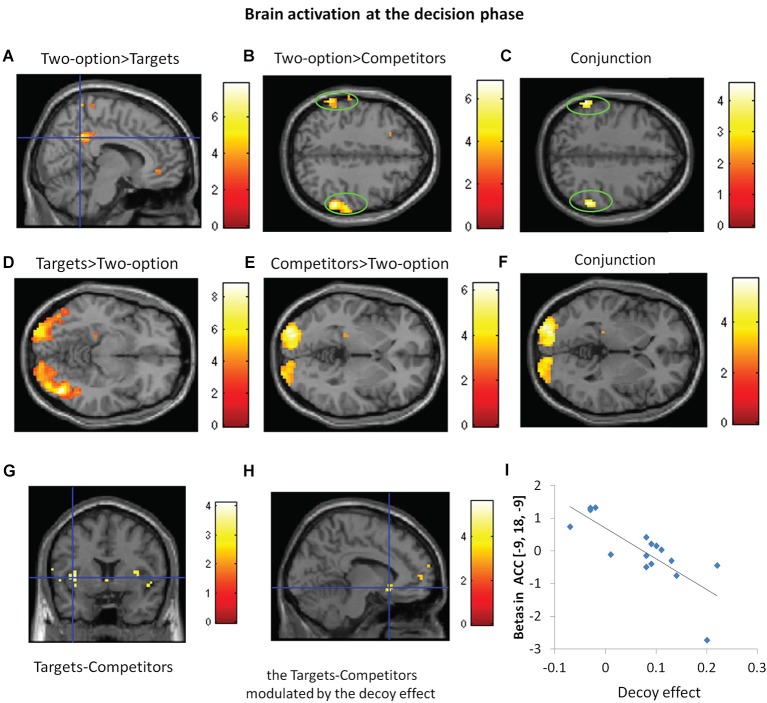
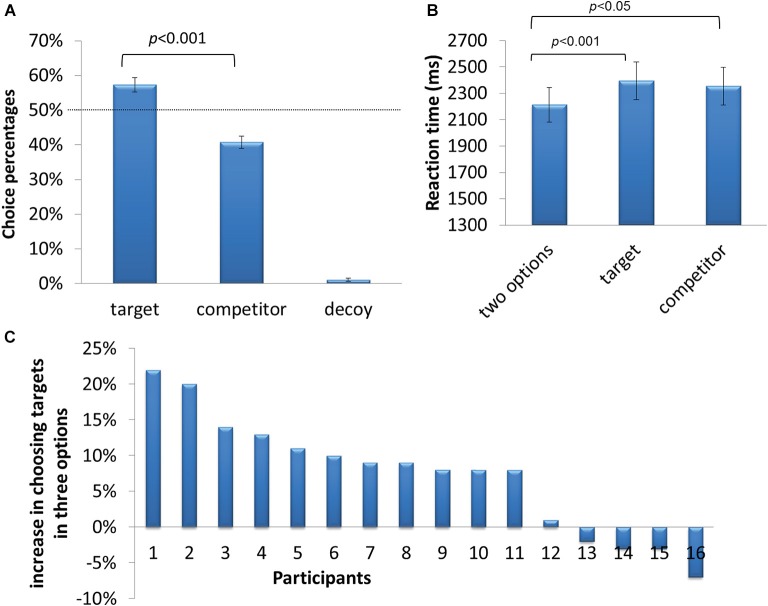
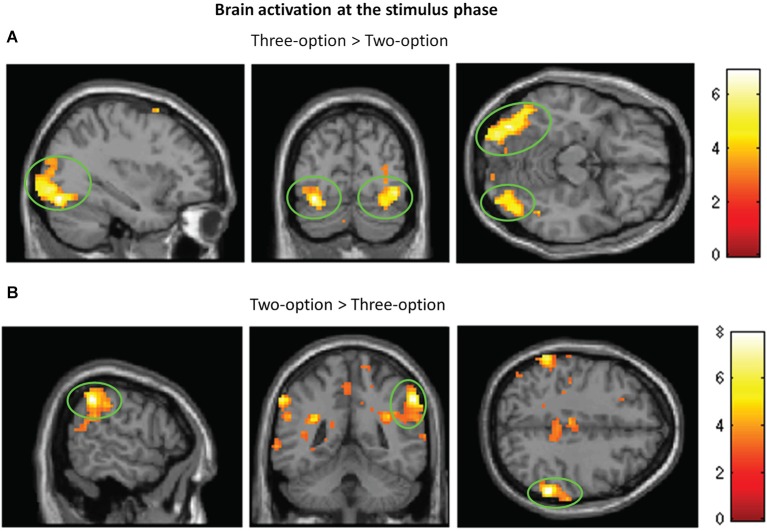
Human choices are remarkably susceptible to the context in which options are presented. The introduction of an inferior option (a decoy) into the choice set can make one of the original options (the target) more attractive than and the other original option (the competitor). This so called "decoy effect" represents a striking violation of the "context-invariant" axiom, yet its underlying neural mechanisms are not well understood. Here, we used a novel gambling task in conjunction with functional magnetic resonance imaging (fMRI) to elucidate its neural basis. At both the stimulus and decision phases, choice sets with decoys activated the occipital gyrus and deactivated the inferior parietal gyrus. At the decision phase, choosing the targets vs. the competitors elicited stronger anterior insula activation, suggesting that perceptual salience drives heuristic decision making in the decoy effect. Moreover, across participants, activity in anterior cingulate cortex (ACC) predicted a reduced susceptibility to the decoy effect, indicating that resisting the tendency to make heuristic decisions is taxing. Our findings highlight the power of the decoy effect in laboratory settings and document the neural mechanisms underlying the decoy effect.
人类的选择极易受到选项呈现背景的影响。在选择集中引入一个较差的选项(诱饵)会使其中一个原始选项(目标选项)比另一个原始选项(竞争选项)更具吸引力。这种所谓的“诱饵效应”明显违背了“背景不变性”公理,但其潜在的神经机制尚未得到充分理解。在此,我们使用了一种新颖的赌博任务并结合功能磁共振成像(fMRI)来阐明其神经基础。在刺激阶段和决策阶段,带有诱饵的选择集均激活了枕叶回并使顶下小叶失活。在决策阶段,选择目标选项而非竞争选项会引发前脑岛更强的激活,这表明知觉显著性驱动了诱饵效应中的启发式决策。此外,在所有参与者中,前扣带回皮质(ACC)的活动预测了对诱饵效应的易感性降低,这表明抵制做出启发式决策的倾向是费力的。我们的研究结果凸显了实验室环境中诱饵效应的影响力,并记录了诱饵效应背后的神经机制。