Senna Gilmar Weber, Rodrigues Bernardo Minelli, Sandy Daniel, Scudese Estevão, Bianco Antonino, Dantas Estélio Henrique Martin
Nursing and Biosciences Post-Graduation Program (PPgEnfBio) - Doctorate of Federal University of State of Rio de Janeiro (UNIRIO)RJ - Brazil.
Laboratory of Biosciences and Human Movement (LABIMH) - Federal University of State of Rio de Janeiro (UNIRIO) - Rio de Janeiro - RJ - Brazil.
J Hum Kinet. 2017 Aug 1;58:197-206. doi: 10.1515/hukin-2017-0077. eCollection 2017 Sep.
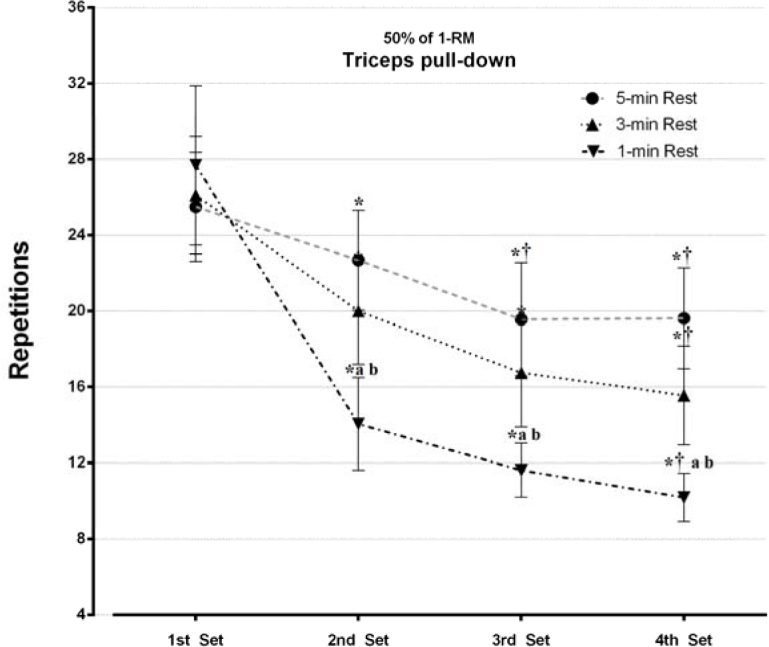
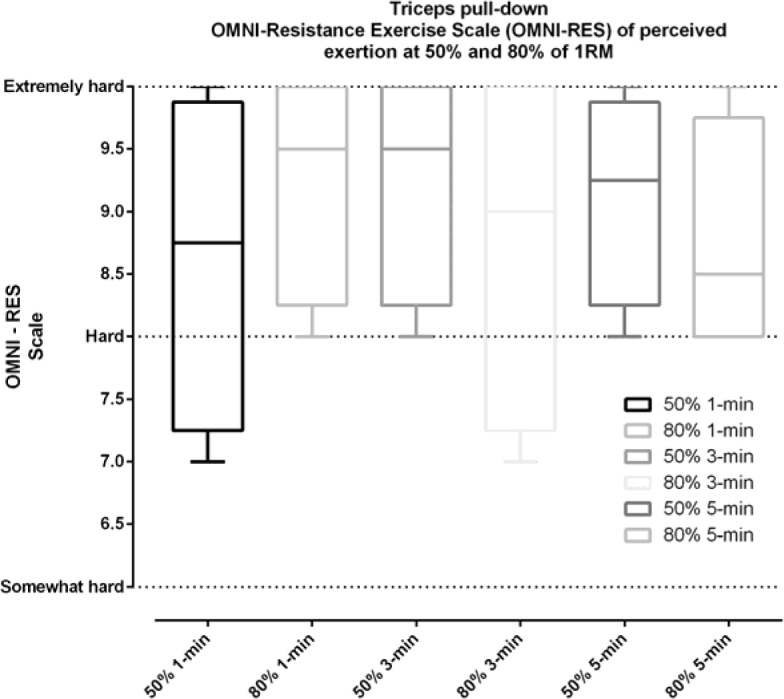
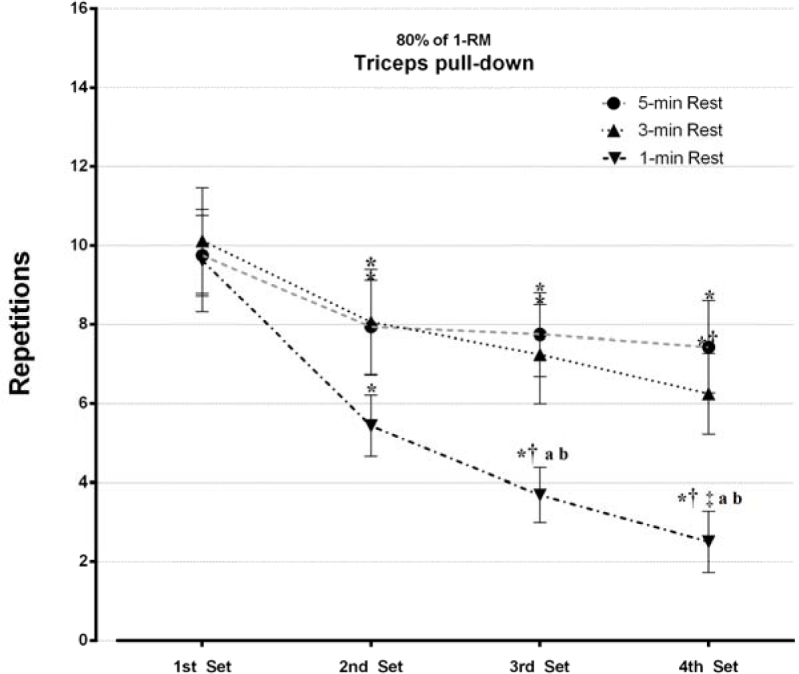
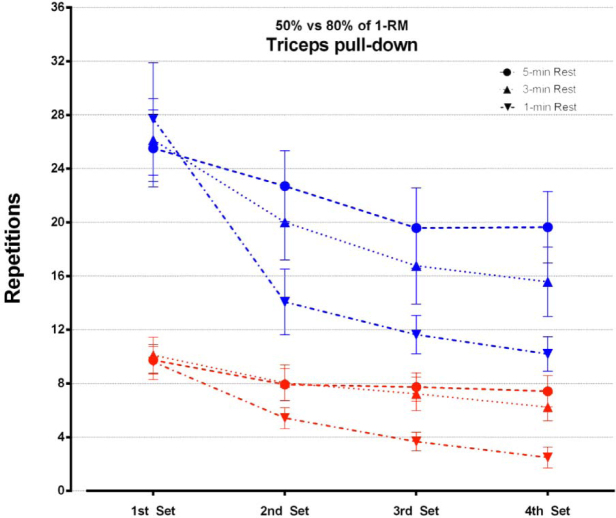
The aim of the study was to compare the effect of three distinct rest period lengths between sets of upper body single-joint exercise with different load zones and volume designed for either endurance or hypertrophy (50% or 80% of 1-RM). Sixteen trained men (20.75 ± 2.54 years; 76.35 ± 5.03 kg; 176.75 ± 3.33 cm, 24.53 ± 1.47 kg/m2) performed a test and retest of 1-RM on non-consecutive days. Forty-eight hours after load testing, the participants were randomly assigned to six sessions consisting of four sets of the triceps pull-down, combining different intensities with distinct rest periods between sets. The shorter 1 minute rest promoted a significant reduction in the total repetition number compared to 3 minute rest for both workloads. There was a difference between 3 and 5 minute conditions for the 50% of 1-RM that did not occur for the 80% of 1-RM condition. Both intensities presented significant interaction values for the rest conditions vs. each set (50% p = 0.0001; 80% p = 0.0001). Additionally, significant values were found for the main effect of the performance of subsequent sets (50% p = 0.003; 80% p = 0.001) and rest conditions (50% p = 0.0001; 80% p = 0.0001). In conclusion, for heavier loads (80%) to fatigue, longer rest of 3 to 5 minutes seems to allow for better recovery between sets and thus, promotes a greater volume. However, when training with lighter loads (50%), the magnitude of the rest seems to directly affect the performance of subsequent sets, and also presents a correlation with total volume achieved for the upper body single-joint exercise scheme.
本研究的目的是比较三种不同的组间休息时长,这些休息时长应用于针对耐力或肥大设计的不同负荷区域和训练量的上身单关节训练(1-RM的50%或80%)。16名受过训练的男性(20.75±2.54岁;76.35±5.03千克;176.75±3.33厘米,24.53±1.47千克/平方米)在非连续的日子里进行了1-RM的测试和复测。负荷测试48小时后,参与者被随机分配到六个训练时段,每个时段包括四组三头肌下拉训练,组间结合不同强度和不同的休息时长。与两种负荷下3分钟的休息相比,1分钟的较短休息显著减少了总重复次数。在1-RM的50%负荷条件下,3分钟和5分钟休息条件之间存在差异,但在1-RM的80%负荷条件下未出现此差异。两种强度在休息条件与每组训练之间均呈现出显著的交互作用值(50%负荷时p = 0.0001;80%负荷时p = 0.0001)。此外,还发现后续组训练表现的主效应(50%负荷时p = 0.003;80%负荷时p = 0.001)和休息条件(50%负荷时p = 0.0001;80%负荷时p = 0.0001)具有显著值。总之,对于较重负荷(80%)直至疲劳的训练,3至5分钟的较长休息似乎能使组间恢复得更好,从而促进更大的训练量。然而,当使用较轻负荷(50%)进行训练时,休息时长似乎直接影响后续组的表现,并且与上身单关节训练方案所达到的总训练量也存在相关性。