Department of Public Health and Infectious Diseases Sapienza University of Rome Rome Italy.
Pasteur Institute-Cenci Bolognetti Foundation Rome Italy.
Brain Behav. 2017 Jul 16;7(8):e00756. doi: 10.1002/brb3.756. eCollection 2017 Aug.
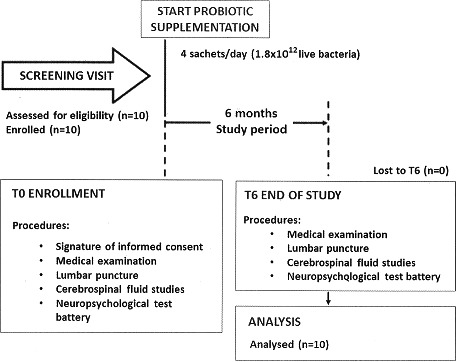
The gut microbiota is involved in the regulation of cognition, mood, anxiety, and pain, and can impact cognitive functions by producing neuroactive substances or releasing bacterial by-products and metabolites. No information is available on the effects of a probiotic supplementation on brain function of HIV+ subjects. In light of the above considerations, we performed a pilot study in cART-treated HIV-1-positive patients with long-term virologic suppression. The aims were to analyze the effect of high-concentration multistrain probiotic supplementation (Vivomixx®; Visbiome®) on several neurocognitive abilities and to evaluate the safety of this supplementation.
To address those issues, neurocognitive performances were explored by administering neuropsychological tests; moreover, miRNA-29a-c levels were measured in cerebrospinal fluid (CSF) to confirm the persistent undetectable levels of HIV-RNA in the central nervous system after probiotic supplementation.
Our results show that the Rey auditory verbal learning test (RAVLT) (immediate and delayed recall), Rey-Osterrieth complex figure test (ROCF) (copy immediate and delayed recall), phonological verbal fluency (PVF) test, Toronto alexithymia scale-20 (Tas-20), State-trait anxiety inventory Y-2 (STAY Y-2), and time and weight estimation test (STEP) scores improved significantly during the study. Moreover, we found unchanged levels, associated to high degree of individual variability, in miRNA-29 levels in CSF collected before and after probiotic supplementation.
In conclusion, we observed that HIV patients treated with 6 months of this probiotic supplementation appear to have an improvement in some neurocognitive functions; moreover, this approach is safe and did not modify significantly the levels of miRNA in CSF. Further studies are needed to better understand the contribution of the probiotics in modulating gut-brain-axis in HIV patients.
肠道微生物群参与认知、情绪、焦虑和疼痛的调节,通过产生神经活性物质或释放细菌副产物和代谢物来影响认知功能。目前尚无关于益生菌补充剂对 HIV+ 患者大脑功能影响的信息。鉴于上述考虑,我们在接受 cART 治疗且病毒学长期抑制的 HIV-1 阳性患者中进行了一项初步研究。目的是分析高浓度多菌株益生菌补充剂(Vivomixx®;Visbiome®)对多种神经认知能力的影响,并评估该补充剂的安全性。
为了解决这些问题,通过进行神经心理学测试来探索神经认知表现;此外,还测量了脑脊液 (CSF) 中的 miRNA-29a-c 水平,以确认在益生菌补充后,HIV-RNA 在中枢神经系统中仍持续不可检测。
我们的结果表明, Rey 听觉言语学习测试(RAVLT)(即时和延迟回忆)、Rey-Osterrieth 复杂图形测试(ROCF)(复制即时和延迟回忆)、语音流畅性测试(PVF)、多伦多述情障碍量表-20(Tas-20)、状态特质焦虑量表 Y-2(STAY Y-2)和时间和重量估计测试(STEP)评分在研究期间显著提高。此外,我们发现 CSF 中 miRNA-29 水平在益生菌补充前后不变,个体差异较大。
总之,我们观察到接受 6 个月这种益生菌补充的 HIV 患者在某些神经认知功能方面似乎有所改善;此外,这种方法是安全的,不会显著改变 CSF 中 miRNA 的水平。需要进一步的研究来更好地了解益生菌在调节 HIV 患者肠道-大脑轴中的作用。