Department of Radiology Guangdong Provincial Corps Hospital of Chinese People's Armed Police Forces Guangzhou Medical University Guangzhou China.
Department of Psychology and Addiction Medicine Guangdong Provincial Corps Hospital of Chinese People's Armed Police Forces Guangzhou Medical University Guangzhou China.
Brain Behav. 2017 Jul 14;7(8):e00769. doi: 10.1002/brb3.769. eCollection 2017 Aug.
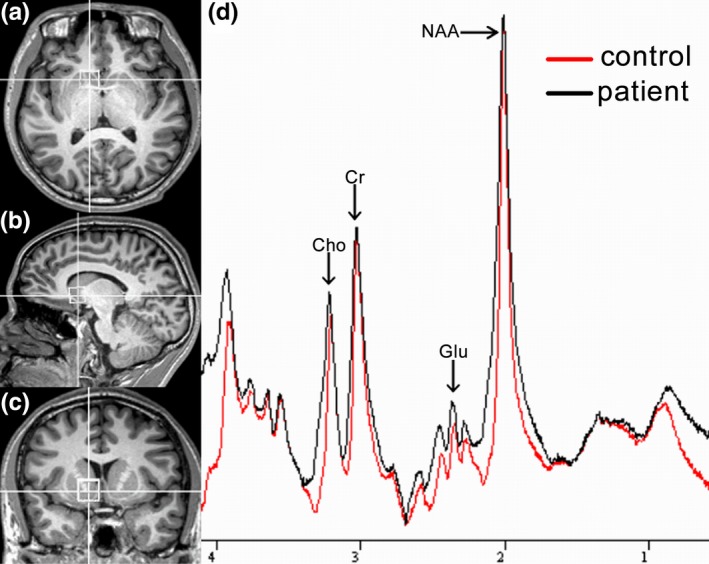
The diagnosis of psychoactive substance use disorders has been based primarily on descriptive, symptomatic checklist criteria. In opioid addiction, there are no objective biological indicators specific enough to guide diagnosis, monitor disease status, and evaluate efficacy of therapeutic interventions. Proton magnetic resonance spectroscopy (H MRS) of the brain has potential to identify and quantify biomarkers for the diagnosis of opioid dependence. The purpose of this study was to detect the absolute glutamate concentration in the nucleus accumbens (NAc) of patients with prescription opioid dependence using H MRS, and to analyze its clinical associations.
Twenty patients with clinically diagnosed definitive prescription opioid dependent (mean age = 26.5 ± 4.3 years) and 20 matched healthy controls (mean age = 26.1 ± 3.8 years) participated in this study. Patients were evaluated with the Barratt Impulsiveness Scale (BIS-11), the Self-Rating Anxiety Scale (SAS), and the opiate Addiction Severity Inventory (ASI). We used point-resolved spectroscopy to quantify the absolute concentrations of metabolites (glutamate, choline, -acetylaspartate, glutamine, creatine) within the NAc. The difference between metabolite levels of groups and Pearson's correlation between glutamate levels and psychometric scores in patients were analyzed statistically.
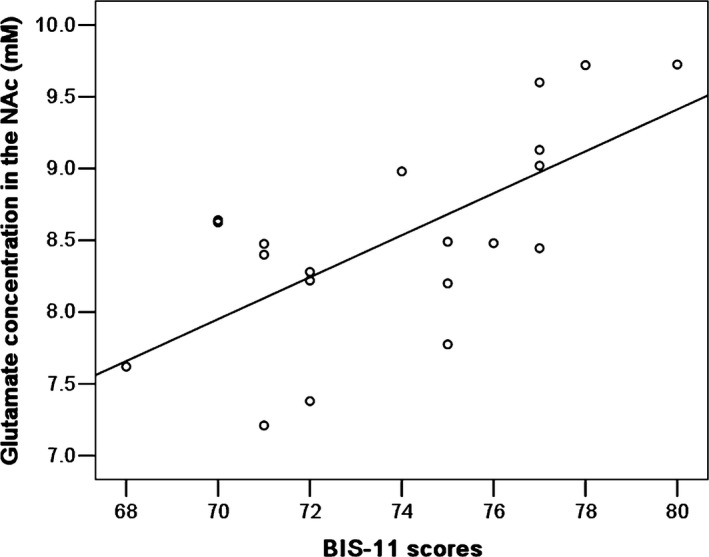
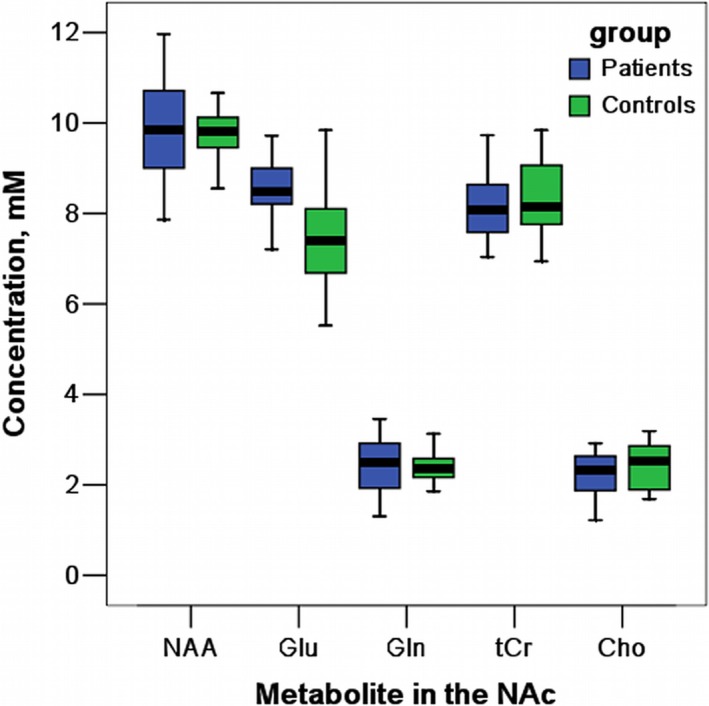
Glutamate concentrations in the NAc were significantly higher in prescription opiate addicts than in controls (=3.84, =.001). None of the other metabolites differed significantly between the two groups (all s > .05). The glutamate concentrations correlated positively with BIS-11 scores in prescription opiate addicts (=.671, =.001), but not with SAS score and ASI index.
Glutamate levels in the NAc measured quantitatively with in vivo H MRS could be used as a biomarker to evaluate disease condition in opioid-dependent patients.
精神活性物质使用障碍的诊断主要基于描述性、症状检查表标准。在阿片类药物成瘾中,没有足够具体的客观生物学指标来指导诊断、监测疾病状态和评估治疗干预的效果。脑质子磁共振波谱(H MRS)有可能识别和量化生物标志物,用于诊断阿片类药物依赖。本研究的目的是使用 H MRS 检测阿片类药物处方依赖患者伏隔核(NAc)中的绝对谷氨酸浓度,并分析其临床相关性。
20 名经临床诊断为明确的阿片类药物依赖患者(平均年龄 26.5 ± 4.3 岁)和 20 名匹配的健康对照者(平均年龄 26.1 ± 3.8 岁)参加了这项研究。采用巴瑞特冲动量表(BIS-11)、焦虑自评量表(SAS)和阿片类药物成瘾严重程度量表(ASI)对患者进行评估。我们使用点分辨波谱法来量化 NAc 内代谢物(谷氨酸、胆碱、乙酰天门冬氨酸、谷氨酰胺、肌酸)的绝对浓度。统计分析了组间代谢物水平的差异,以及患者谷氨酸水平与心理计量评分之间的 Pearson 相关性。
阿片类药物处方成瘾者 NAc 中的谷氨酸浓度明显高于对照组(=3.84,P=.001)。两组间其他代谢物的浓度无显著差异(均 P>.05)。阿片类药物处方成瘾者的谷氨酸浓度与 BIS-11 评分呈正相关(=0.671,P=.001),但与 SAS 评分和 ASI 指数无相关性。
用活体 H MRS 定量测量 NAc 中的谷氨酸水平可作为评估阿片类药物依赖患者疾病状况的生物标志物。