Department of Psychiatry, Academic Medical Center (AMC), Meibergdreef 5, 1105 AZ, Amsterdam, The Netherlands.
Early Psychosis Department, Department of Psychiatry, Amsterdam Medical Center, Amsterdam, The Netherlands.
Eur Arch Psychiatry Clin Neurosci. 2018 Feb;268(1):57-64. doi: 10.1007/s00406-017-0833-7. Epub 2017 Aug 21.
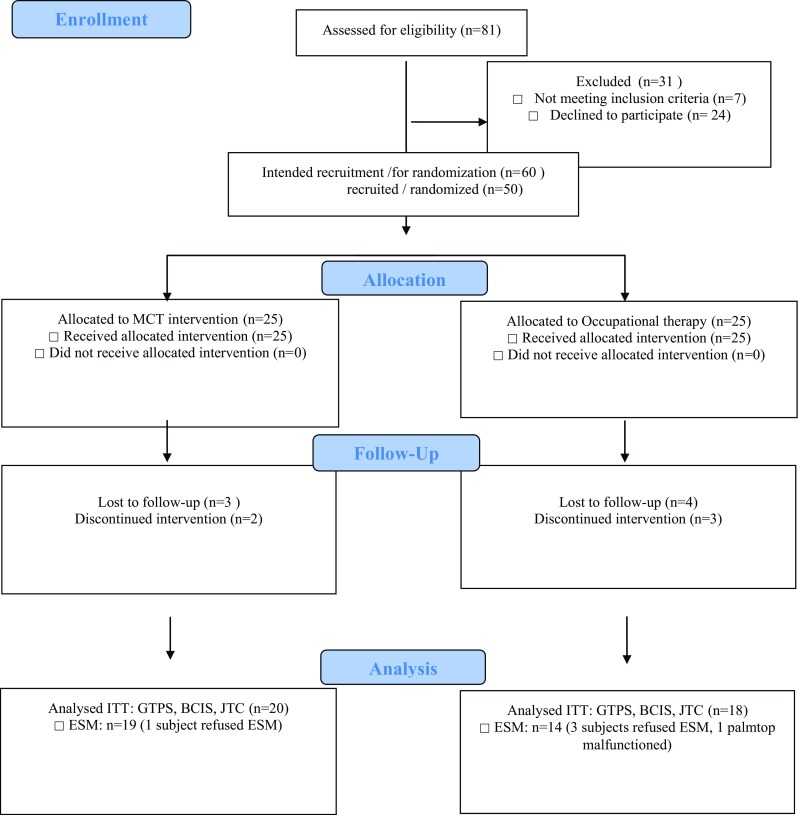
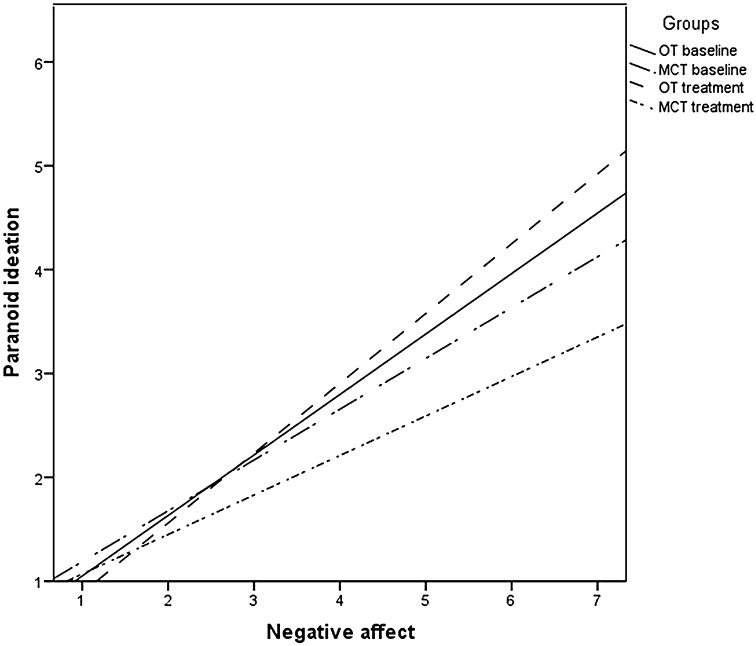
Cognitive biases, negative affect and negative self-esteem are associated with paranoia in people with psychotic disorders. Metacognitive group training (MCT) aims to target these biases although research has shown mixed results. Our objective was to establish the effect of MCT on paranoid ideation in patients with recent onset psychosis in a powerful experience sampling design. 50 patients between the age of 18 and 35 were included in a single-blind, parallel group RCT comparing MCT with occupational therapy (OT) as an active control condition. We assessed via questionnaires and experience sampling treatment effects on paranoid ideation, delusional conviction, the cognitive bias jumping to conclusion (JTC), and cognitive insight, as well as treatment effects on associations between negative affect, negative self-esteem and paranoid ideation. Patients in the MCT group did not show a decrease in paranoid ideation, delusional conviction, JTC-bias or an increase in cognitive insight compared with OT. However, negative affect showed a weaker association with paranoid ideation post-treatment in the MCT condition. In the OT condition, this association was stronger post-treatment. We tentatively suggest that patients with an early psychosis seemed to benefit from MCT in emotional learning compared with the OT condition. Despite the fact that the group training is well-received by patients, subsequent individual MCT (MCT+) may be indicated for stronger favorable effects on paranoid ideation.
认知偏差、负性情绪和低自尊与精神病患者的偏执有关。元认知团体训练(MCT)旨在针对这些偏差,但研究结果喜忧参半。我们的目的是在一项强大的经验抽样设计中,确定 MCT 对首发精神病患者偏执观念的影响。共有 50 名年龄在 18 至 35 岁之间的患者参与了一项单盲、平行组 RCT,比较了 MCT 与职业治疗(OT)作为积极对照条件。我们通过问卷和经验抽样评估了偏执观念、妄想信念、认知偏差“仓促结论”(JTC)和认知洞察力的治疗效果,以及治疗对负性情绪、低自尊和偏执观念之间关系的影响。与 OT 相比,MCT 组患者的偏执观念、妄想信念、JTC 偏差或认知洞察力均未降低。然而,与治疗后 OT 条件相比,MCT 条件下负性情绪与偏执观念的关联较弱。在 OT 条件下,这种关联在治疗后更强。我们推测,与 OT 条件相比,早期精神病患者在情绪学习方面似乎受益于 MCT。尽管团体训练受到患者的欢迎,但随后的个体化 MCT(MCT+)可能更有利于偏执观念的改善。