Maxwell Kara N, Wubbenhorst Bradley, Wenz Brandon M, De Sloover Daniel, Pluta John, Emery Lyndsey, Barrett Amanda, Kraya Adam A, Anastopoulos Ioannis N, Yu Shun, Jiang Yuchao, Chen Hao, Zhang Nancy R, Hackman Nicole, D'Andrea Kurt, Daber Robert, Morrissette Jennifer J D, Mitra Nandita, Feldman Michael, Domchek Susan M, Nathanson Katherine L
Division of Hematology-Oncology, Department of Medicine, Perelman School of Medicine at the University of Pennsylvania, Philadelphia, PA, 19104, USA.
Division of Translational Medicine and Human Genetics, Department of Medicine, Perelman School of Medicine at the University of Pennsylvania, Philadelphia, PA, 19104, USA.
Nat Commun. 2017 Aug 22;8(1):319. doi: 10.1038/s41467-017-00388-9.
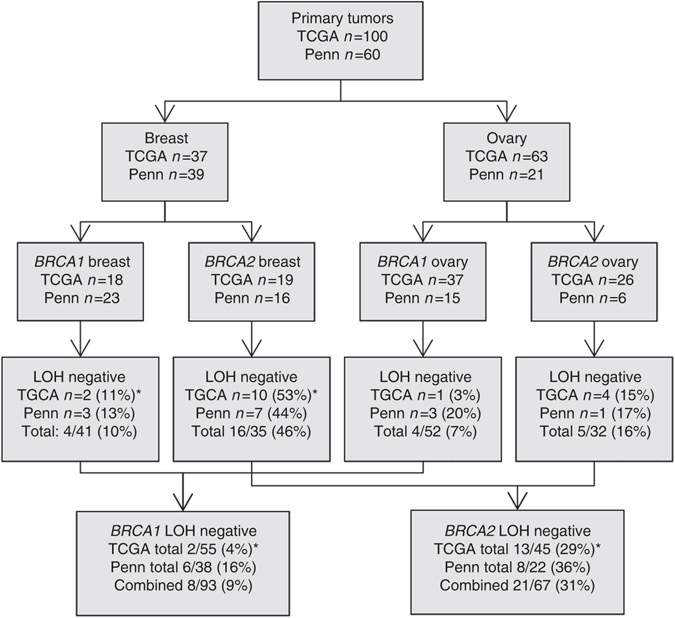
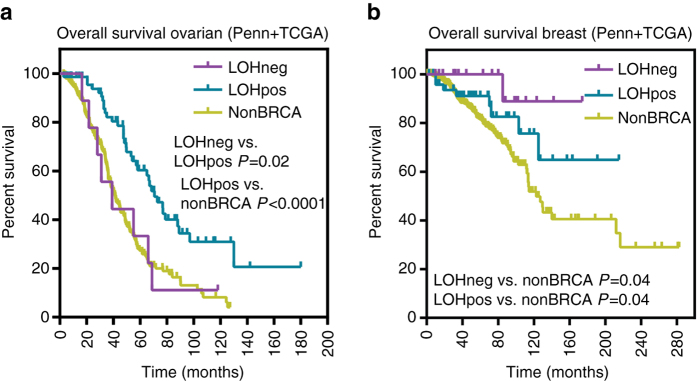
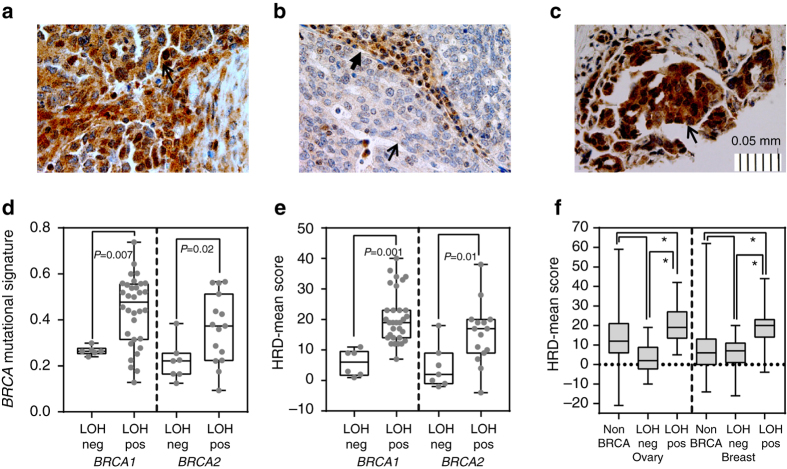
Complete loss of BRCA1 or BRCA2 function is associated with sensitivity to DNA damaging agents. However, not all BRCA1 and BRCA2 germline mutation-associated tumors respond. Herein we report analyses of 160 BRCA1 and BRCA2 germline mutation-associated breast and ovarian tumors. Retention of the normal BRCA1 or BRCA2 allele (absence of locus-specific loss of heterozygosity (LOH)) is observed in 7% of BRCA1 ovarian, 16% of BRCA2 ovarian, 10% of BRCA1 breast, and 46% of BRCA2 breast tumors. These tumors have equivalent homologous recombination deficiency scores to sporadic tumors, significantly lower than scores in tumors with locus-specific LOH (ovarian, P = 0.0004; breast P < 0.0001, two-tailed Student's t-test). Absence of locus-specific LOH is associated with decreased overall survival in ovarian cancer patients treated with platinum chemotherapy (P = 0.01, log-rank test). Locus-specific LOH may be a clinically useful biomarker to predict primary resistance to DNA damaging agents in patients with germline BRCA1 and BRCA2 mutations.Most tumours associated with germline BRCA1/BRCA2 loss of function mutations respond to DNA damaging agents, however, some do not. Herein, the authors identify that a subset of breast/ovarian tumors retain a normal allele, which is associated with decreased overall survival after DNA damage-inducing platinum chemotherapy.
BRCA1或BRCA2功能的完全丧失与对DNA损伤剂的敏感性相关。然而,并非所有与BRCA1和BRCA2种系突变相关的肿瘤都有反应。在此,我们报告了对160例与BRCA1和BRCA2种系突变相关的乳腺和卵巢肿瘤的分析。在7%的BRCA1卵巢肿瘤、16%的BRCA2卵巢肿瘤、10%的BRCA1乳腺肿瘤和46%的BRCA2乳腺肿瘤中观察到正常BRCA1或BRCA2等位基因的保留(不存在位点特异性杂合性缺失(LOH))。这些肿瘤的同源重组缺陷评分与散发性肿瘤相当,显著低于存在位点特异性LOH的肿瘤(卵巢癌,P = 0.0004;乳腺癌,P < 0.0001,双尾学生t检验)。在位点特异性LOH缺失与接受铂类化疗的卵巢癌患者总生存期降低相关(P = 0.01,对数秩检验)。位点特异性LOH可能是预测种系BRCA1和BRCA2突变患者对DNA损伤剂原发性耐药的一种临床有用的生物标志物。大多数与种系BRCA1/BRCA2功能丧失突变相关的肿瘤对DNA损伤剂有反应,然而,有些则没有。在此,作者发现一部分乳腺/卵巢肿瘤保留了正常等位基因,这与DNA损伤诱导的铂类化疗后总生存期降低相关。