Centro de Sensoriamento Remoto, Instituto de Geociências, Universidade Federal de Minas Gerais - UFMG, Av. Antonio Carlos 6627, CEP 31270-901, Belo Horizonte, MG, Brazil.
Departamento de Zoologia, Instituto de Ciências Biológicas, Universidade Federal de Minas Gerais - UFMG, Av. Antonio Carlos 6627, CEP 31270-901, Belo Horizonte, MG, Brazil.
Sci Rep. 2017 Aug 22;7(1):9141. doi: 10.1038/s41598-017-08707-2.
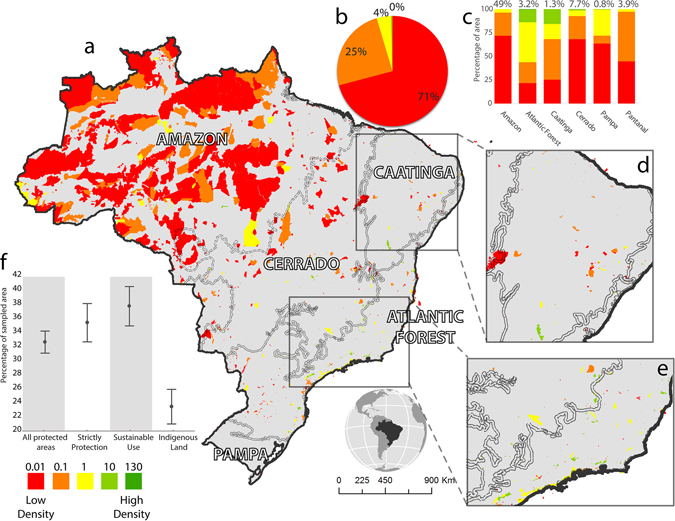
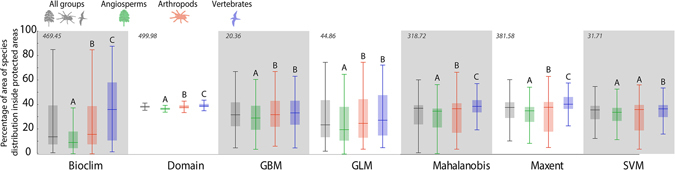
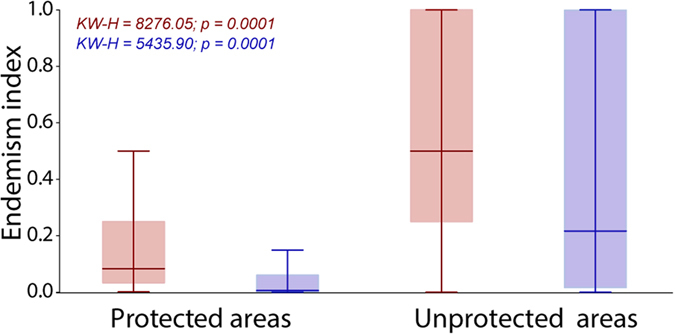
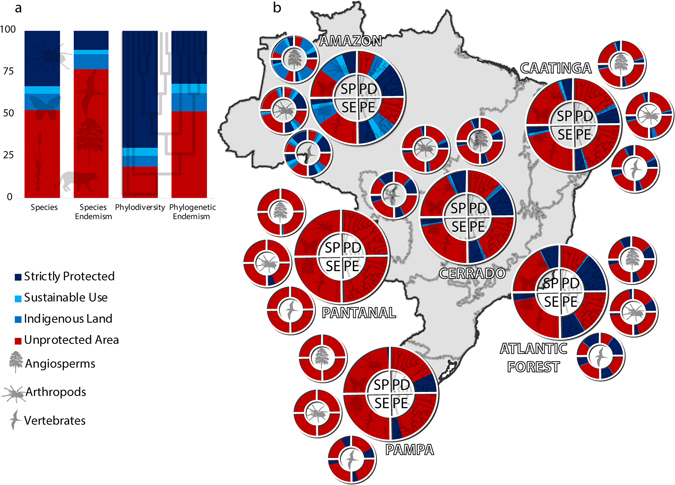
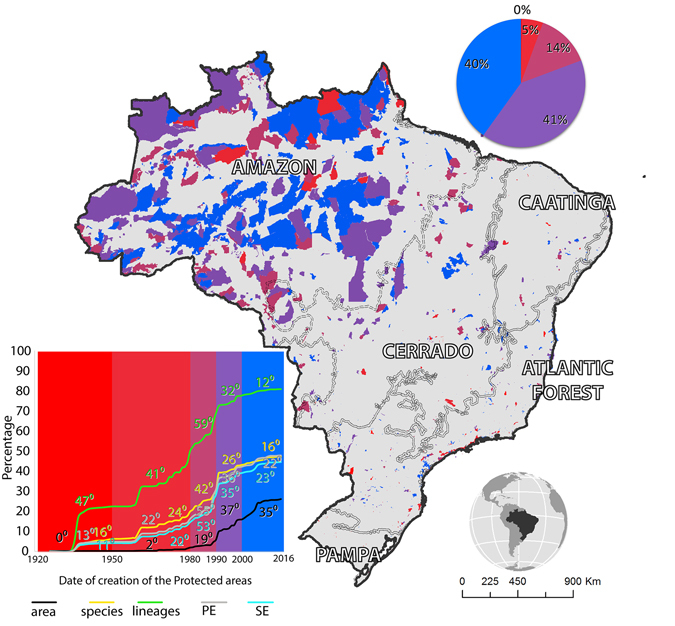
Although Brazil is a megadiverse country and thus a conservation priority, no study has yet quantified conservation gaps in the Brazilian protected areas (PAs) using extensive empirical data. Here, we evaluate the degree of biodiversity protection and knowledge within all the Brazilian PAs through a gap analysis of vertebrate, arthropod and angiosperm occurrences and phylogenetic data. Our results show that the knowledge on biodiversity in most Brazilian PAs remain scant as 71% of PAs have less than 0.01 species records per km. Almost 55% of Brazilian species and about 40% of evolutionary lineages are not found in PAs, while most species have less than 30% of their geographic distribution within PAs. Moreover, the current PA network fails to protect the majority of endemic species. Most importantly, these results are similar for all taxonomic groups analysed here. The methods and results of our countrywide assessment are suggested to help design further inventories in order to map and secure the key biodiversity of the Brazilian PAs. In addition, our study illustrates the most common biodiversity knowledge shortfalls in the tropics.
尽管巴西是一个生物多样性大国,因此是保护的重点,但迄今为止,还没有利用广泛的经验数据来量化巴西保护区(PAs)中的保护差距。在这里,我们通过对脊椎动物、节肢动物和被子植物出现和系统发育数据的差距分析,评估了所有巴西保护区内生物多样性保护和知识的程度。我们的结果表明,由于 71%的保护区每公里的物种记录少于 0.01 个,因此大多数巴西保护区的生物多样性知识仍然很少。将近 55%的巴西物种和约 40%的进化谱系未在保护区中发现,而大多数物种的地理分布在保护区内不到 30%。此外,目前的保护区网络未能保护大多数特有物种。最重要的是,这里分析的所有分类群都有类似的结果。建议使用我们全国性评估的方法和结果来帮助设计进一步的清查,以绘制和保护巴西保护区的关键生物多样性。此外,我们的研究说明了热带地区最常见的生物多样性知识差距。