Leibniz Institute for Farm Animal Biology, Institute for Genome Biology, Wilhelm-Stahl-Allee 2, 18196, Dummerstorf, Germany.
Hermitage Genetics, Sion Road, Kilkenny, Ireland.
Sci Rep. 2017 Aug 22;7(1):9118. doi: 10.1038/s41598-017-08961-4.
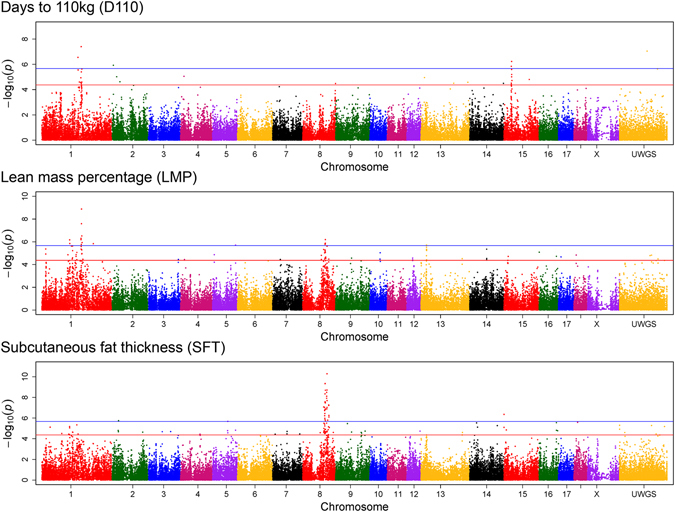
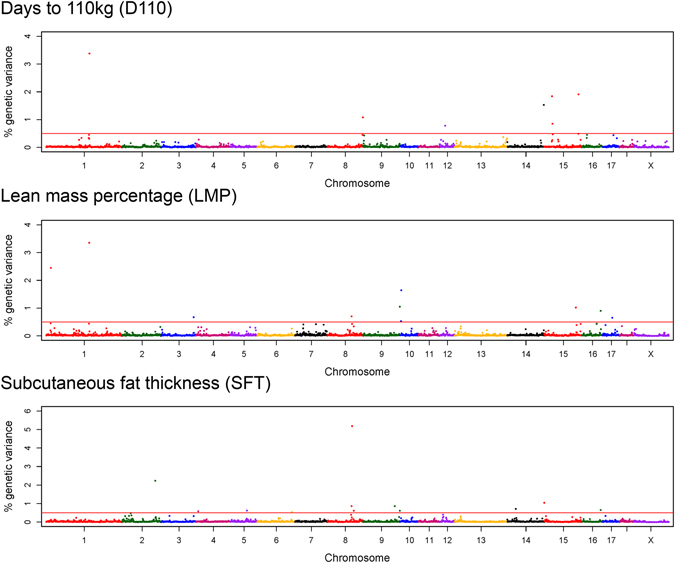
Obesity is characterized as the excessive accumulation of body fat and has a complex genetic foundation in humans including monogenic high-risk mutations and polygenic contributions. Domestic pigs represent a valuable model on an obesity-promoting high-caloric diet while constantly evaluated for body characteristics. As such, we investigated the genetics of obesity-related traits, comprising subcutaneous fat thickness, lean mass percentage, and growth rate, in a pig population. We conducted genome-wide association analyses using an integrative approach of single-marker regression models and multi-marker Bayesian analyses. Thus, we identified 30 genomic regions distributed over 14 different chromosomes contributing to the variation in obesity-related traits. In these regions, we validated the association of four candidate genes that are functionally connected to the regulation of appetite, processes of adipogenesis, and extracellular matrix formation. Our findings revealed fundamental genetic factors which deserves closer attention regarding their roles in the etiology of obesity.
肥胖的特征是体脂肪过度积累,在人类中具有复杂的遗传基础,包括单基因高风险突变和多基因贡献。家猪在促进肥胖的高热量饮食下是一个有价值的模型,同时不断评估其身体特征。因此,我们研究了肥胖相关特征(包括皮下脂肪厚度、瘦肉百分比和生长速度)在猪群中的遗传基础。我们使用单一标记回归模型和多标记贝叶斯分析的综合方法进行全基因组关联分析。因此,我们鉴定了 30 个分布在 14 条不同染色体上的基因组区域,这些区域与肥胖相关特征的变化有关。在这些区域中,我们验证了四个候选基因的关联,这些基因在食欲调节、脂肪生成过程和细胞外基质形成方面具有功能联系。我们的研究结果揭示了基本的遗传因素,这些因素在肥胖的发病机制中值得进一步关注。