National Engineering Research Center for Breeding Swine Industry, College of Animal Science, South China Agricultural University, Guangzhou 510642, China.
Lingnan Guangdong Laboratory of Modern Agriculture, Guangzhou 510642, China.
Genes (Basel). 2021 Jan 19;12(1):117. doi: 10.3390/genes12010117.
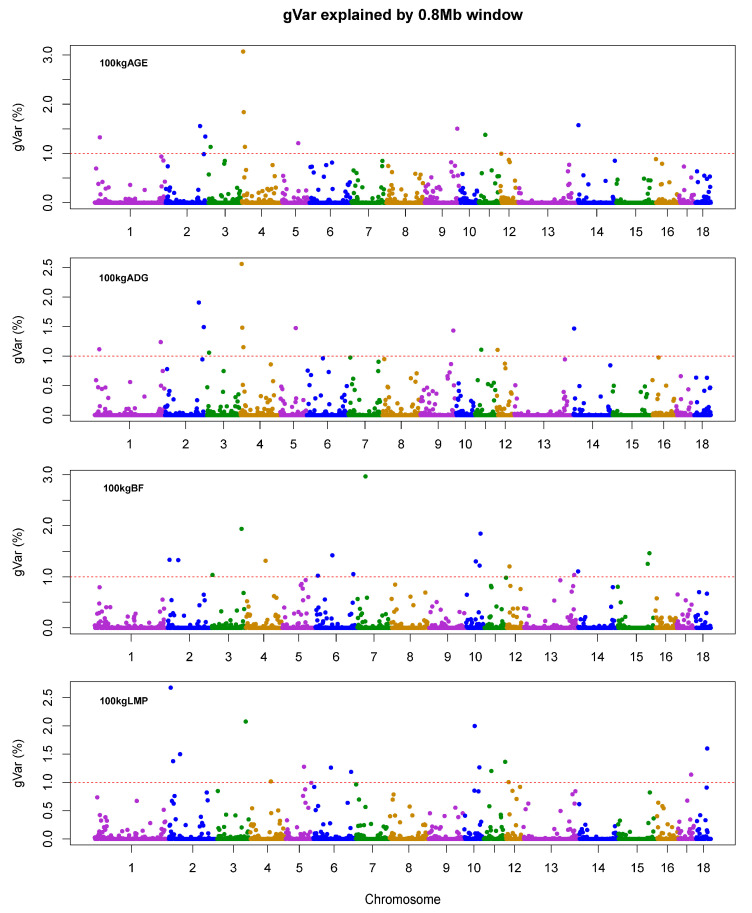
Growth traits are important economic traits of pigs that are controlled by several major genes and multiple minor genes. To better understand the genetic architecture of growth traits, we performed a weighted single-step genome-wide association study (wssGWAS) to identify genomic regions and candidate genes that are associated with days to 100 kg (AGE), average daily gain (ADG), backfat thickness (BF) and lean meat percentage (LMP) in a Duroc pig population. In this study, 3945 individuals with phenotypic and genealogical information, of which 2084 pigs were genotyped with a 50 K single-nucleotide polymorphism (SNP) array, were used for association analyses. We found that the most significant regions explained 2.56-3.07% of genetic variance for four traits, and the detected significant regions (>1%) explained 17.07%, 18.59%, 23.87% and 21.94% for four traits. Finally, 21 genes that have been reported to be associated with metabolism, bone growth, and fat deposition were treated as candidate genes for growth traits in pigs. Moreover, gene ontology (GO) and Kyoto Encyclopedia of Genes and Genomes (KEGG) enrichment analyses implied that the identified genes took part in bone formation, the immune system, and digestion. In conclusion, such full use of phenotypic, genotypic, and genealogical information will accelerate the genetic improvement of growth traits in pigs.
生长性状是猪的重要经济性状,受几个主基因和多个微效基因控制。为了更好地了解生长性状的遗传结构,我们进行了加权单步全基因组关联研究(wssGWAS),以鉴定与 100 千克日龄(AGE)、平均日增重(ADG)、背膘厚(BF)和瘦肉率(LMP)相关的基因组区域和候选基因。在这项研究中,使用了具有表型和系谱信息的 3945 个个体,其中 2084 个个体使用 50K 单核苷酸多态性(SNP)芯片进行了基因分型,用于关联分析。我们发现,四个性状中最显著的区域解释了 2.56-3.07%的遗传变异,检测到的显著区域(>1%)解释了四个性状的 17.07%、18.59%、23.87%和 21.94%。最后,将 21 个已报道与代谢、骨骼生长和脂肪沉积相关的基因视为猪生长性状的候选基因。此外,基因本体论(GO)和京都基因与基因组百科全书(KEGG)富集分析表明,鉴定的基因参与了骨骼形成、免疫系统和消化。总之,充分利用表型、基因型和系谱信息将加速猪生长性状的遗传改良。