Rezvani-Kamran Arezoo, Salehi Iraj, Shahidi Siamak, Zarei Mohammad, Moradkhani Shirin, Komaki Alireza
a Neurophysiology Research Center , Hamadan University of Medical Sciences , Hamadan , Iran.
b Department of Pharmacognosy and Pharmaceutical Biotechnology, School of Pharmacy , Hamadan University of Medical Sciences , Hamadan , Iran.
Pharm Biol. 2017 Dec;55(1):2065-2073. doi: 10.1080/13880209.2017.1362010.
High-fat diet (HFD) can cause deficits in learning and memory through oxidative stress and increase Alzheimer disease risk. Rosa damascena Mill. (Rosaceae) extract possesses potent antioxidant properties.
This study investigated the effects of the hydroalcoholic extracts of petals of R. damascena on learning and memory in male rats consuming an HFD.
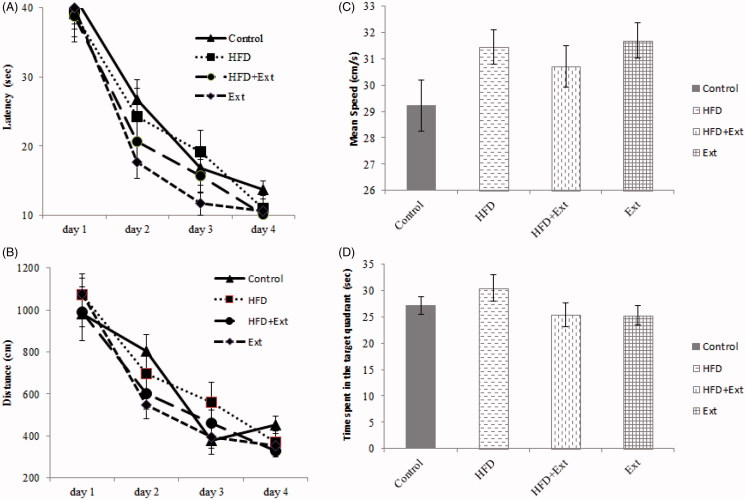
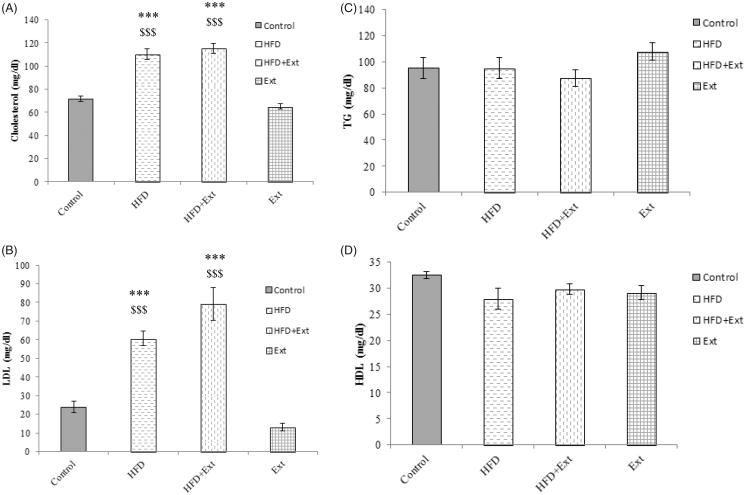
Forty male Wistar rats (200-250 g) were randomly assigned to four groups: control, R. damascena extract, HFD and HFD + extract. The extract (1 g/kg bw daily) was administered by oral gavage for 1 month. Animals were allowed free access to high-fat chow for 3 months. The Morris water maze and the passive avoidance learning tests were used to assess learning and memory.
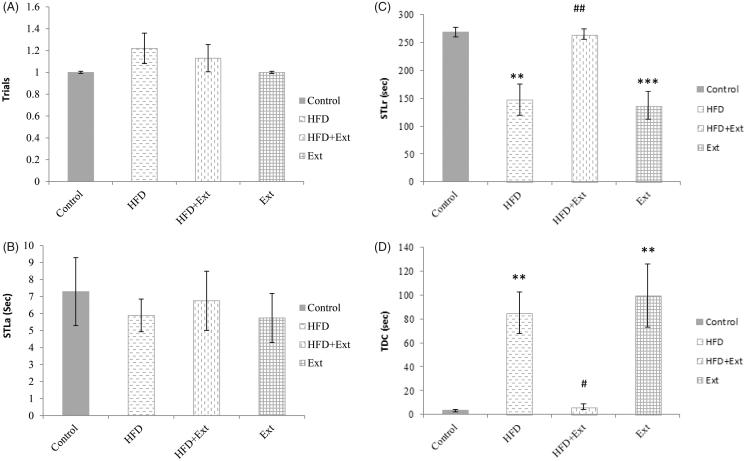
In the passive avoidance learning test, the step-through latencies in the retention test (STLr) of the extract (147.4 ± 23.3) and HFD (150.3 ± 25.2) groups were significantly lower than those of the control group (270.4 ± 10.5) (respectively, p < 0.001 and p < 0.01). STLr was significantly higher in the HFD + extract group (265.3 ± 10.6) than in the HFD group (150.3 ± 25.2) (p < 0.01). Time spent in the dark compartment (TDC) in the HFD + extract group (5.3 ± 2.6) was significantly lower than that in the HFD group (85.8 ± 19.1) (p < 0.05).
Our results indicate that, while HFD or R. damascena extract alone leads to memory deficits, R. damascena extract exerted a positive effect on HFD-induced memory deficits. We hypothesize that the observed effects of R. damascena extract are likely due to its strong antioxidant properties.
高脂饮食(HFD)可通过氧化应激导致学习和记忆缺陷,并增加患阿尔茨海默病的风险。大马士革蔷薇(蔷薇科)提取物具有强大的抗氧化特性。
本研究调查了大马士革蔷薇花瓣水醇提取物对食用HFD的雄性大鼠学习和记忆的影响。
40只雄性Wistar大鼠(200 - 250 g)随机分为四组:对照组、大马士革蔷薇提取物组、HFD组和HFD + 提取物组。提取物(每日1 g/kg体重)通过灌胃给药1个月。动物可自由进食高脂饲料3个月。采用莫里斯水迷宫和被动回避学习试验评估学习和记忆。
在被动回避学习试验中,提取物组(147.4 ± 23.3)和HFD组(150.3 ± 25.2)在记忆保持试验(STLr)中的穿通潜伏期显著低于对照组(270.4 ± 10.5)(分别为p < 0.001和p < 0.01)。HFD + 提取物组的STLr(265.3 ± 10.6)显著高于HFD组(150.3 ± 25.2)(p < 0.01)。HFD + 提取物组在暗室中的停留时间(TDC)(5.3 ± 2.6)显著低于HFD组(85.8 ± 19.1)(p < 0.05)。
我们的结果表明,虽然单独的HFD或大马士革蔷薇提取物会导致记忆缺陷,但大马士革蔷薇提取物对HFD诱导的记忆缺陷具有积极作用。我们推测,大马士革蔷薇提取物观察到的效果可能归因于其强大的抗氧化特性。