Dock Jeffrey, Ramirez Christina M, Hultin Lance, Hausner Mary Ann, Hultin Patricia, Elliott Julie, Yang Otto O, Anton Peter A, Jamieson Beth D, Effros Rita B
Department of Pathology and Laboratory Medicine, David Geffen School of Medicine, University of California-Los Angeles, Los Angeles, CA, United States of America.
Department of Biostatistics, Fielding School of Public Health, University of California-Los Angeles, Los Angeles, CA, United States of America.
PLoS One. 2017 Aug 23;12(8):e0182498. doi: 10.1371/journal.pone.0182498. eCollection 2017.
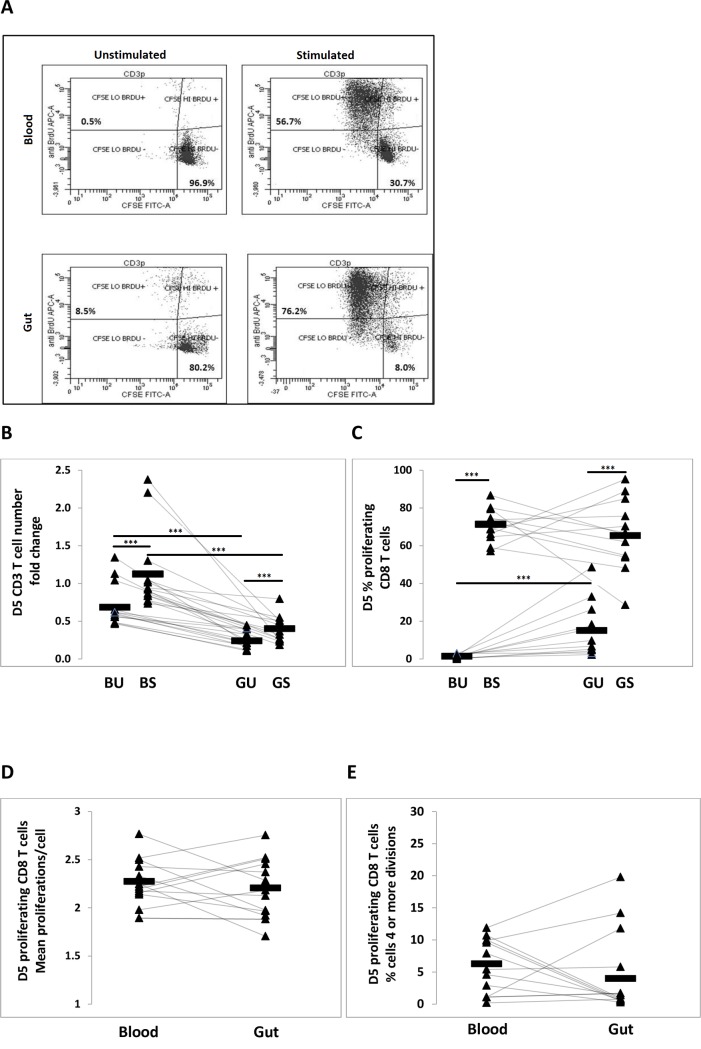
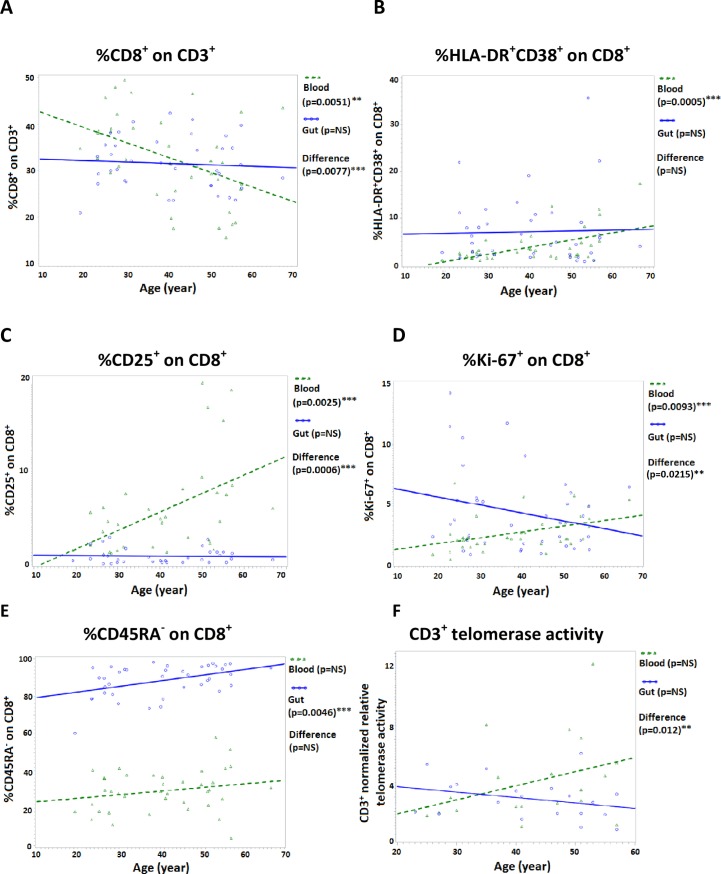
A hallmark of human immunosenescence is the accumulation of late-differentiated memory CD8+ T cells with features of replicative senescence, such as inability to proliferate, absence of CD28 expression, shortened telomeres, loss of telomerase activity, enhanced activation, and increased secretion of inflammatory cytokines. Importantly, oligoclonal expansions of these cells are associated with increased morbidity and mortality risk in elderly humans. Currently, most information on the adaptive immune system is derived from studies using peripheral blood, which contains approximately only 2% of total body lymphocytes. However, most lymphocytes reside in tissues. It is not clear how representative blood changes are of the total immune status. This is especially relevant with regard to the human gastrointestinal tract (GALT), a major reservoir of total body lymphocytes (approximately 60%) and an anatomical region of high antigenic exposure. To assess how peripheral blood T cells relate to those in other locations, we compare CD8+ T cells from peripheral blood and the GALT, specifically rectosigmoid colon, in young/middle age, healthy donors, focusing on phenotypic and functional alterations previously linked to senescence in peripheral blood. Overall, our results indicate that gut CD8+ T cells show profiles suggestive of greater differentiation and activation than those in peripheral blood. Specifically, compared to blood from the same individual, the gut contains significantly greater proportions of CD8+ T cells that are CD45RA- (memory), CD28-, CD45RA-CD28+ (early memory), CD45RA-CD28- (late memory), CD25-, HLA-DR+CD38+ (activated) and Ki-67+ (proliferating); ex vivo CD3+ telomerase activity levels are greater in the gut as well. However, gut CD8+ T cells may not necessarily be more senescent, since they expressed significantly lower levels of CD57 and PD-1 on CD45RO+ memory cells, and had in vitro proliferative dynamics similar to that of blood cells. Compartment-specific age-effects in this cohort were evident as well. Blood cells showed a significant increase with age in proportion of HLA-DR+38+, Ki-67+ and CD25+ CD8+ T cells; and an increase in total CD3+ ex-vivo telomerase activity that approached significance. By contrast, the only age-effect seen in the gut was a significant increase in CD45RA- (memory) and concurrent decrease in CD45RA+CD28+ (naïve) CD8+ T cells. Overall, these results indicate dynamics of peripheral blood immune senescence may not hold true in the gut mucosa, underscoring the importance for further study of this immunologically important tissue in evaluating the human immune system, especially in the context of chronic disease and aging.
人类免疫衰老的一个标志是晚期分化的记忆性CD8+ T细胞的积累,这些细胞具有复制性衰老的特征,如无法增殖、缺乏CD28表达、端粒缩短、端粒酶活性丧失、活化增强以及炎性细胞因子分泌增加。重要的是,这些细胞的寡克隆扩增与老年人发病和死亡风险增加相关。目前,关于适应性免疫系统的大多数信息来自使用外周血的研究,而外周血仅包含全身淋巴细胞的约2%。然而,大多数淋巴细胞存在于组织中。尚不清楚血液变化在多大程度上代表整体免疫状态。这在人类胃肠道(GALT)方面尤其相关,胃肠道是全身淋巴细胞的主要储存库(约60%),也是抗原暴露程度高的解剖区域。为了评估外周血T细胞与其他部位T细胞的关系,我们比较了年轻/中年健康供体外周血和GALT(特别是直肠乙状结肠)中的CD8+ T细胞,重点关注先前与外周血衰老相关的表型和功能改变。总体而言,我们的结果表明,肠道CD8+ T细胞显示出比外周血中T细胞更具分化和活化的特征。具体而言,与同一个体的血液相比,肠道中CD45RA-(记忆性)、CD28-、CD45RA-CD28+(早期记忆性)、CD45RA-CD28-(晚期记忆性)、CD25-、HLA-DR+CD38+(活化)和Ki-67+(增殖)的CD8+ T细胞比例显著更高;肠道中离体CD3+端粒酶活性水平也更高。然而,肠道CD8+ T细胞不一定更衰老,因为它们在CD45RO+记忆细胞上表达的CD57和PD-1水平显著更低,并且体外增殖动力学与血细胞相似。该队列中特定区域的年龄效应也很明显。血细胞中HLA-DR+38+、Ki-67+和CD25+ CD8+ T细胞的比例随年龄显著增加;总CD3+离体端粒酶活性增加,接近显著水平。相比之下,在肠道中观察到的唯一年龄效应是CD45RA-(记忆性)CD8+ T细胞显著增加,同时CD45RA+CD28+(幼稚)CD8+ T细胞减少。总体而言,这些结果表明外周血免疫衰老的动态变化在肠道黏膜中可能不成立,强调了在评估人类免疫系统,特别是在慢性疾病和衰老背景下,进一步研究这个免疫重要组织的重要性。