Wang Shih-Ho, Wang Kuan-Lin, Yang Wen-Kai, Lee Tsung-Han, Lo Wan-Yu, Lee Jane-Dar
Division of General Surgery, Department of Surgery, Kaohsiung Chang Gung Memorial Hospital and Chang Gung University, College of Medicine, Kaohsiung, Taiwan, R.O.C.
Center for General Education, Cheng Shiu University, Kaohsiung, Taiwan, R.O.C.
PLoS One. 2017 Aug 23;12(8):e0183692. doi: 10.1371/journal.pone.0183692. eCollection 2017.
Gastric adenocarcinoma originates from an abnormal epithelium. The aim of this study was to investigate the expression of sodium-potassium ATPase (NKA), a transmembrane protein located in the epithelium for Na+ and K+ transportation, and E-cadherin, which are both crucial for the epithelium and adherens junction, as potential gastric cancer biomarkers.
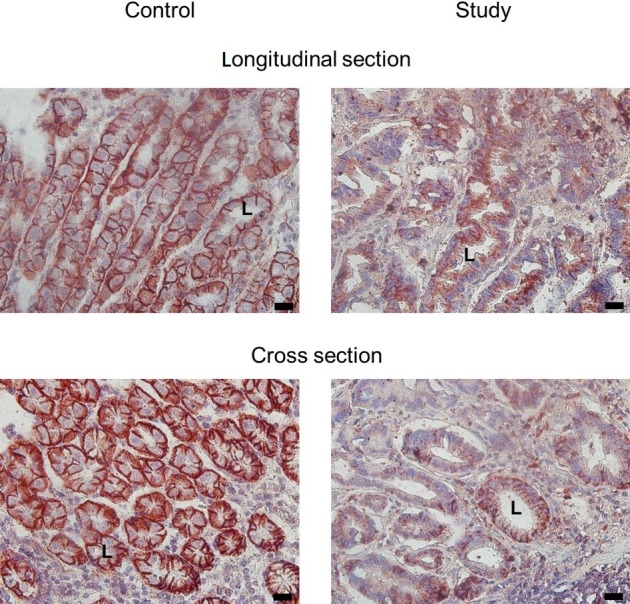
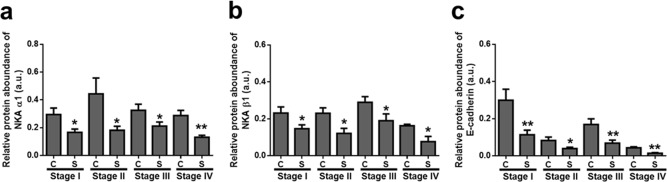
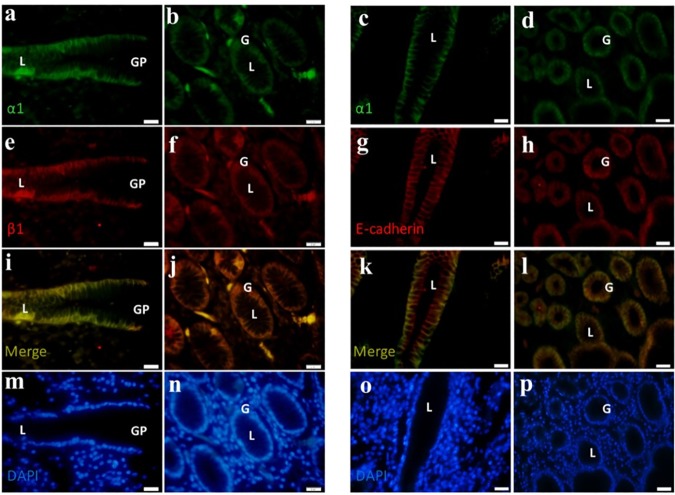
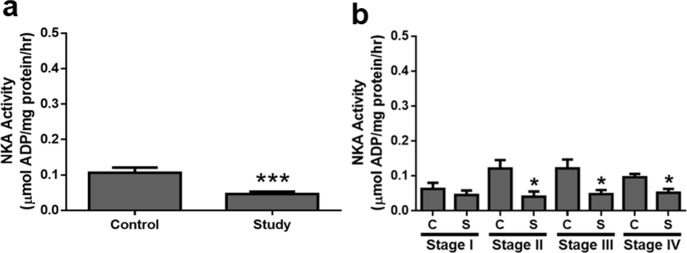
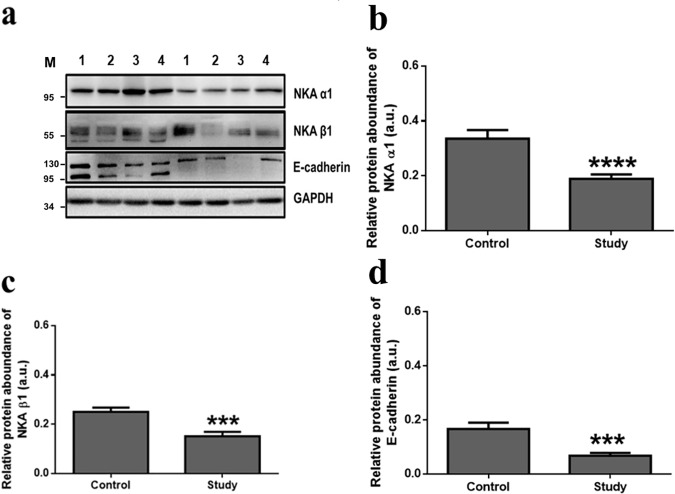
45 patients diagnosed with gastric adenocarcinoma were recruited. Immunohistochemistry and immunofluorescence were conducted to for localization of NKA α1-, β1-isoform, and E-cadherin. NKA enzyme activity was determined by NADH-linked methods and immunoblotting of NKA α1-, β1-isoform, and E-cadherin were performed to evaluate protein expression.
Immunostaining revealed that NKA was co-localized with E-cadherin in the glands of the gastric epithelium. Both NKA activity and α1-isoform protein expression were reduced in the study group (P < 0.05), indicating impaired NKA functions. In the adherens junctions, the NKA β1-isoform and E-cadherin were significantly reduced in the study groups (P < 0.05), indicating the adhesion force between cells may have been weakened.
A significant decrease in NKA function (protein and activity) and E-cadherin in tumor lesions appear promising biomarker for gastric adenocarcinoma. Therefore, developing screening methods for detecting NKA function may be beneficial for the early diagnosis of gastric cancer. In our knowledge, this study was the first to investigate the NKA and E-cadherin expression in the relation of gastric adenocarcinoma in human patients.
胃腺癌起源于异常上皮细胞。本研究旨在探讨钠钾ATP酶(NKA)和E-钙黏蛋白的表达,NKA是一种位于上皮细胞用于钠钾转运的跨膜蛋白,二者对上皮细胞和黏附连接均至关重要,有望作为胃癌生物标志物。
招募45例经诊断患有胃腺癌的患者。采用免疫组织化学和免疫荧光法对NKA α1、β1亚型及E-钙黏蛋白进行定位。通过NADH连接法测定NKA酶活性,并对NKA α1、β1亚型及E-钙黏蛋白进行免疫印迹以评估蛋白表达。
免疫染色显示,NKA与E-钙黏蛋白在胃上皮腺体内共定位。研究组中NKA活性及α1亚型蛋白表达均降低(P < 0.05),表明NKA功能受损。在黏附连接中,研究组NKA β1亚型和E-钙黏蛋白显著减少(P < 0.05),表明细胞间黏附力可能减弱。
肿瘤病变中NKA功能(蛋白和活性)及E-钙黏蛋白显著降低,有望成为胃腺癌的生物标志物。因此,开发检测NKA功能的筛查方法可能有助于胃癌的早期诊断。据我们所知,本研究首次在人类患者中探讨胃腺癌相关的NKA和E-钙黏蛋白表达。