Varani Stefania, Ortalli Margherita, Attard Luciano, Vanino Elisa, Gaibani Paolo, Vocale Caterina, Rossini Giada, Cagarelli Roberto, Pierro Anna, Billi Patrizia, Mastroianni Antonio, Di Cesare Simona, Codeluppi Mauro, Franceschini Erica, Melchionda Fraia, Gramiccia Marina, Scalone Aldo, Gentilomi Giovanna A, Landini Maria P
Unit of Clinical Microbiology, Regional Reference Centre for Microbiological Emergencies (CRREM), St. Orsola-Malpighi University Hospital, Bologna, Italy.
Department of Experimental, Diagnostic and Specialty Medicine, University of Bologna, Bologna, Italy.
PLoS One. 2017 Aug 23;12(8):e0183699. doi: 10.1371/journal.pone.0183699. eCollection 2017.
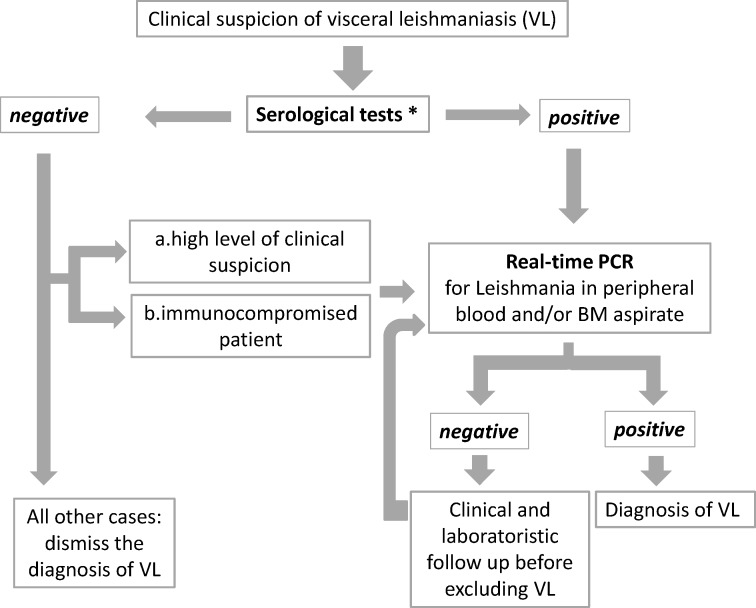
The diagnosis of visceral leishmaniasis (VL) remains challenging, due to the limited sensitivity of microscopy, the poor performance of serological methods in immunocompromised patients and the lack of standardization of molecular tests. The aim of this study was to implement a combined diagnostic workflow by integrating serological and molecular tests with standardized clinical criteria. Between July 2013 and June 2015, the proposed workflow was applied to specimens obtained from 94 in-patients with clinical suspicion of VL in the Emilia-Romagna region, Northern Italy. Serological tests and molecular techniques were employed. Twenty-one adult patients (22%) had a confirmed diagnosis of VL by clinical criteria, serology and/or real-time polymerase chain reaction; 4 of these patients were HIV-positive. Molecular tests exhibited higher sensitivity than serological tests for the diagnosis of VL. In our experience, the rK39 immunochromatographic test was insufficiently sensitive for use as a screening test for the diagnosis of VL caused by L. infantum in Italy. However, as molecular tests are yet not standardized, further studies are required to identify an optimal screening test for Mediterranean VL.
由于显微镜检查的敏感性有限、免疫功能低下患者血清学方法的表现不佳以及分子检测缺乏标准化,内脏利什曼病(VL)的诊断仍然具有挑战性。本研究的目的是通过将血清学和分子检测与标准化临床标准相结合,实施一种联合诊断工作流程。2013年7月至2015年6月期间,将所提议的工作流程应用于从意大利北部艾米利亚 - 罗马涅地区94例临床怀疑患有VL的住院患者获得的标本。采用了血清学检测和分子技术。21例成年患者(22%)通过临床标准、血清学和/或实时聚合酶链反应确诊为VL;其中4例患者为HIV阳性。分子检测在VL诊断中表现出比血清学检测更高的敏感性。根据我们的经验,rK39免疫层析试验作为意大利婴儿利什曼原虫引起的VL诊断的筛查试验,敏感性不足。然而,由于分子检测尚未标准化,需要进一步研究以确定地中海地区VL的最佳筛查试验。