Scarpini Sara, Dondi Arianna, Totaro Camilla, Biagi Carlotta, Melchionda Fraia, Zama Daniele, Pierantoni Luca, Gennari Monia, Campagna Cinzia, Prete Arcangelo, Lanari Marcello
Specialty School of Pediatrics, Alma Mater Studiorum, University of Bologna, 40126 Bologna, Italy.
Pediatric Emergency Unit, IRCCS Azienda Ospedaliero-Universitaria di Bologna, 40138 Bologna, Italy.
Microorganisms. 2022 Sep 21;10(10):1887. doi: 10.3390/microorganisms10101887.
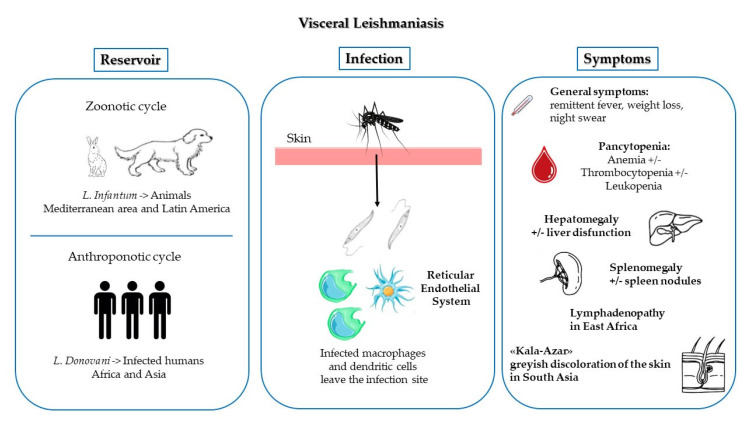
Visceral Leishmaniasis (VL) is a vector-borne disease caused by an intracellular protozoa of the genus that can be lethal if not treated. VL is caused by in Asia and in Eastern Africa, where the pathogens' reservoir is represented by humans, and by in Latin America and in the Mediterranean area, where VL is a zoonotic disease and dog is the main reservoir. A part of the infected individuals become symptomatic, with irregular fever, splenomegaly, anemia or pancytopenia, and weakness, whereas others are asymptomatic. VL treatment has made progress in the last decades with the use of new drugs such as liposomal amphotericin B, and with new therapeutic regimens including monotherapy or a combination of drugs, aiming at shorter treatment duration and avoiding the development of resistance. However, the same treatment protocol may not be effective all over the world, due to differences in the infecting species, so depending on the geographical area. This narrative review presents a comprehensive description of the clinical picture of VL, especially in children, the diagnostic approach, and some insight into the most used pharmacological therapies available worldwide.
内脏利什曼病(VL)是一种由利什曼原虫属细胞内原生动物引起的媒介传播疾病,若不治疗可能会致命。在亚洲和东非,VL由杜氏利什曼原虫引起,病原体的宿主是人类;在拉丁美洲和地中海地区,VL由婴儿利什曼原虫引起,是一种人畜共患病,狗是主要宿主。一部分受感染个体出现症状,表现为不规则发热、脾肿大、贫血或全血细胞减少以及虚弱,而其他个体则无症状。在过去几十年中,VL治疗取得了进展,使用了如脂质体两性霉素B等新药,以及包括单一疗法或联合用药在内的新治疗方案,旨在缩短治疗时间并避免耐药性的产生。然而,由于感染的利什曼原虫种类不同,所以取决于地理区域,相同的治疗方案在世界各地可能并不都有效。这篇叙述性综述全面描述了VL的临床症状,尤其是儿童患者的症状、诊断方法,并对全球最常用的药物治疗方法进行了一些深入探讨。