Section of Microbiology, Department of Experimental, Diagnostic and Specialty Medicine, Alma Mater Studiorum University of Bologna, Bologna, Italy.
Unit of Hygiene and Public Health, Department of Public Health, AUSL Bologna, Bologna, Italy.
PLoS Negl Trop Dis. 2022 Aug 15;16(8):e0010676. doi: 10.1371/journal.pntd.0010676. eCollection 2022 Aug.
Most people infected with Leishmania remain asymptomatic, which is a common element that may promote the resurgence of clinically evident leishmaniasis in individuals with impaired cell-mediated immune responses. Unfortunately, there is no universally accepted assay to identify asymptomatic infection. This cross-sectional study focuses on the employment of three methods targeting different features of the parasitic infection to be used in combination for the screening of latent leishmaniasis in a newly endemic area of northeastern Italy.
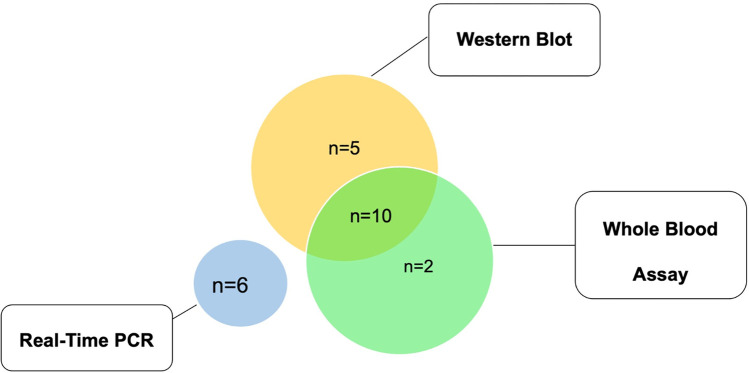
METHODOLOGY/PRINCIPAL FINDINGS: The selected methods included highly sensitive Real-Time PCR for detection of parasitic kinetoplast (k)DNA in peripheral blood, Western Blot (WB) for detection of specific IgG, and Whole Blood stimulation Assay (WBA) to evaluate the anti-leishmanial T-cell response by quantifying the production of IL-2 after stimulation of patients' blood with Leishmania specific antigens. Among 145 individuals living in a municipality of the Bologna province, northeastern Italy, recruited and screened for Leishmania infection, 23 subjects tested positive (15.9%) to one or more tests. Positive serology was the most common marker of latent leishmaniasis (15/145, 10%), followed by the detection of specific cell-mediated response (12/145, 8%), while only few individuals (6/145, 4%) harbored parasitic DNA in the blood.
CONCLUSIONS/SIGNIFICANCE: Combining different tests substantially increased the yield of positivity in detecting latent Leishmania infection. The test combination that we employed in this study appears to be effective to accurately identify latent leishmaniasis in an endemic area.
大多数感染利什曼原虫的人无症状,这是一个常见的因素,可能会促进细胞介导免疫反应受损的个体中临床明显的利什曼病的复发。不幸的是,目前还没有普遍接受的检测方法来识别无症状感染。本横断面研究重点关注采用三种针对寄生虫感染不同特征的方法,这些方法将联合用于筛查意大利东北部新流行地区的潜伏性利什曼病。
方法/主要发现:所选方法包括用于检测外周血中寄生虫动基体(k)DNA的高灵敏度实时 PCR、用于检测特异性 IgG 的 Western Blot(WB)和全血刺激测定(WBA),通过定量刺激患者血液后产生的 IL-2 来评估抗利什曼原虫 T 细胞反应用利什曼原虫特异性抗原。在意大利博洛尼亚省一个市镇招募并筛查利什曼原虫感染的 145 人中,23 人(15.9%)一项或多项检测呈阳性。阳性血清学是潜伏性利什曼病最常见的标志物(15/145,10%),其次是特异性细胞介导反应的检测(12/145,8%),而只有少数人(6/145,4%)血液中存在寄生虫 DNA。
结论/意义:联合使用不同的检测方法大大提高了检测潜伏性利什曼感染的阳性率。我们在这项研究中使用的联合检测方法似乎可以有效地准确识别流行地区的潜伏性利什曼病。