Nishijuka Fábio Akio, Silva Christina Grüne de Souza E, Duarte Carlos Vieira, Araújo Claudio Gil Soares de
Programa de Pós-Graduação em Cardiologia, Universidade Federal do Rio de Janeiro, Rio de Janeiro, RJ, Brazil.
Clínica de Medicina do Exercício, Rio de Janeiro, RJ, Brazil.
Arq Bras Cardiol. 2017 Oct;109(4):340-347. doi: 10.5935/abc.20170132. Epub 2017 Aug 17.
Exercise-based cardiac rehabilitation tends to reduce mortality. However, it requires medium/long-term adherence to regular physical exercise. It is relevant to identify the variables that affect adherence to an supervised exercise program (SEP).
To evaluate the influence of pre-participation levels of aerobic and non-aerobic physical fitness components in medium-term adherence to SEP.
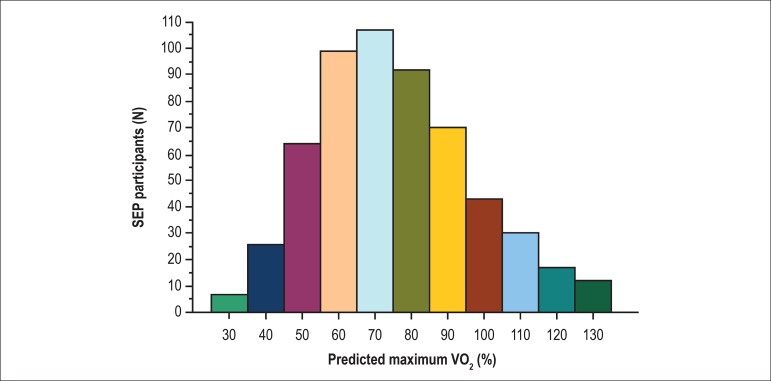
A total of 567 SEP participants (65 ± 12 years) (68% men) were studied. Participants adherent to the program for less than 6 months (48%) (non-adherent - NAD) were compared with 52% of participants who were adherent for 6 months or more (adherents - AD). In the non-aerobic fitness, flexibility (FLX) (Flexitest) and muscle power (MPW)/body weight in standing rowing (watts/kg) were evaluated while aerobic fitness was obtained by direct measure of VO2max/body weight (VO2). These measurements were normatized for sex and age based on percentiles (P) (P-FLX/P-MPW) of reference data or percentages of predicted (P-VO2). Additionally, AD and NAD with extreme results (tertiles) were simultaneously compared for the three variables.
There was no difference between AD and NAD for non-aerobic results, in median [P25-P75], P-FLX: 30 [13-56] and 31 [9-52], respectively, (p = 0.69) and P-MPW: 34 [17-58] and 36 [16-62], respectively (p = 0.96), and for aerobic results (mean ± standard error) P-VO2 (75.9 ± 1.3% and 75.0 ± 1.3%, respectively) (p = 0.83). When comparing extreme tertiles, a difference was found for P-MPW in the lower tertile only, with a slight advantage of AD over NAD- 9 [5-16] versus 4 [1-11] (p = 0.04).
Although awareness of the pre-participation levels of aerobic and non-aerobic physical fitness components is useful for individualized exercise prescription, these variables do not seem to influence medium-term adherence to SEP.
基于运动的心脏康复有助于降低死亡率。然而,这需要中长期坚持规律的体育锻炼。识别影响对监督运动计划(SEP)依从性的变量具有重要意义。
评估参与前有氧和无氧身体素质成分水平对SEP中期依从性的影响。
共研究了567名SEP参与者(65±12岁)(68%为男性)。将坚持该计划少于6个月的参与者(48%)(非依从者 - NAD)与52%坚持6个月或更长时间的参与者(依从者 - AD)进行比较。在无氧身体素质方面,评估柔韧性(FLX)(Flexitest测试)和肌肉力量(MPW)/站立划船时的体重(瓦/千克),而有氧身体素质通过直接测量最大摄氧量/体重(VO2)获得。这些测量值根据参考数据的百分位数(P)(P-FLX/P-MPW)或预测百分比(P-VO2)按性别和年龄进行标准化。此外,同时比较了三个变量结果处于极端三分位数的AD组和NAD组。
无氧结果方面,AD组和NAD组之间无差异,中位数[P25 - P75],P-FLX分别为30[13 - 56]和31[9 - 52],(p = 0.69),P-MPW分别为34[17 - 58]和36[16 - 62],(p = 0.96);有氧结果方面(均值±标准误),P-VO2分别为(75.9±1.3%和75.0±1.3%)(p = 0.83)。比较极端三分位数时,仅在较低三分位数的P-MPW上发现差异,AD组比NAD组略有优势 - 9[5 - 16]对4[1 - 11](p = 0.04)。
尽管了解参与前有氧和无氧身体素质成分水平对个性化运动处方有用,但这些变量似乎并不影响对SEP的中期依从性。