Department of Neuroscience, Jikei University School of Medicine, Minato-ku, Tokyo, Japan.
Department of Orthopaedic Surgery, Jikei University School of Medicine, Minato-ku, Tokyo, Japan.
Eur J Neurosci. 2017 Sep;46(6):2149-2160. doi: 10.1111/ejn.13662. Epub 2017 Sep 7.
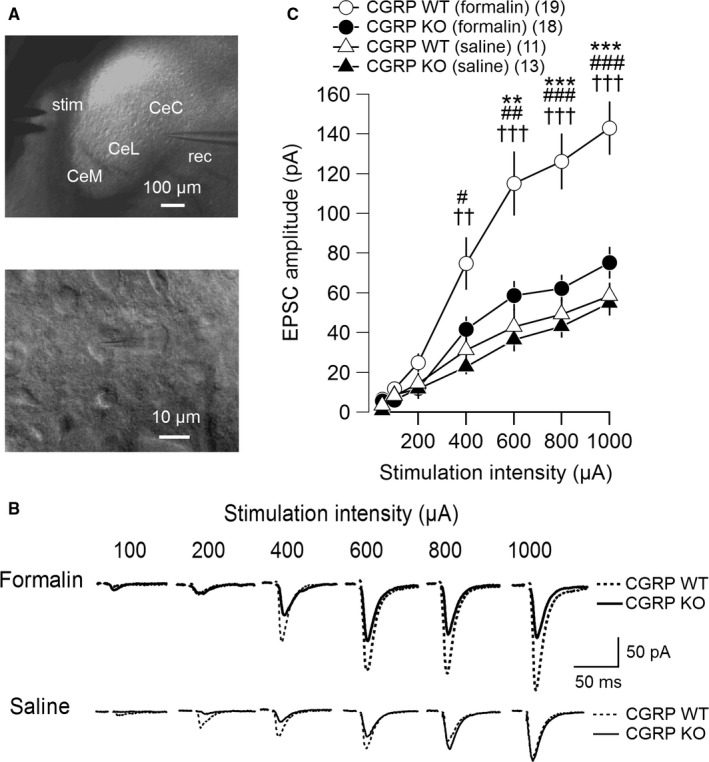
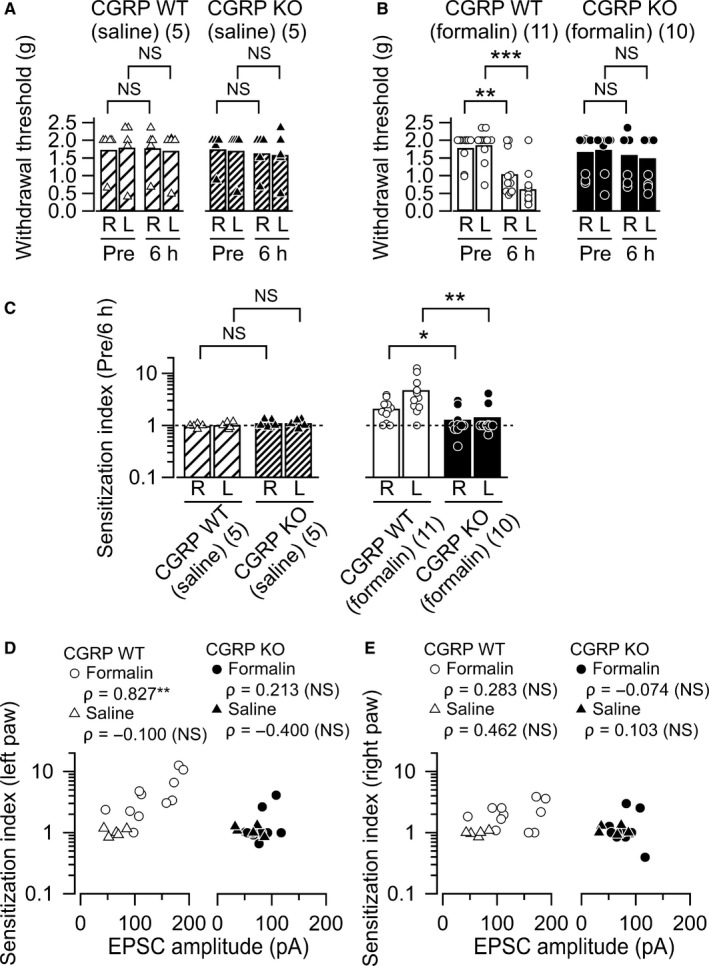
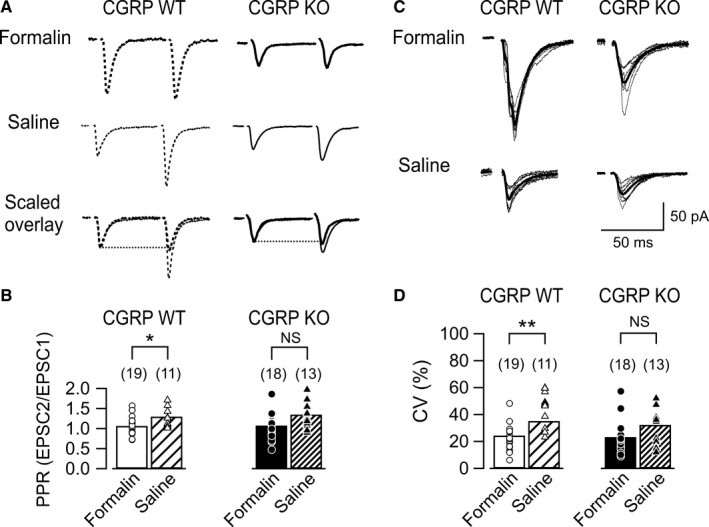
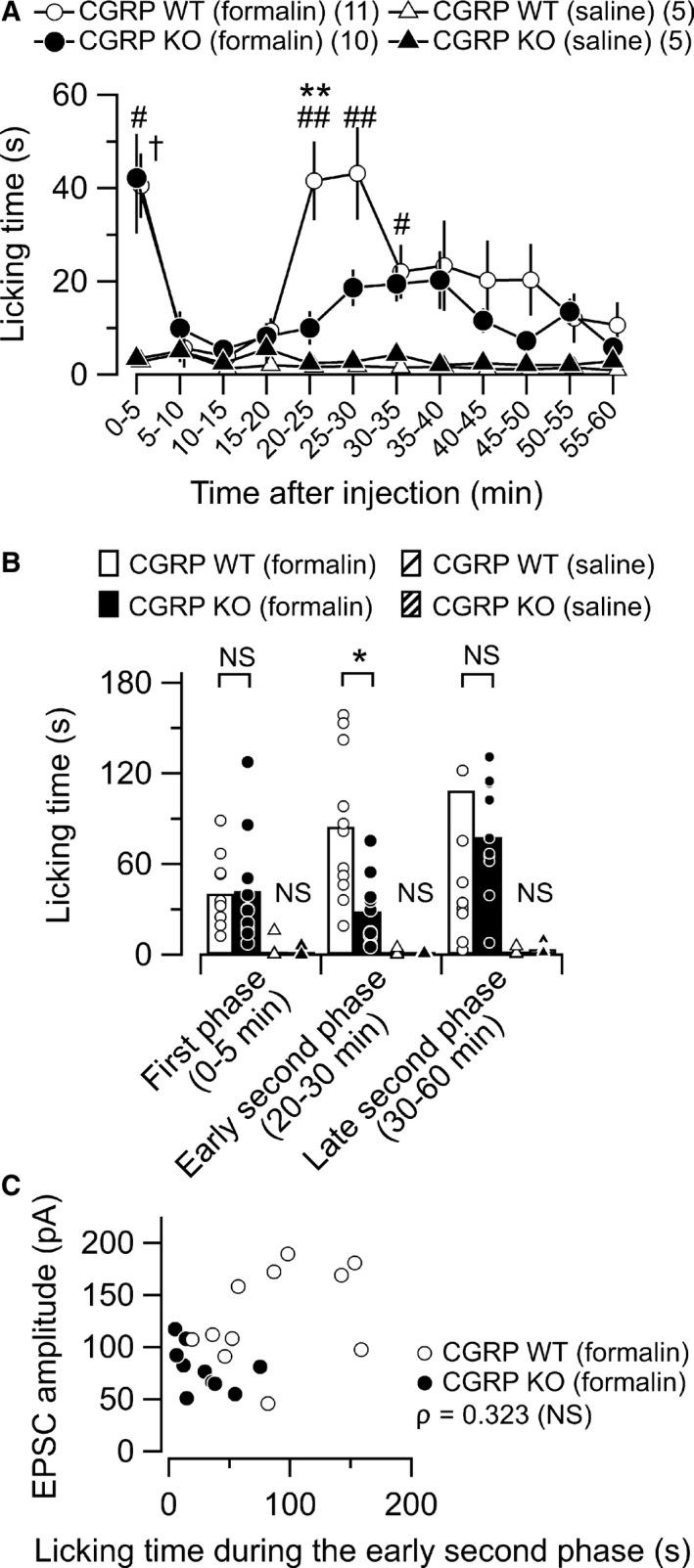
The role of the neuropeptide calcitonin gene-related peptide (CGRP) is well established in nociceptive behaviors. CGRP is highly expressed in the projection pathway from the parabrachial nucleus to the laterocapsular region of the central amygdala (CeC), which plays a critical role in relaying nociceptive information. The CeC is a key structure in pain behavior because it integrates and modulates nociceptive information along with other sensory signals. Previous studies have demonstrated that blockade of the amygdalar CGRP-signaling cascade attenuates nociceptive behaviors in pain models, while CGRP application facilitates amygdalar synaptic transmission and induces pain behaviors. Despite these lines of evidence, it remains unclear whether endogenous CGRP is involved in the development of nociceptive behaviors accompanied with amygdalar plasticity in a peripheral inflammation model in vivo. To directly address this, we utilized a previously generated CGRP knockout (KO) mouse to longitudinally study formalin-induced plasticity and nociceptive behavior. We found that synaptic potentiation in the right PB-CeC pathway that was observed in wild-type mice was drastically attenuated in the CGRP KO mice 6 h post-inflammation, when acute nociceptive behavior was no longer observed. Furthermore, the bilateral tactile allodynia 6 h post-inflammation was significantly decreased in the CGRP KO mice. In contrast, the acute nociceptive behavior immediately after the formalin injection was reduced only at 20-25 min post-injection in the CGRP KO mice. These results suggest that endogenous CGRP contributes to peripheral inflammation-induced synaptic plasticity in the amygdala, and this plasticity may underlie the exaggerated nociception-emotion linkage in pain chronification.
降钙素基因相关肽(CGRP)在伤害性行为中起着重要作用。CGRP 在从臂旁核到杏仁中央外侧核(CeC)的投射途径中高度表达,在传递伤害性信息中起着关键作用。CeC 是疼痛行为的关键结构,因为它整合和调节伤害性信息以及其他感觉信号。先前的研究表明,阻断杏仁核的 CGRP 信号级联可减轻疼痛模型中的伤害性行为,而 CGRP 的应用则促进了杏仁核突触传递并引起疼痛行为。尽管有这些证据,但仍不清楚内源性 CGRP 是否参与了体内外周炎症模型中伴随杏仁核可塑性的伤害性行为的发展。为了直接解决这个问题,我们利用先前生成的 CGRP 敲除(KO)小鼠进行纵向研究福尔马林诱导的可塑性和伤害性行为。我们发现,在野生型小鼠中观察到的右侧 PB-CeC 通路的突触增强在炎症后 6 小时急剧减弱,此时急性伤害性行为不再观察到。此外,在 CGRP KO 小鼠中,炎症后 6 小时双侧触觉痛觉过敏明显降低。相比之下,在 CGRP KO 小鼠中,福尔马林注射后立即的急性伤害性行为仅在注射后 20-25 分钟减少。这些结果表明,内源性 CGRP 有助于外周炎症诱导的杏仁核中的突触可塑性,这种可塑性可能是疼痛慢性化中伤害性情绪联系夸大的基础。