Laboratory Medicine Program, University Health Network, Toronto, Ontario, Canada.
Institute of Biomaterials and Biomedical Engineering, University of Toronto, Toronto, Ontario, Canada.
Stem Cells Transl Med. 2017 Oct;6(10):1930-1939. doi: 10.1002/sctm.17-0054. Epub 2017 Aug 18.
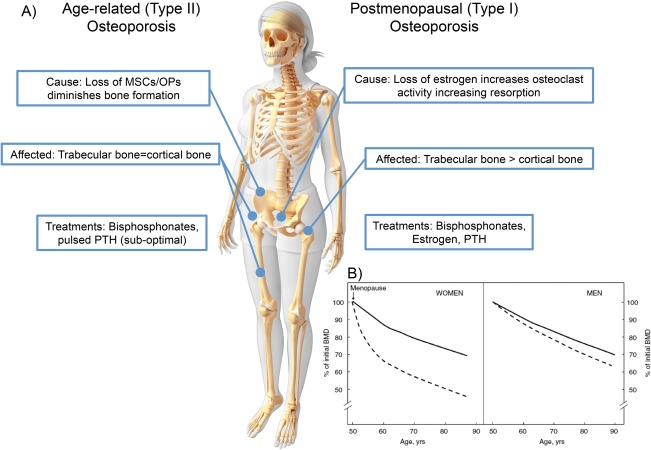
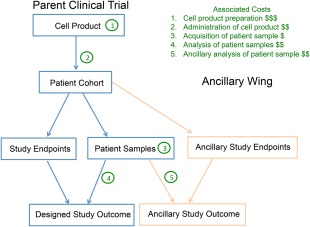
Age-related (type-II) osteoporosis is a common and debilitating condition driven in part by the loss of bone marrow (BM) mesenchymal stromal cells (MSC) and their osteoblast progeny, leading to reduced bone formation. Current pharmacological regiments targeting age-related osteoporosis do not directly treat the disease by increasing bone formation, but instead use bisphosphonates to reduce bone resorption-a treatment designed for postmenopausal (type-I) osteoporosis. Recently, the bone regenerative capacity of MSCs has been found within a very rare population of skeletal stem cells (SSCs) residing within the larger heterogeneous BM-MSC pool. The osteoregenerative potential of SSCs would be an ideal candidate for cell-based therapies to treat degenerative bone diseases such as osteoporosis. However, to date, clinical and translational studies attempting to improve bone formation through cell transplantation have used the larger, nonspecific, MSC pool. In this review, we will outline the physiological basis of age-related osteoporosis, as well as discuss relevant preclinical studies that use exogenous MSC transplantation with the aim of treating osteoporosis in murine models. We will also discuss results from specific clinical trials aimed at treating other systemic bone diseases, and how the discovery of SSC could help realize the full regenerative potential of MSC therapy to increase bone formation. Finally, we will outline how ancillary clinical trials could be initiated to assess MSC/SSC-mediated bone formation gains in existing and potentially unrelated clinical trials, setting the stage for a dedicated clinical investigation to treat age-related osteoporosis. Stem Cells Translational Medicine 2017;6:1930-1939.
与年龄相关的(II 型)骨质疏松症是一种常见且使人虚弱的疾病,部分原因是骨髓(BM)间充质基质细胞(MSC)及其成骨前体的丢失,导致骨形成减少。目前针对与年龄相关的骨质疏松症的药物治疗方案并没有通过增加骨形成来直接治疗这种疾病,而是使用双磷酸盐来减少骨吸收 - 这是一种针对绝经后(I 型)骨质疏松症的治疗方法。最近,在更大的异质 BM-MSC 池内的非常罕见的骨骼干细胞(SSC)群体中发现了 MSC 的骨再生能力。SSC 的成骨再生潜力将是治疗骨质疏松症等退行性骨病的细胞治疗的理想候选者。然而,迄今为止,试图通过细胞移植来提高骨形成的临床和转化研究都使用了更大、非特异性的 MSC 池。在这篇综述中,我们将概述与年龄相关的骨质疏松症的生理基础,并讨论相关的临床前研究,这些研究使用外源性 MSC 移植来治疗小鼠模型中的骨质疏松症。我们还将讨论针对其他系统性骨疾病的特定临床试验的结果,以及 SSC 的发现如何有助于实现 MSC 治疗增加骨形成的全部再生潜力。最后,我们将概述如何启动辅助临床试验,以评估现有和潜在无关的临床试验中 MSC/SSC 介导的骨形成增加,为专门治疗与年龄相关的骨质疏松症的临床研究奠定基础。《干细胞转化医学》2017 年;6:1930-1939。