Discipline of Surgery, Westmead Hospital, University of Sydney, Sydney, Australia.
Department of Urology, Westmead Hospital, Westmead, Australia.
Cancer Med. 2017 Oct;6(10):2188-2193. doi: 10.1002/cam4.1137. Epub 2017 Aug 22.
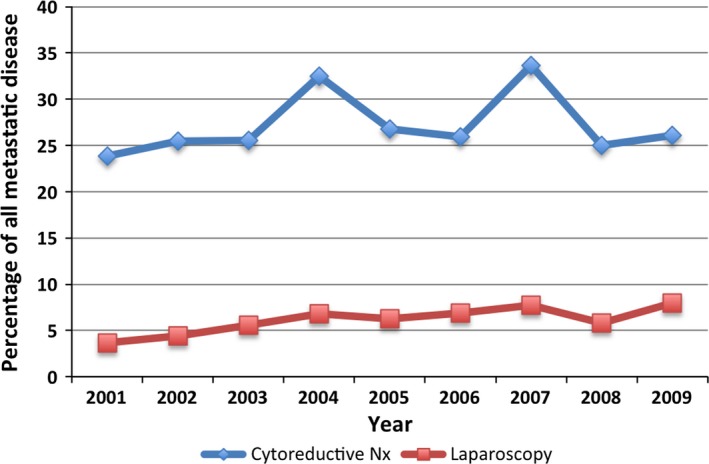
The use of cytoreductive nephrectomy (CRN) in the targeted therapy era is still debated. We aimed to determine factors associated with reduced use of CRN and determine the effect of CRN on overall survival in patients with metastatic renal cell carcinoma (RCC). All advanced RCC diagnosed between 2001 and 2009 in New South Wales, Australia, were identified from the Central Cancer Registry. Records of treatment and death were electronically linked. Follow-up was to the end of 2011. Multivariable logistic regression analysis was used to determine factors associated with the receipt of CRN. Cox proportional hazards model was used to determine factors associated with survival. A total of 1062 patients were identified with metastatic RCC of whom 289 (27%) received CRN. There was no difference in the use of CRN over the time period of the study. Females (OR 0.68 (95% CI: 0.48-0.96)), unmarried individuals (OR 0.68 (95% CI: 0.48-0.96)), treatment in a nonteaching hospital (OR 0.26 (95% CI: 0.18-0.36)) and individuals without private insurance (OR 0.29 (95% CI: 0.20-0.41)) all had reduced likelihood of receiving CRN. On multivariable analysis, not receiving CRN resulted in a 90% increase in death (HR 1.90 (95% CI: 1.61-2.25)). In addition, increasing age (P < 0.001), increasing Charlson comorbidity status (P = 0.002) and female gender also had a significant independent association with death. Despite a strong association with improved survival, individuals who are elderly, female, have treatment in a nonteaching facility or have no private insurance have a reduced likelihood of receiving CRN.
在靶向治疗时代,细胞减灭性肾切除术(CRN)的应用仍存在争议。我们旨在确定与 CRN 使用减少相关的因素,并确定 CRN 对转移性肾细胞癌(RCC)患者总生存的影响。从澳大利亚新南威尔士州中央癌症登记处确定了 2001 年至 2009 年间诊断的所有晚期 RCC 病例。通过电子方式将治疗和死亡记录联系起来。随访至 2011 年底。多变量逻辑回归分析用于确定与接受 CRN 相关的因素。Cox 比例风险模型用于确定与生存相关的因素。共确定了 1062 例转移性 RCC 患者,其中 289 例(27%)接受了 CRN。在研究期间,CRN 的使用没有差异。女性(OR 0.68(95%CI:0.48-0.96))、未婚者(OR 0.68(95%CI:0.48-0.96))、在非教学医院接受治疗(OR 0.26(95%CI:0.18-0.36))和没有私人保险的个体(OR 0.29(95%CI:0.20-0.41))接受 CRN 的可能性降低。多变量分析显示,未接受 CRN 会导致死亡风险增加 90%(HR 1.90(95%CI:1.61-2.25))。此外,年龄增长(P<0.001)、Charlson 合并症状态增加(P=0.002)和女性也与死亡有显著的独立关联。尽管与生存改善有很强的关联,但年龄较大、女性、在非教学机构接受治疗或没有私人保险的个体接受 CRN 的可能性降低。