Guangdong Provincial Key Laboratory of Malignant Tumor Epigenetics and Gene Regulation, Sun Yat-Sen Memorial Hospital, Sun Yat-Sen University, Guangzhou, China.
Breast Tumor Center, Sun Yat-Sen Memorial Hospital, Sun Yat-Sen University, Guangzhou, China.
Thorac Cancer. 2017 Nov;8(6):582-591. doi: 10.1111/1759-7714.12487. Epub 2017 Aug 23.
Breast cancer is the most commonly diagnosed cancer in women, and has become the second leading cause of cancer death among women worldwide. Chemoresistance has become an important problem in breast cancer clinics. The identification of new mechanisms affecting chemosensitivity is of great clinical value for the treatment of breast cancer.
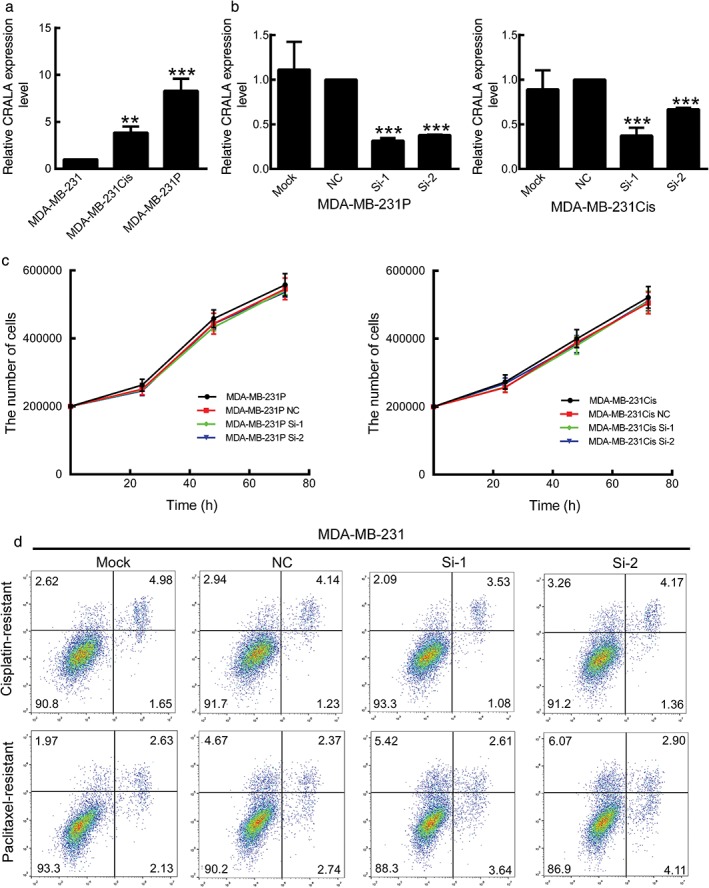
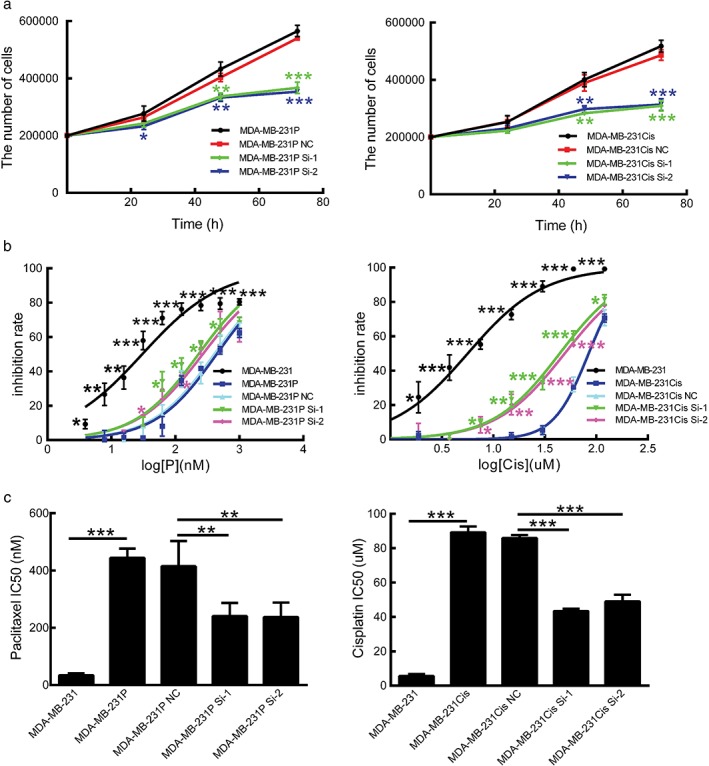
The expression levels of chemoresistance-associated long non-coding RNA (CRALA), a newly discovered long non-coding RNA, were measured by quantitative real time-PCR in 79 pre-treatment biopsied primary breast cancer samples. Small interfering RNAs were used to knockdown CRALA expression. The effect of CRALA on chemosensitivity was evaluated using cell growth assay.
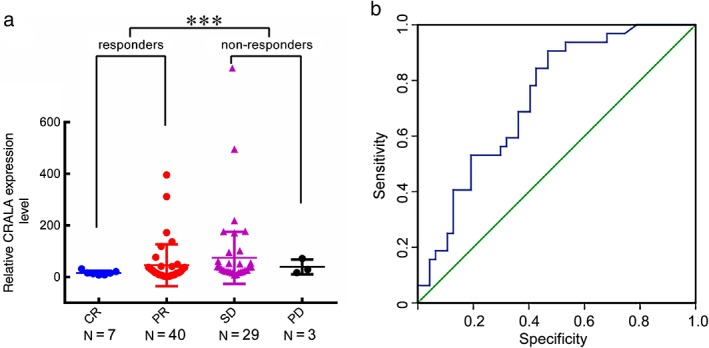
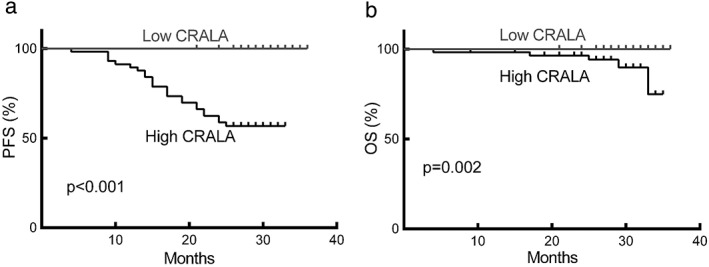
Non-responding tumors (poor response to chemotherapy, 32 samples) had fourfold higher CRALA expression than responding tumors (good response to chemotherapy, 47 samples). CRALA is upregulated in chemoresistant breast cancer cell lines compared to their parental lines. Silencing of CRALA in chemoresistant breast cancer cells resensitizes the cells to chemotherapy in vitro. Furthermore, univariate and multivariate analysis showed that higher CRALA expression was significantly associated with poor prognosis in 144 breast cancer patients.
The study findings indicate that CRALA expression may be an important biomarker for predicting the clinical response to chemotherapy and prognosis in breast cancer patients. It is possible to target CRALA to reverse chemoresistance in breast cancer patients.
乳腺癌是女性最常见的癌症,已成为全球女性癌症死亡的第二大主要原因。化疗耐药性已成为乳腺癌临床治疗中的一个重要问题。鉴定影响化疗敏感性的新机制对于乳腺癌的治疗具有重要的临床价值。
采用实时定量 PCR 检测 79 例未经治疗的原发性乳腺癌活检样本中与化疗耐药相关的长链非编码 RNA(CRALA)的表达水平。使用小干扰 RNA 敲低 CRALA 表达。通过细胞生长试验评估 CRALA 对化疗敏感性的影响。
非应答性肿瘤(化疗反应差,32 例)的 CRALA 表达水平是应答性肿瘤(化疗反应好,47 例)的 4 倍。与亲本细胞系相比,耐药性乳腺癌细胞系中 CRALA 表达上调。沉默耐药性乳腺癌细胞中的 CRALA 可使细胞在体外对化疗重新敏感。此外,单因素和多因素分析显示,144 例乳腺癌患者中 CRALA 表达水平较高与预后不良显著相关。
研究结果表明,CRALA 表达可能是预测乳腺癌患者化疗临床反应和预后的重要生物标志物。靶向 CRALA 逆转乳腺癌患者的化疗耐药性是可能的。