LS2N, UMR 6004, École Centrale de Nantes, Nantes, France.
CRCINA, INSERM, CNRS, Université d'Angers, Université de Nantes, Nantes, France.
Sci Rep. 2017 Aug 23;7(1):9257. doi: 10.1038/s41598-017-09378-9.
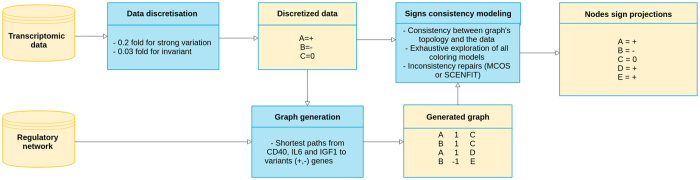
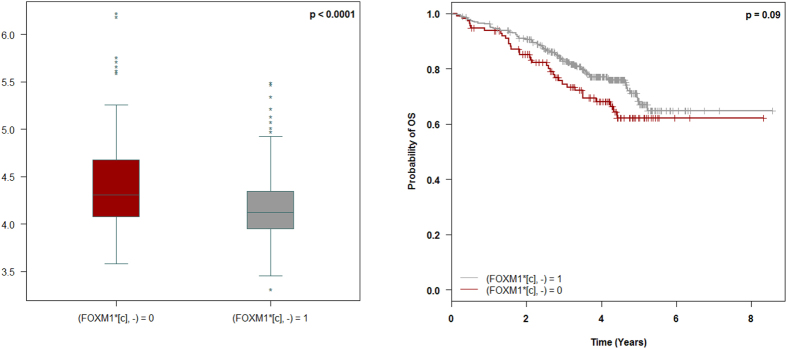
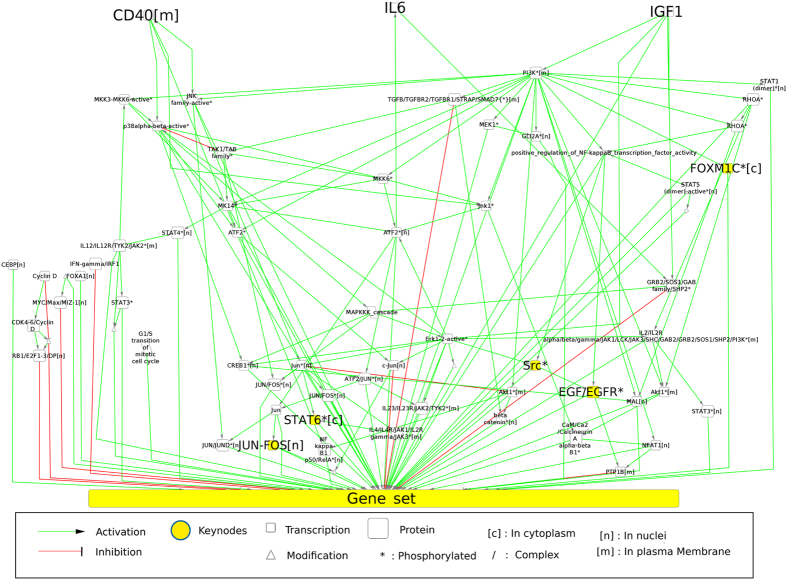
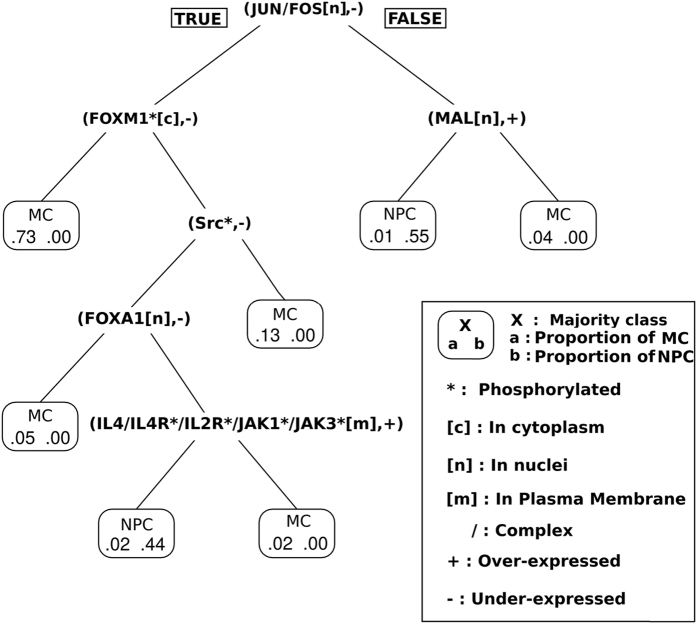
Innovative approaches combining regulatory networks (RN) and genomic data are needed to extract biological information for a better understanding of diseases, such as cancer, by improving the identification of entities and thereby leading to potential new therapeutic avenues. In this study, we confronted an automatically generated RN with gene expression profiles (GEP) from a cohort of multiple myeloma (MM) patients and normal individuals using global reasoning on the RN causality to identify key-nodes. We modeled each patient by his or her GEP, the RN and the possible automatically detected repairs needed to establish a coherent flow of the information that explains the logic of the GEP. These repairs could represent cancer mutations leading to GEP variability. With this reasoning, unmeasured protein states can be inferred, and we can simulate the impact of a protein perturbation on the RN behavior to identify therapeutic targets. We showed that JUN/FOS and FOXM1 activities are altered in almost all MM patients and identified two survival markers for MM patients. Our results suggest that JUN/FOS-activation has a strong impact on the RN in view of the whole GEP, whereas FOXM1-activation could be an interesting way to perturb an MM subgroup identified by our method.
需要创新的方法将调控网络 (RN) 和基因组数据相结合,以提取生物学信息,从而更好地理解疾病,如癌症,通过提高实体的识别能力,从而为潜在的新治疗方法开辟道路。在这项研究中,我们使用 RN 的全局推理,将自动生成的 RN 与来自多发性骨髓瘤 (MM) 患者和正常个体的基因表达谱 (GEP) 进行了对比,以识别关键节点。我们通过患者的 GEP、RN 和可能自动检测到的修复来对每个患者进行建模,以建立一个连贯的信息流,解释 GEP 的逻辑。这些修复可能代表导致 GEP 变异性的癌症突变。通过这种推理,可以推断出未测量的蛋白质状态,并且可以模拟蛋白质扰动对 RN 行为的影响,以确定治疗靶点。我们表明,JUN/FOS 和 FOXM1 的活性在几乎所有 MM 患者中都发生了改变,并确定了两个 MM 患者的生存标记物。我们的结果表明,考虑到整个 GEP,JUN/FOS 的激活对 RN 有很大的影响,而 FOXM1 的激活可能是我们方法识别的 MM 亚群的一种有趣的扰动方式。