Singapore Bioimaging Consortium, Agency for Science Technology and Research, 11 Biopolis Way, #02-02 Helios, Singapore, 138667, Singapore.
Institute for Infocomm Research, Agency for Science Technology and Research, 1 Fusionopolis Way, #21-01 Connexis (South Tower), Singapore, 138632, Singapore.
Sci Rep. 2017 Aug 23;7(1):9222. doi: 10.1038/s41598-017-08928-5.
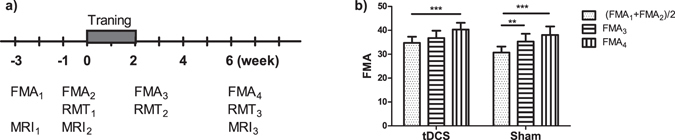
Brain-computer interface-assisted motor imagery (MI-BCI) or transcranial direct current stimulation (tDCS) has been used in stroke rehabilitation, though their combinatory effect is unknown. We investigated brain plasticity following a combined MI-BCI and tDCS intervention in chronic subcortical stroke patients with unilateral upper limb disability. Nineteen patients were randomized into tDCS and sham-tDCS groups. Diffusion and perfusion MRI, and transcranial magnetic stimulation were used to study structural connectivity, cerebral blood flow (CBF), and corticospinal excitability, respectively, before and 4 weeks after the 2-week intervention. After quality control, thirteen subjects were included in the CBF analysis. Eleven healthy controls underwent 2 sessions of MRI for reproducibility study. Whereas motor performance showed comparable improvement, long-lasting neuroplasticity can only be detected in the tDCS group, where white matter integrity in the ipsilesional corticospinal tract and bilateral corpus callosum was increased but sensorimotor CBF was decreased, particularly in the ipsilesional side. CBF change in the bilateral parietal cortices also correlated with motor function improvement, consistent with the increased white matter integrity in the corpus callosum connecting these regions, suggesting an involvement of interhemispheric interaction. The preliminary results indicate that tDCS may facilitate neuroplasticity and suggest the potential for refining rehabilitation strategies for stroke patients.
脑-机接口辅助运动想象(MI-BCI)或经颅直流电刺激(tDCS)已被用于中风康复,但它们的联合效应尚不清楚。我们研究了联合 MI-BCI 和 tDCS 干预对慢性皮质下中风单侧上肢残疾患者的大脑可塑性的影响。19 名患者被随机分为 tDCS 和假刺激 tDCS 组。使用弥散和灌注 MRI 以及经颅磁刺激分别研究结构连接、脑血流(CBF)和皮质脊髓兴奋性,分别在 2 周干预前和 4 周后进行。经过质量控制,13 名受试者纳入 CBF 分析。11 名健康对照者进行了 2 次 MRI 以进行重复性研究。尽管运动表现显示出可比较的改善,但只有在 tDCS 组中才能检测到持久的神经可塑性,其中同侧皮质脊髓束和双侧胼胝体的白质完整性增加,但感觉运动 CBF 减少,特别是在同侧。双侧顶叶皮质的 CBF 变化也与运动功能改善相关,这与胼胝体连接这些区域的白质完整性增加一致,表明涉及半球间相互作用。初步结果表明,tDCS 可能促进神经可塑性,并为中风患者的康复策略提供了潜在的改进。