Liang Wei-Wei, Huang Jing-Hao, Li Chun-Ping, Yang Lin-Tong, Ye Xin, Lin Dan, Chen Li-Song
Institute of Plant Nutritional Physiology and Molecular Biology, College of Resources and Environment, Fujian Agriculture and Forestry University, Fuzhou, 350002, China.
Pomological Institute, Fujian Academy of Agricultural Sciences, Fuzhou, 350013, China.
BMC Genomics. 2017 Aug 24;18(1):657. doi: 10.1186/s12864-017-3999-5.
Magnesium (Mg)-deficiency occurs most frequently in strongly acidic, sandy soils. Citrus are grown mainly on acidic and strong acidic soils. Mg-deficiency causes poor fruit quality and low fruit yield in some Citrus orchards. For the first time, we investigated Mg-deficiency-responsive miRNAs in 'Xuegan' (Citrus sinensis) roots using Illumina sequencing in order to obtain some miRNAs presumably responsible for Citrus Mg-deficiency tolerance.
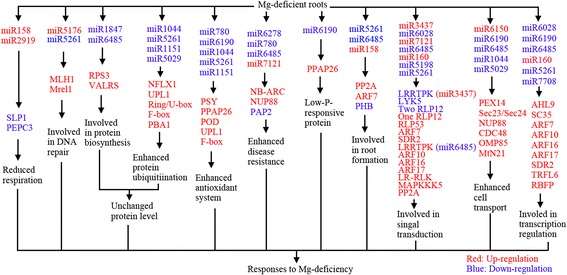
We obtained 101 (69) miRNAs with increased (decreased) expression from Mg-starved roots. Our results suggested that the adaptation of Citrus roots to Mg-deficiency was related to the several aspects: (a) inhibiting root respiration and related gene expression via inducing miR158 and miR2919; (b) enhancing antioxidant system by down-regulating related miRNAs (miR780, miR6190, miR1044, miR5261 and miR1151) and the adaptation to low-phosphorus (miR6190); (c) activating transport-related genes by altering the expression of miR6190, miR6485, miR1044, miR5029 and miR3437; (d) elevating protein ubiquitination due to decreased expression levels of miR1044, miR5261, miR1151 and miR5029; (e) maintaining root growth by regulating miR5261, miR6485 and miR158 expression; and (f) triggering DNA repair (transcription regulation) by regulating miR5176 and miR6485 (miR6028, miR6190, miR6485, miR5621, miR160 and miR7708) expression. Mg-deficiency-responsive miRNAs involved in root signal transduction also had functions in Citrus Mg-deficiency tolerance.
We obtained several novel Mg-deficiency-responsive miRNAs (i.e., miR5261, miR158, miR6190, miR6485, miR1151 and miR1044) possibly contributing to Mg-deficiency tolerance. These results revealed some novel clues on the miRNA-mediated adaptation to nutrient deficiencies in higher plants.
镁(Mg)缺乏在强酸性沙质土壤中最为常见。柑橘主要种植在酸性和强酸性土壤上。镁缺乏会导致一些柑橘果园果实品质差、产量低。我们首次利用Illumina测序技术研究了‘雪柑’(甜橙)根系中对镁缺乏响应的微小RNA(miRNA),以获得一些可能与柑橘耐镁缺乏相关的miRNA。
我们从缺镁根系中获得了101个(69个)表达上调(下调)的miRNA。我们的结果表明,柑橘根系对镁缺乏的适应与以下几个方面有关:(a)通过诱导miR158和miR2919抑制根系呼吸及相关基因表达;(b)通过下调相关miRNA(miR780、miR6190、miR1044、miR5261和miR1151)以及对低磷的适应(miR6190)来增强抗氧化系统;(c)通过改变miR6190、miR6485、miR1044、miR5029和miR3437的表达来激活运输相关基因;(d)由于miR1044、miR5261、miR1151和miR5029表达水平降低而提高蛋白质泛素化;(e)通过调节miR5261、miR6485和miR158的表达来维持根系生长;(f)通过调节miR5176和miR6485(miR6028、miR6190、miR6485、miR5621、miR160和miR7708)的表达来触发DNA修复(转录调控)。参与根系信号转导的对镁缺乏响应的miRNA在柑橘耐镁缺乏中也发挥作用。
我们获得了几个可能有助于耐镁缺乏的新的对镁缺乏响应的miRNA(即miR5261、miR158、miR6190、miR6485、miR1151和miR1044)。这些结果揭示了miRNA介导的高等植物对营养缺乏适应的一些新线索。