Mburu Monicah M, Mweresa Collins K, Omusula Philemon, Hiscox Alexandra, Takken Willem, Mukabana Wolfgang R
International Centre of Insect Physiology and Ecology, P.O. Box 30772, Nairobi, 00100, Kenya.
School of Biological Sciences, University of Nairobi, P.O. Box 30197, Nairobi, 00100, Kenya.
Malar J. 2017 Aug 24;16(1):351. doi: 10.1186/s12936-017-1998-2.
Most odour baits designed to attract host-seeking mosquitoes contain carbon dioxide (CO), which enhances trap catches, given its role as a mosquito flight activator. However, the use of CO is expensive and logistically demanding for prolonged area-wide use.
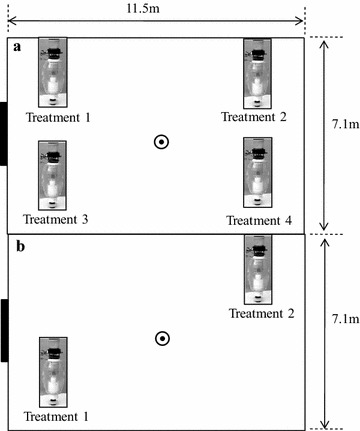
This study explored the possibility of replacing organically-produced CO with 2-butanone in odour blends targeting host-seeking malaria mosquitoes. During semi-field and field experiments MM-X traps were baited with a human odour mimic (MB5 blend) plus CO or 2-butanone at varying concentrations. Unbaited traps formed a control. The attraction of Anopheles gambiae s.s., Anopheles arabiensis and Anopheles funestus to these differently baited traps was measured and mean catch sizes were compared to determine whether 2-butanone could form a viable replacement for CO for these target species.
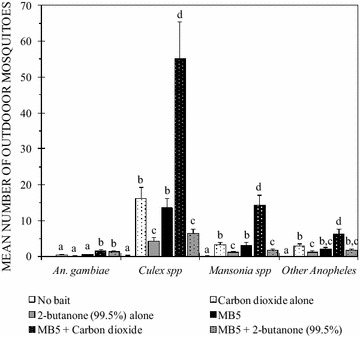
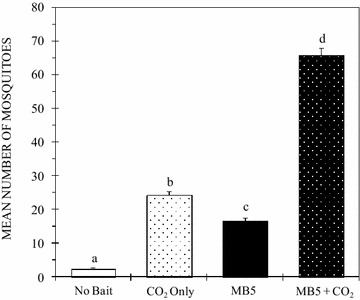
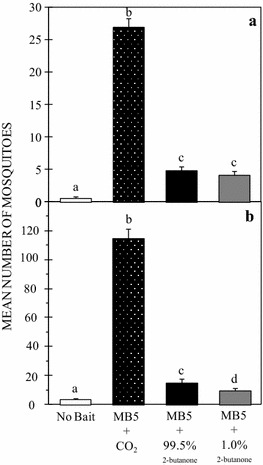
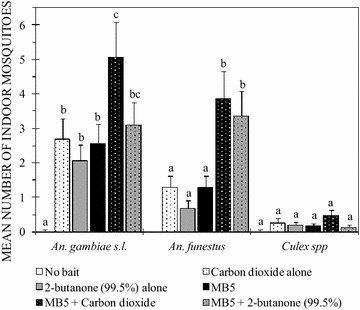
Under semi-field conditions significantly more female An. gambiae mosquitoes were attracted to a reference attractant blend (MB5 + CO) compared to MB5 without CO (P < 0.001), CO alone (P < 0.001), or a trap without a bait (P < 0.001). Whereas MB5 + CO attracted significantly more mosquitoes than its variants containing MB5 plus different dilutions of 2-butanone (P = 0.001), the pure form (99.5%) and the 1.0% dilution of 2-butanone gave promising results. In the field mean indoor catches of wild female An. gambiae s.l. in traps containing MB5 + CO (5.07 ± 1.01) and MB5 + 99.5% 2-butanone (3.10 ± 0.65) did not differ significantly (P = 0.09). The mean indoor catches of wild female An. funestus attracted to traps containing MB5 + CO (3.87 ± 0.79) and MB5 + 99.5% 2-butanone (3.37 ± 0.70) were also similar (P = 0.635). Likewise, the mean outdoor catches of An. gambiae and An. funestus associated with MB5 + CO (1.63 ± 0.38 and 0.53 ± 0.17, respectively) and MB5 + 99.5% 2-butanone (1.33 ± 0.32 and 0.40 ± 0.14, respectively) were not significantly different (P = 0.544 and P = 0.533, respectively).
These results demonstrate that 2-butanone can serve as a good replacement for CO in synthetic blends of attractants designed to attract host-seeking An. gambiae s.l. and An. funestus mosquitoes. This development underscores the possibility of using odour-baited traps (OBTs) for monitoring and surveillance as well as control of malaria vectors and potentially other mosquito species.
大多数旨在吸引寻找宿主的蚊子的气味诱饵都含有二氧化碳(CO₂),鉴于其作为蚊子飞行激活剂的作用,它能提高诱捕器的捕获量。然而,对于长期的区域广泛使用,CO₂的使用成本高昂且在后勤方面要求较高。
本研究探索了在针对寻找宿主的疟疾蚊子的气味混合物中用2-丁酮替代有机产生的CO₂的可能性。在半野外和野外实验中,MM-X诱捕器用人类气味模拟物(MB5混合物)加CO₂或不同浓度的2-丁酮进行诱饵处理。未加诱饵的诱捕器作为对照。测量冈比亚按蚊、阿拉伯按蚊和嗜人按蚊对这些不同诱饵诱捕器的吸引力,并比较平均捕获量,以确定2-丁酮是否可以作为这些目标物种的CO₂的可行替代品。
在半野外条件下,与不含CO₂的MB5(P < 0.001)、单独的CO₂(P < 0.001)或未加诱饵的诱捕器(P < 0.001)相比,显著更多的雌性冈比亚按蚊被吸引到参考引诱剂混合物(MB5 + CO₂)中。虽然MB5 + CO₂比其含有MB5加不同稀释度2-丁酮的变体吸引了显著更多的蚊子(P = 0.001),但2-丁酮的纯形式(99.5%)和1.0%稀释度给出了有希望的结果。在野外,含有MB5 + CO₂(5.07 ± 1.01)和MB5 + 99.5% 2-丁酮(3.10 ± 0.65)的诱捕器中野生雌性冈比亚按蚊复合体的平均室内捕获量没有显著差异(P = 0.09)。吸引到含有MB5 + CO₂(3.87 ± 0.79)和MB5 + 99.5% 2-丁酮(3.37 ± 0.70)的诱捕器中的野生雌性嗜人按蚊的平均室内捕获量也相似(P = 0.635)。同样,与MB5 + CO₂(分别为1.63 ± 0.38和0.53 ± 0.17)和MB5 + 99.5% 2-丁酮(分别为1.33 ± 0.32和0.40 ± 0.14)相关的冈比亚按蚊和嗜人按蚊的平均室外捕获量没有显著差异(分别为P = 0.544和P = 0.533)。
这些结果表明,在旨在吸引寻找宿主的冈比亚按蚊复合体和嗜人按蚊的合成引诱剂混合物中,2-丁酮可以作为CO₂的良好替代品。这一进展强调了使用气味诱饵诱捕器(OBTs)进行监测和监视以及控制疟疾媒介和潜在其他蚊种的可能性。