Rakic Rodolphe, Bourdon Bastien, Hervieu Magalie, Branly Thomas, Legendre Florence, Saulnier Nathalie, Audigié Fabrice, Maddens Stéphane, Demoor Magali, Galera Philippe
Normandie Université, UNICAEN, Laboratoire Microenvironnement Cellulaire et Pathologies (MILPAT), équipe Microenvironnement des Pathologies Dégénératives et Fibrotiques (MIPDF), EA 4652/BIOTARGEN EA 7450, UFR Santé, Université de Caen Normandie, 14032 Caen, France.
Vetbiobank, 1 Avenue Bourgelat, 69280 Marcy l'Etoile, France.
Int J Mol Sci. 2017 Aug 24;18(9):1842. doi: 10.3390/ijms18091842.
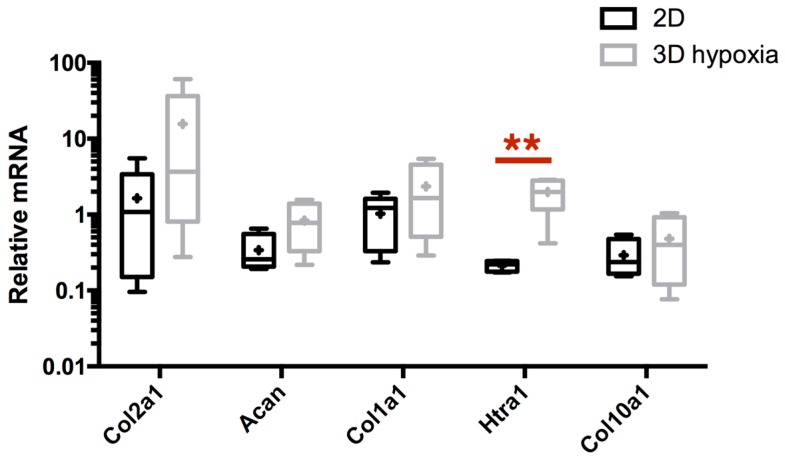
As in humans, osteoarthritis (OA) causes considerable economic loss to the equine industry. New hopes for cartilage repair have emerged with the matrix-associated autologous chondrocyte implantation (MACI). Nevertheless, its limitation is due to the dedifferentiation occurring during the chondrocyte amplification phase, leading to the loss of its capacity to produce a hyaline extracellular matrix (ECM). To enhance the MACI therapy efficiency, we have developed a strategy for chondrocyte redifferentiation, and demonstrated its feasibility in the equine model. Thus, to mimic the cartilage microenvironment, the equine dedifferentiated chondrocytes were cultured in type I/III collagen sponges for 7 days under hypoxia in the presence of BMP-2. In addition, chondrocytes were transfected by siRNA targeting and mRNAs, which are overexpressed during dedifferentiation and OA. To investigate the quality of the neo-synthesized ECM, specific and atypical cartilage markers were evaluated by RT-qPCR and Western blot. Our results show that the combination of 3D hypoxia cell culture, BMP-2 (Bone morphogenetic protein-2), and RNA interference, increases the chondrocytes functional indexes (/, /), leading to an effective chondrocyte redifferentiation. These data represent a proof of concept for this process of application, in vitro, in the equine model, and will lead to the improvement of the MACI efficiency for cartilage tissue engineering therapy in preclinical/clinical trials, both in equine and human medicine.
与人类一样,骨关节炎(OA)给马产业造成了巨大的经济损失。基质相关自体软骨细胞植入术(MACI)为软骨修复带来了新希望。然而,其局限性在于软骨细胞扩增阶段会发生去分化,导致其产生透明软骨细胞外基质(ECM)的能力丧失。为提高MACI治疗效率,我们开发了一种软骨细胞再分化策略,并在马模型中证明了其可行性。因此,为模拟软骨微环境,将马去分化软骨细胞在I/III型胶原海绵中于缺氧条件下在骨形态发生蛋白-2(BMP-2)存在下培养7天。此外,用靶向在去分化和OA过程中过表达的 和 信使核糖核酸(mRNA)的小干扰RNA(siRNA)转染软骨细胞。为研究新合成ECM的质量,通过逆转录定量聚合酶链反应(RT-qPCR)和蛋白质免疫印迹法评估特异性和非典型软骨标志物。我们的结果表明,三维缺氧细胞培养、BMP-2和RNA干扰的组合增加了软骨细胞功能指标(/,/),导致有效的软骨细胞再分化。这些数据代表了该应用过程在马模型体外的概念验证,并将在临床前/临床试验中提高马医学和人类医学中软骨组织工程治疗的MACI效率。