Barykina Natalia V, Subach Oksana M, Piatkevich Kiryl D, Jung Erica E, Malyshev Aleksey Y, Smirnov Ivan V, Bogorodskiy Andrey O, Borshchevskiy Valentin I, Varizhuk Anna M, Pozmogova Galina E, Boyden Edward S, Anokhin Konstantin V, Enikolopov Grigori N, Subach Fedor V
Moscow Institute of Physics and Technology, Dolgoprudny, Moscow Region, Russia.
P.K. Anokhin Institute of Normal Physiology of RAMS, Moscow, Russia.
PLoS One. 2017 Aug 24;12(8):e0183757. doi: 10.1371/journal.pone.0183757. eCollection 2017.
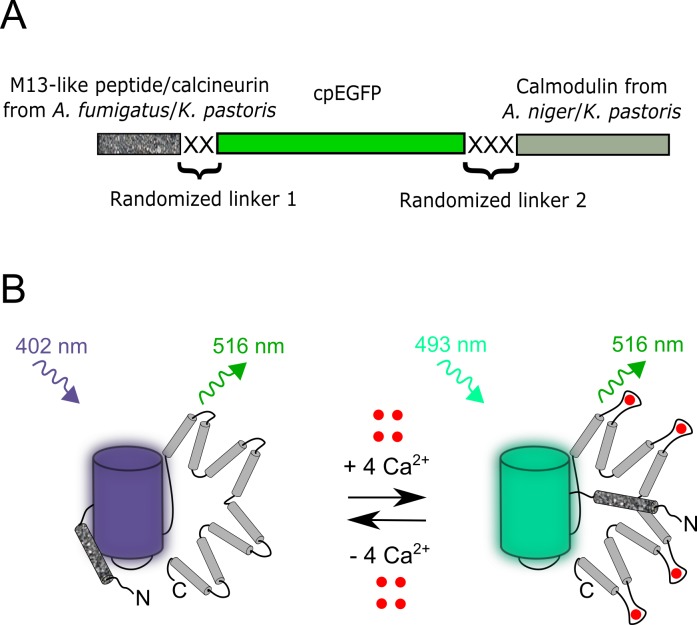
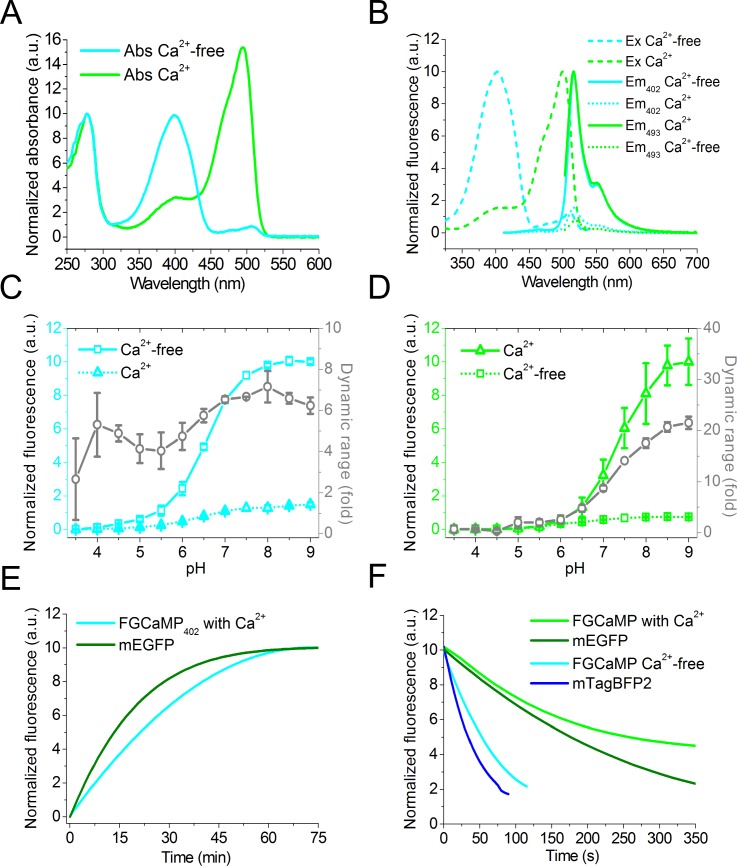
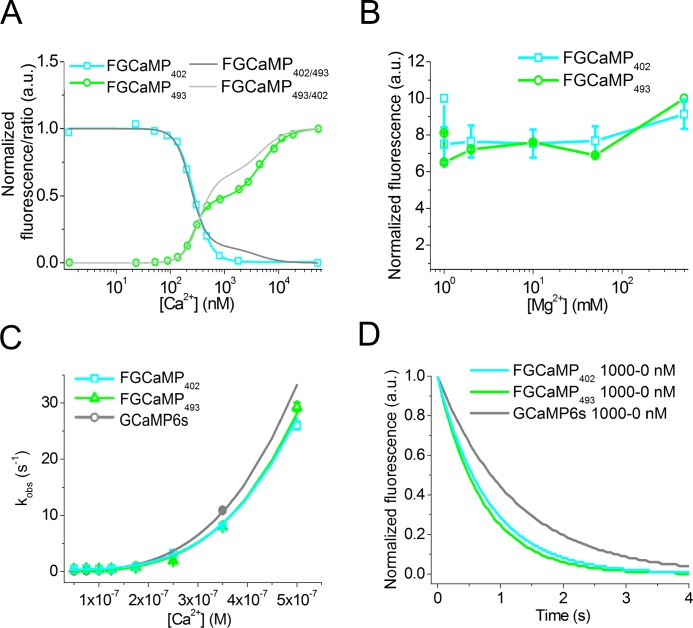
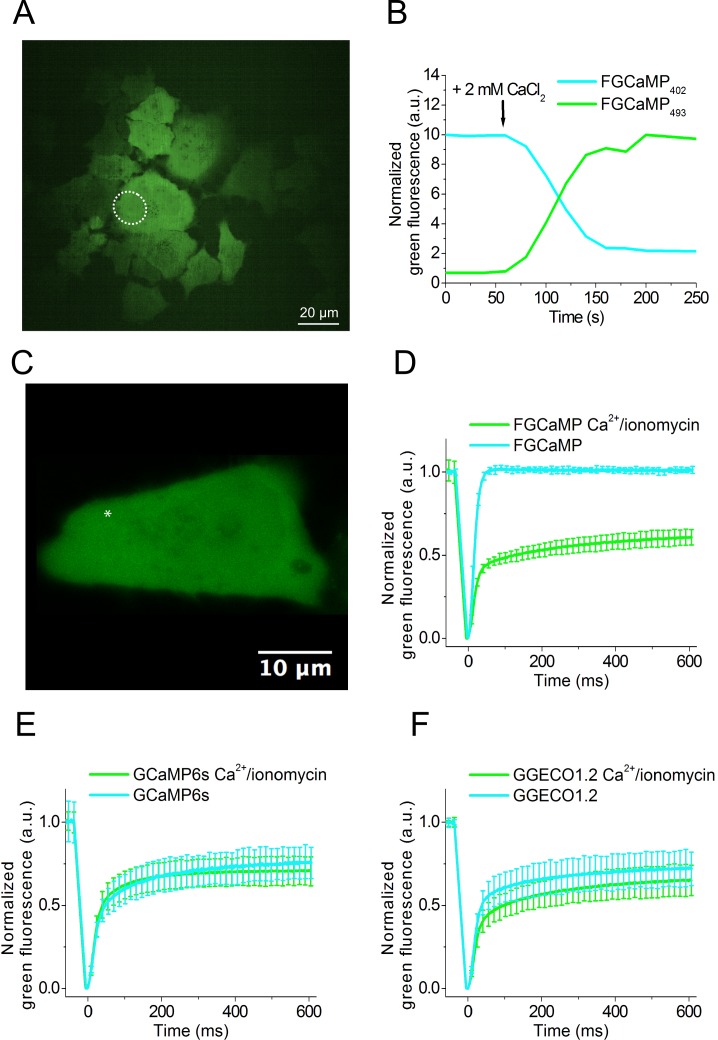
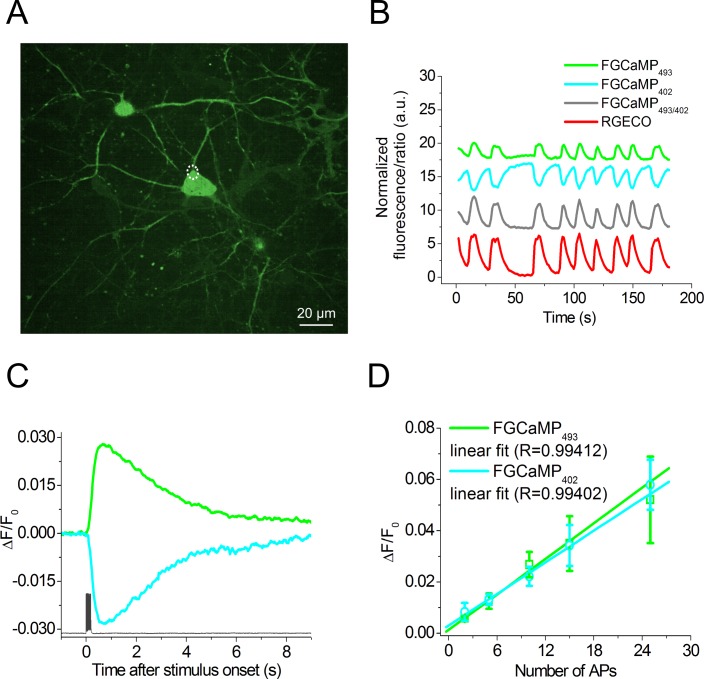
Currently available genetically encoded calcium indicators (GECIs) utilize calmodulins (CaMs) or troponin C from metazoa such as mammals, birds, and teleosts, as calcium-binding domains. The amino acid sequences of the metazoan calcium-binding domains are highly conserved, which may limit the range of the GECI key parameters and cause undesired interactions with the intracellular environment in mammalian cells. Here we have used fungi, evolutionary distinct organisms, to derive CaM and its binding partner domains and design new GECI with improved properties. We applied iterative rounds of molecular evolution to develop FGCaMP, a novel green calcium indicator. It includes the circularly permuted version of the enhanced green fluorescent protein (EGFP) sandwiched between the fungal CaM and a fragment of CaM-dependent kinase. FGCaMP is an excitation-ratiometric indicator that has a positive and an inverted fluorescence response to calcium ions when excited at 488 and 405 nm, respectively. Compared with the GCaMP6s indicator in vitro, FGCaMP has a similar brightness at 488 nm excitation, 7-fold higher brightness at 405 nm excitation, and 1.3-fold faster calcium ion dissociation kinetics. Using site-directed mutagenesis, we generated variants of FGCaMP with improved binding affinity to calcium ions and increased the magnitude of FGCaMP fluorescence response to low calcium ion concentrations. Using FGCaMP, we have successfully visualized calcium transients in cultured mammalian cells. In contrast to the limited mobility of GCaMP6s and G-GECO1.2 indicators, FGCaMP exhibits practically 100% molecular mobility at physiological concentrations of calcium ion in mammalian cells, as determined by photobleaching experiments with fluorescence recovery. We have successfully monitored the calcium dynamics during spontaneous activity of neuronal cultures using FGCaMP and utilized whole-cell patch clamp recordings to further characterize its behavior in neurons. Finally, we used FGCaMP in vivo to perform structural and functional imaging of zebrafish using wide-field, confocal, and light-sheet microscopy.
目前可用的基因编码钙指示剂(GECIs)利用来自后生动物(如哺乳动物、鸟类和硬骨鱼)的钙调蛋白(CaMs)或肌钙蛋白C作为钙结合结构域。后生动物钙结合结构域的氨基酸序列高度保守,这可能会限制GECI关键参数的范围,并导致与哺乳动物细胞内环境产生不必要的相互作用。在这里,我们利用真菌(进化上不同的生物体)来获得CaM及其结合伴侣结构域,并设计具有改进特性的新型GECI。我们应用了多轮分子进化来开发FGCaMP,一种新型绿色钙指示剂。它包括夹在真菌CaM和钙调蛋白依赖性激酶片段之间的增强型绿色荧光蛋白(EGFP)的环状排列版本。FGCaMP是一种激发比率指示剂,当分别在488和
405 nm激发时,对钙离子具有正向和反向荧光响应。与体外的GCaMP6s指示剂相比,FGCaMP在488 nm激发时具有相似的亮度,在405 nm激发时亮度高7倍,钙离子解离动力学快1.3倍。使用定点诱变,我们生成了对钙离子具有更高结合亲和力的FGCaMP变体,并增加了FGCaMP对低钙离子浓度的荧光响应幅度。使用FGCaMP,我们成功地在培养的哺乳动物细胞中可视化了钙瞬变。与GCaMP6s和G-GECO1.2指示剂的有限流动性相反,通过荧光恢复光漂白实验确定,FGCaMP在哺乳动物细胞中生理浓度的钙离子下表现出几乎100%的分子流动性。我们使用FGCaMP成功监测了神经元培养物自发活动期间的钙动力学,并利用全细胞膜片钳记录进一步表征其在神经元中的行为。最后,我们在体内使用FGCaMP,通过宽场、共聚焦和光片显微镜对斑马鱼进行结构和功能成像。