Helassa Nordine, Zhang Xiao-hua, Conte Ianina, Scaringi John, Esposito Elric, Bradley Jonathan, Carter Thomas, Ogden David, Morad Martin, Török Katalin
Institute of Cardiovascular and Cell Science, St George's, University of London, London SW17 0RE, UK.
Department of Regenerative Medicine and Cell Biology, Medical University of South Carolina, Charleston SC 29425, USA.
Sci Rep. 2015 Nov 3;5:15978. doi: 10.1038/srep15978.
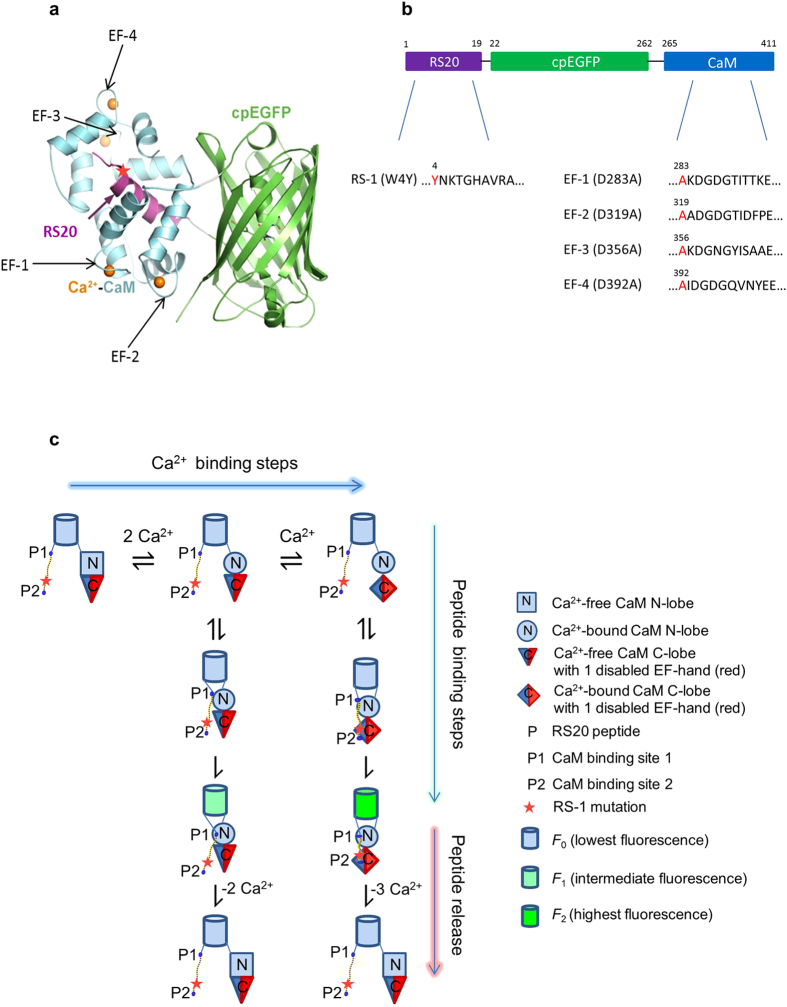
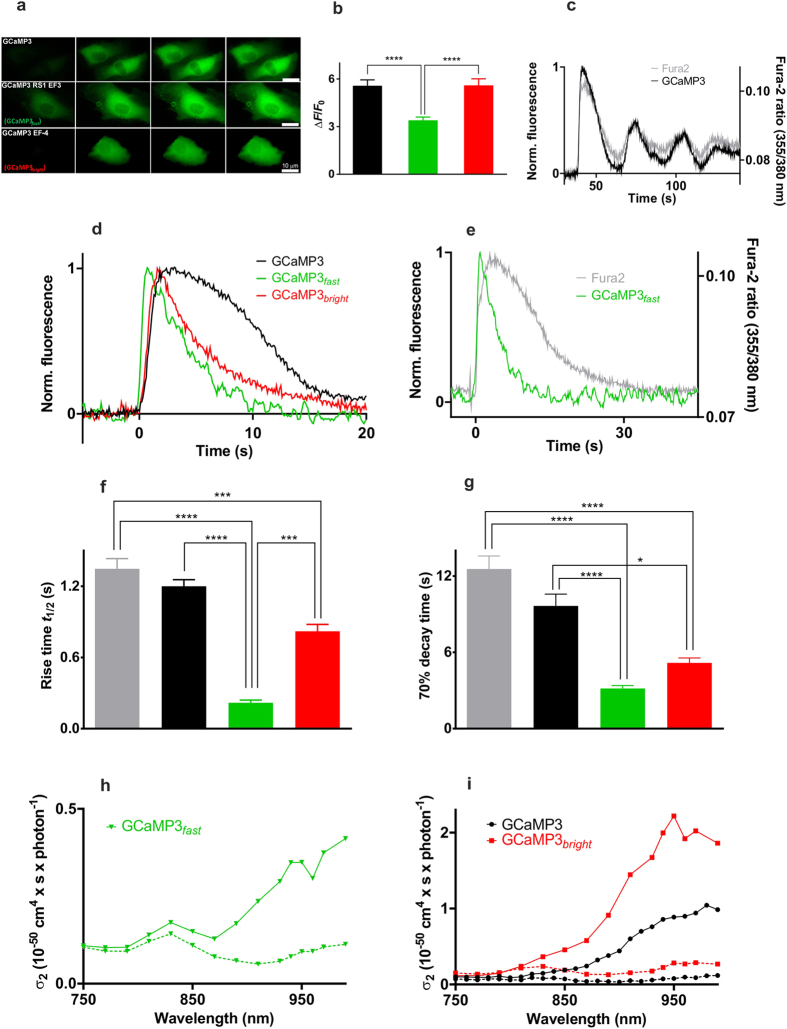
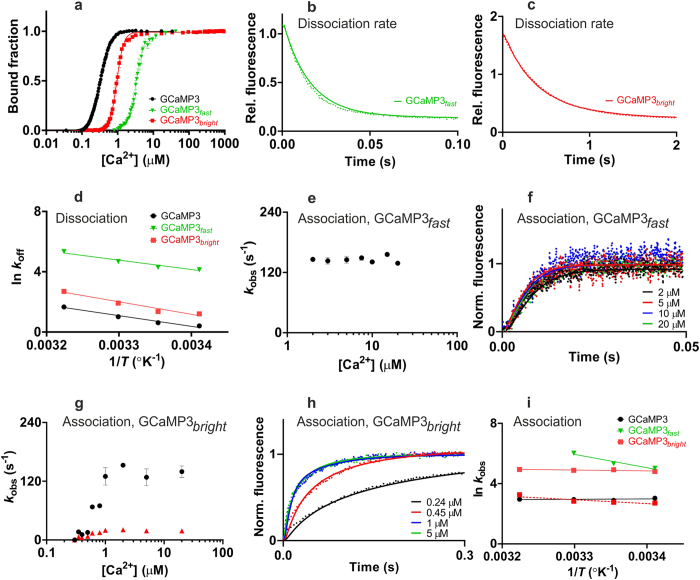
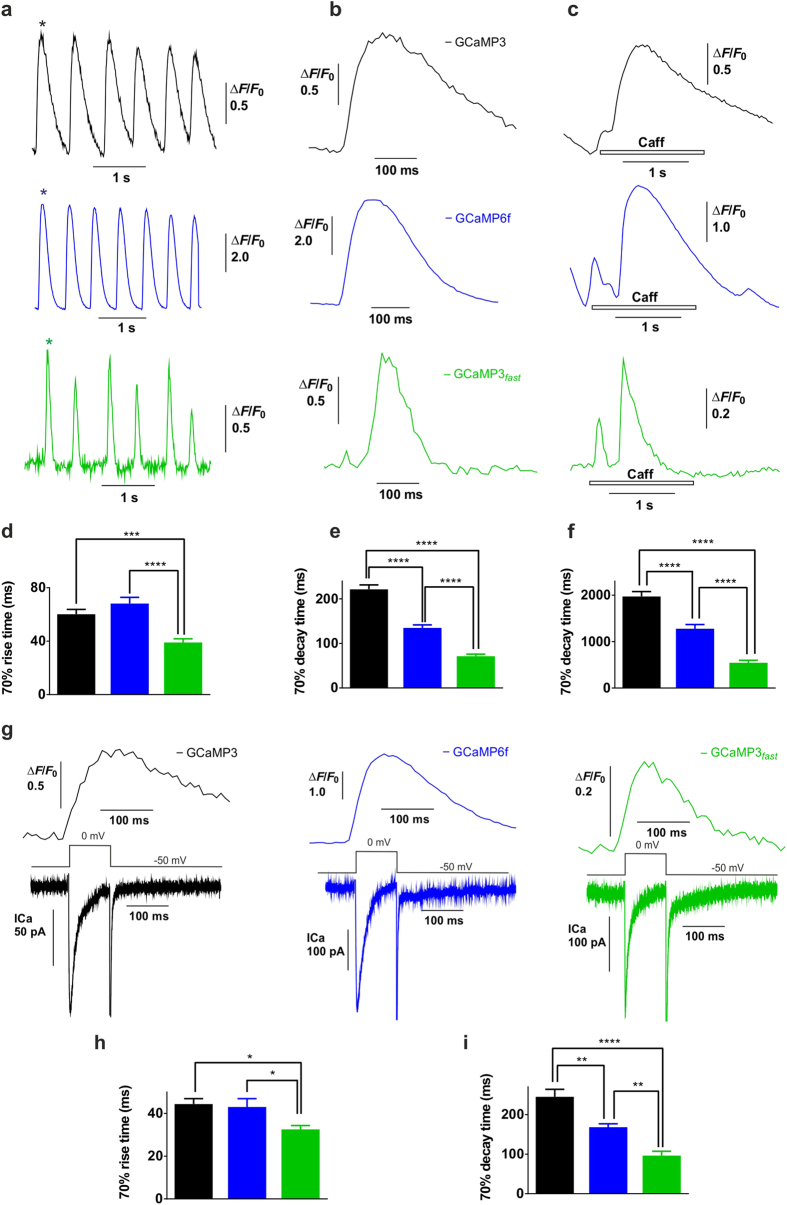
Faithful reporting of temporal patterns of intracellular Ca(2+) dynamics requires the working range of indicators to match the signals. Current genetically encoded calmodulin-based fluorescent indicators are likely to distort fast Ca(2+) signals by apparent saturation and integration due to their limiting fluorescence rise and decay kinetics. A series of probes was engineered with a range of Ca(2+) affinities and accelerated kinetics by weakening the Ca(2+)-calmodulin-peptide interactions. At 37 °C, the GCaMP3-derived probe termed GCaMP3fast is 40-fold faster than GCaMP3 with Ca(2+) decay and rise times, t1/2, of 3.3 ms and 0.9 ms, respectively, making it the fastest to-date. GCaMP3fast revealed discreet transients with significantly faster Ca(2+) dynamics in neonatal cardiac myocytes than GCaMP6f. With 5-fold increased two-photon fluorescence cross-section for Ca(2+) at 940 nm, GCaMP3fast is suitable for deep tissue studies. The green fluorescent protein serves as a reporter providing important novel insights into the kinetic mechanism of target recognition by calmodulin. Our strategy to match the probe to the signal by tuning the affinity and hence the Ca(2+) kinetics of the indicator is applicable to the emerging new generations of calmodulin-based probes.
对细胞内钙离子(Ca(2+))动态变化的时间模式进行如实报告,要求指示剂的工作范围与信号相匹配。当前基于基因编码钙调蛋白的荧光指示剂,由于其有限的荧光上升和衰减动力学,可能会因明显的饱和及积分作用而扭曲快速Ca(2+)信号。通过减弱Ca(2+)-钙调蛋白-肽相互作用,设计了一系列具有不同Ca(2+)亲和力和加速动力学的探针。在37°C时,源自GCaMP3的探针GCaMP3fast的Ca(2+)衰减和上升时间(t1/2)分别为3.3毫秒和0.9毫秒,比GCaMP3快40倍,使其成为迄今为止最快的探针。与GCaMP6f相比,GCaMP3fast在新生心肌细胞中揭示了具有明显更快Ca(2+)动态变化的离散瞬变。GCaMP3fast在940纳米处对Ca(2+)的双光子荧光截面增加了5倍,适用于深部组织研究。绿色荧光蛋白作为报告基因,为钙调蛋白识别靶标的动力学机制提供了重要的新见解。我们通过调节指示剂的亲和力从而调节Ca(2+)动力学,使探针与信号相匹配的策略适用于新一代基于钙调蛋白的探针。