Nicholls Mathew A, Fierlinger Anke, Niazi Faizan, Bhandari Mohit
Orthopedics and Sports Medicine, Virginia Mason, Seattle, WA, USA.
Ferring Pharmaceuticals Inc., Parsippany, NJ, USA.
Clin Med Insights Arthritis Musculoskelet Disord. 2017 Aug 11;10:1179544117723611. doi: 10.1177/1179544117723611. eCollection 2017.
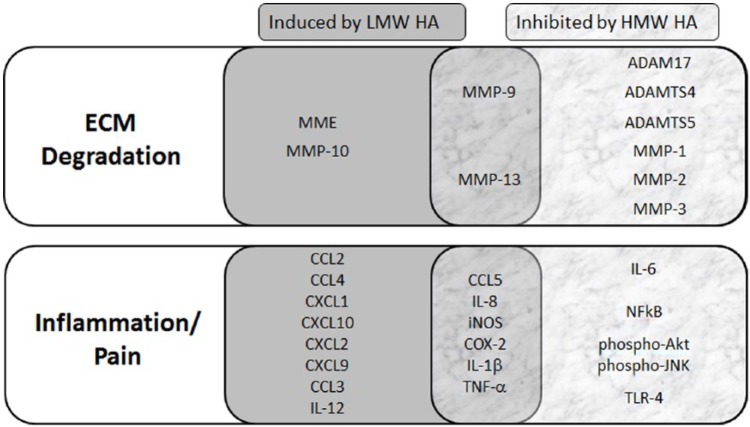
Hyaluronic acid (HA) has been a treatment modality for patients with knee osteoarthritis (OA) for many years now. Since HA was first introduced for the treatment of painful knee OA, much has been elucidated regarding both the etiology of this disease and the mechanisms by which HA may mitigate joint pain and tissue destruction. The objectives of this article are to (1) describe the etiology and pathophysiology of OA including both what is known about the genetics and biochemistry, (2) describe the role of HA on disease progression, (3) detail the antinociceptive and anti-inflammatory actions of HA in OA, and (4) present evidence of disease-modifying effects of HA in the preservation and restoration of the extracellular matrix. These data support that HA is not only just a simple device used for viscosupplementation but also a biologically active molecule that can affect the physiology of articular cartilage.
多年来,透明质酸(HA)一直是膝关节骨关节炎(OA)患者的一种治疗方式。自从HA首次被用于治疗疼痛性膝关节OA以来,关于这种疾病的病因以及HA减轻关节疼痛和组织破坏的机制,人们已经有了很多了解。本文的目的是:(1)描述OA的病因和病理生理学,包括已知的遗传学和生物化学方面的内容;(2)描述HA在疾病进展中的作用;(3)详细阐述HA在OA中的抗伤害感受和抗炎作用;(4)展示HA在细胞外基质的保存和恢复方面具有疾病修饰作用的证据。这些数据支持,HA不仅是一种用于粘弹性补充的简单装置,而且是一种能够影响关节软骨生理学的生物活性分子。