Said Moustoifa, Tavakoli Clément, Dumot Chloé, Toupet Karine, Olivier Cécile, Gilles Alexia, Maumus Marie, Dong Yuxi Clara, Collomb Nora, Auxenfans Céline, Moisan Anaïck, Favier Bertrand, Chovelon Benoit, Barbier Emmanuel Luc, Cormode David Peter, Brun Emmanuel, Elleaume Hélène, Wiart Marlène, Detante Olivier, Rome Claire, Noël Danièle, Auzély-Velty Rachel
Univ. Grenoble Alpes, Centre de Recherches sur les Macromolécules Végétales (CERMAV-CNRS), 38041 Grenoble, France.
Univ. Grenoble Alpes, Inserm, U1216, Grenoble Institut Neurosciences, 38000 Grenoble, France.
Theranostics. 2025 Mar 10;15(9):4054-4073. doi: 10.7150/thno.104551. eCollection 2025.
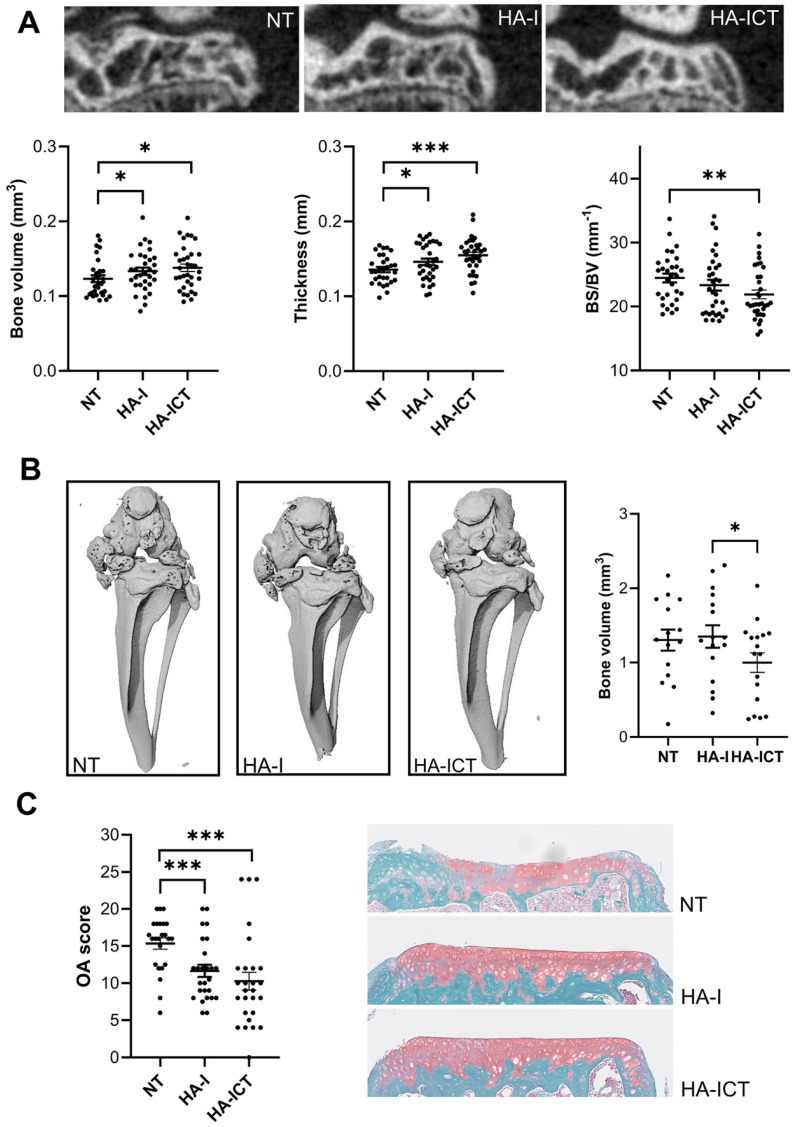
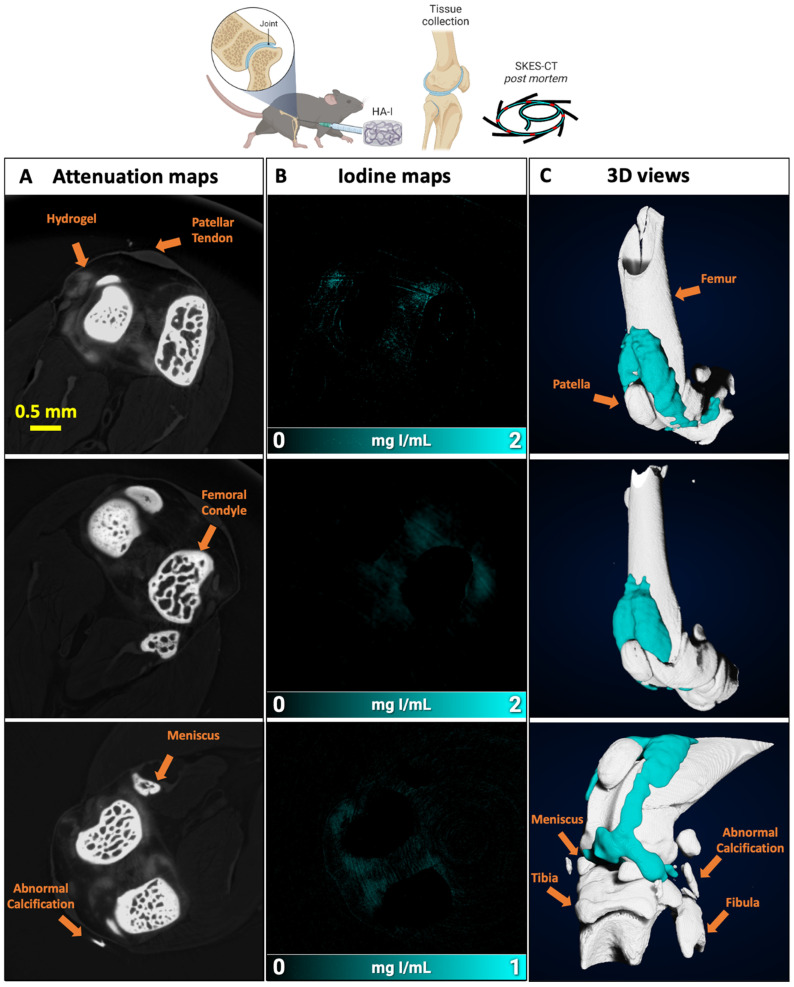
Osteoarthritis (OA) is a degenerative disease affecting cartilage, synovium and bone, that is a major cause of pain and disability. Intra-articular injection of hyaluronic acid (HA) derivatives, also known as viscosupplementation (VS), is a common treatment for the symptomatic management of knee OA. Despite its widespread use, the magnitude of the clinical benefit of VS remains controversial, with conflicting results due to methodological differences and possible differences in efficacy between products related to remanence and rheological properties. Here, to create an effective HA-based treatment, an injectable self-healing HA hydrogel with long-persistent radiopacity is formed by tethering a clinical iodine contrast agent to HA. The labeling conditions are tuned to obtain sufficient X-ray signal without altering the biocompatibility, rheological and injectability properties of the hydrogel. The iodine labeling enabled to monitor not only delivery of the hydrogel but also its retention in mouse knees up to 5 weeks post-administration using synchrotron K-edge subtraction-computed tomography. We further demonstrated that the unique properties of this hydrogel enable creation of a transient HA network that attenuates OA progression in a mouse model of OA. Moreover, our data showed that the rate of HA-I disappearance appears to predict treatment response, likely because a rapid elimination serves as an indirect indicator of inflammation. Collectively, these results show that our radiopaque HA-I hydrogel holds significant promise for improving patient management in the treatment of OA before clinical symptoms worsen. Its capacity for tracking over time allows for personalized treatment schedules based on observed retention and therapeutic effect. As a result, this theranostic hydrogel emerges as a strong candidate for precision medicine in OA.
骨关节炎(OA)是一种影响软骨、滑膜和骨骼的退行性疾病,是疼痛和残疾的主要原因。关节内注射透明质酸(HA)衍生物,也称为粘弹性补充疗法(VS),是膝关节OA症状管理的常见治疗方法。尽管其广泛应用,但VS的临床益处程度仍存在争议,由于方法学差异以及产品之间与残留和流变学特性相关的疗效可能存在差异,导致结果相互矛盾。在此,为了创建一种有效的基于HA的治疗方法,通过将临床碘造影剂与HA连接,形成了一种具有长效不透射线的可注射自愈HA水凝胶。调整标记条件以获得足够的X射线信号,同时不改变水凝胶的生物相容性、流变学和可注射性。碘标记不仅能够监测水凝胶的递送情况,还能使用同步加速器K边减法计算机断层扫描监测其在小鼠膝关节内给药后长达5周的保留情况。我们进一步证明,这种水凝胶的独特特性能够创建一个短暂的HA网络,该网络可减轻OA小鼠模型中的OA进展。此外,我们的数据表明,HA-I消失的速率似乎可以预测治疗反应,可能是因为快速消除是炎症的间接指标。总体而言,这些结果表明,我们的不透射线的HA-I水凝胶在改善OA治疗中临床症状恶化前的患者管理方面具有巨大潜力。其随时间追踪的能力允许基于观察到的保留情况和治疗效果制定个性化的治疗方案。因此,这种治疗诊断水凝胶成为OA精准医学的有力候选者。