Vollmer Brandi, Nair Kavita V, Sillau Stefan H, Corboy John, Vollmer Timothy, Alvarez Enrique
Rocky Mountain MS Center at University of Colorado, USA.
Skaggs School of Pharmacy and Pharmaceutical Sciences, University of Colorado Denver, United States.
Mult Scler J Exp Transl Clin. 2017 Aug 17;3(3):2055217317725102. doi: 10.1177/2055217317725102. eCollection 2017 Jul-Sep.
Fingolimod (FTY) and dimethyl fumarate (DMF) are multiple sclerosis (MS) oral therapies that became available in 2010 and 2013, respectively.
The objective of this article is to compare discontinuation rates, efficacy, and adverse events (AEs) of FTY and DMF over two years.
Patients prescribed FTY or DMF at the Rocky Mountain MS Center at University of Colorado prior to October 2013 were identified. Clinician-reported data were retrospectively collected. Primary outcome was discontinuation of drug by the end of year two. Reasons for discontinuation were evaluated.
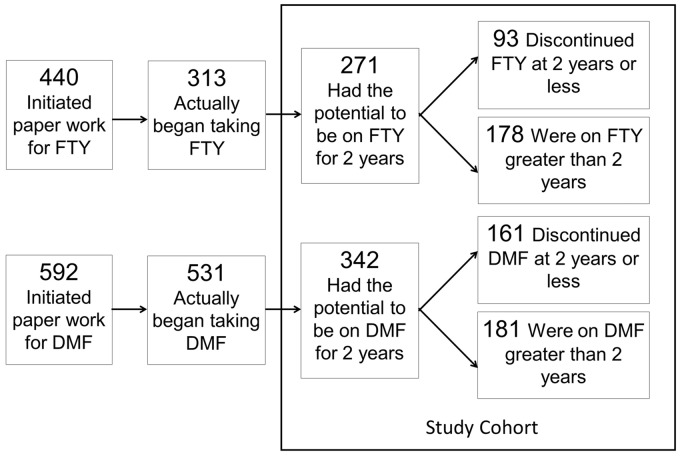
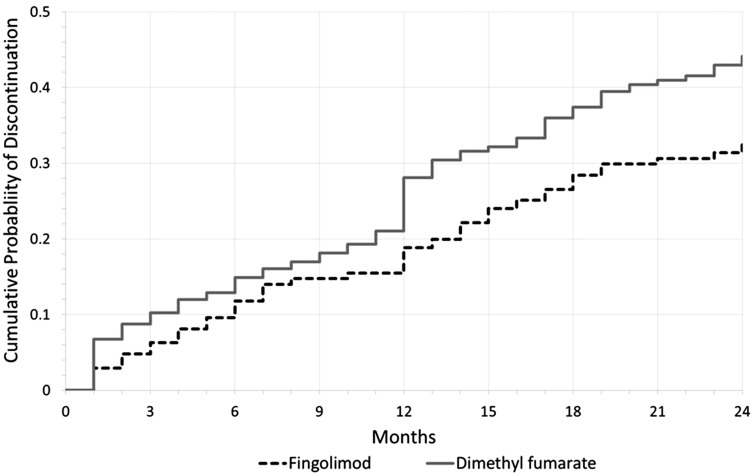
A total of 271 FTY and 342 DMF patients were evaluated. Patients had a mean age of 42.5 (FTY) and 45.8 (DMF) years and were predominantly female (72.0% FTY; 69.6% DMF) and white (86.3% FTY; 82.2% DMF). At ≤24 months, 93 (34.3%) and 161 (47.1%) discontinued FTY and DMF, respectively, with an unadjusted odds ratio (OR) of 1.70 (1.23-2.37, = 0.002), or 1.69 (1.16-2.46, = 0.006) for the doubly robust propensity score weighted estimator. Primary reason for discontinuation was AEs, which were less likely for FTY 46 (17.0%) compared to DMF 82 (24.0%) (OR 1.54, 1.03-2.31, = 0.035). Discontinuation due to disease activity (FTY (10%) DMF (11.1%); OR 1.13, 0.67-1.90, = 0.647) and breakthrough disease activity, regardless of discontinuation (FTY (34.7%) DMF (33.6%); OR 0.95, 0.68-1.34, = 0.783), were similar.
The odds of discontinuation were less for FTY than DMF, and were driven by AEs for both drugs.
芬戈莫德(FTY)和富马酸二甲酯(DMF)是分别于2010年和2013年上市的用于治疗多发性硬化症(MS)的口服药物。
本文旨在比较FTY和DMF在两年内的停药率、疗效及不良事件(AE)。
确定2013年10月之前在科罗拉多大学落基山MS中心开具FTY或DMF处方的患者。回顾性收集临床医生报告的数据。主要结局是在第二年年底停药情况。对停药原因进行评估。
共评估了271例FTY患者和342例DMF患者。患者的平均年龄分别为42.5岁(FTY组)和45.8岁(DMF组),且以女性为主(FTY组为72.0%;DMF组为69.6%),白人占多数(FTY组为86.3%;DMF组为82.2%)。在≤24个月时,分别有93例(34.3%)和161例(47.1%)停用FTY和DMF,未调整的优势比(OR)为1.70(1.23 - 2.37,P = 0.002),双重稳健倾向评分加权估计值的OR为1.69(1.16 - 2.46,P = 0.006)。停药的主要原因是AE,FTY组为46例(17.0%),低于DMF组的82例(24.0%)(OR 1.54,1.03 - 2.31,P = 0.035)。因疾病活动导致的停药(FTY组为10%,DMF组为11.1%;OR 1.13,0.67 - 1.90,P = 0.647)以及无论是否停药的突破性疾病活动(FTY组为34.7%,DMF组为33.6%;OR 0.95,0.68 - 1.34,P = 0.783)相似。
FTY停药几率低于DMF,且两种药物的停药均由AE导致。