
健康衰老过程中记忆力的预测因素:多不饱和脂肪酸平衡与穹窿白质完整性
Predictors of Memory in Healthy Aging: Polyunsaturated Fatty Acid Balance and Fornix White Matter Integrity.
作者信息
Zamroziewicz Marta K, Paul Erick J, Zwilling Chris E, Barbey Aron K
机构信息
1Decision Neuroscience Laboratory, University of Illinois Urbana-Champaign, Urbana, IL, USA.
2Beckman Institute for Advanced Science and Technology, University of Illinois Urbana-Champaign, Urbana, IL, USA.
出版信息
Aging Dis. 2017 Jul 21;8(4):372-383. doi: 10.14336/AD.2017.0501. eCollection 2017 Jul.
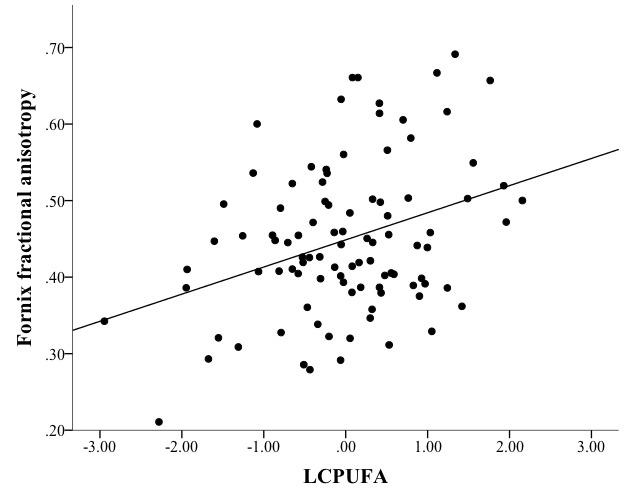
Recent evidence demonstrates that age and disease-related decline in cognition depends not only upon degeneration in brain structure and function, but also on dietary intake and nutritional status. Memory, a potential preclinical marker of Alzheimer's disease, is supported by white matter integrity in the brain and dietary patterns high in omega-3 and omega-6 polyunsaturated fatty acids. However, the extent to which memory is supported by specific omega-3 and omega-6 polyunsaturated fatty acids, and the degree to which this relationship is reliant upon microstructure of particular white matter regions is not known. This study therefore examined the cross-sectional relationship between empirically-derived patterns of omega-3 and omega-6 polyunsaturated fatty acids (represented by nutrient biomarker patterns), memory, and regional white matter microstructure in healthy, older adults. We measured thirteen plasma phospholipid omega-3 and omega-6 polyunsaturated fatty acids, memory, and regional white matter microstructure in 94 cognitively intact older adults (65 to 75 years old). A three-step mediation analysis was implemented using multivariate linear regressions, adjusted for age, gender, education, income, depression status, and body mass index. The mediation analysis revealed that a mixture of plasma phospholipid omega-3 and omega-6 polyunsaturated fatty acids is linked to memory and that white matter microstructure of the fornix fully mediates the relationship between this pattern of plasma phospholipid polyunsaturated fatty acids and memory. These results suggest that memory may be optimally supported by a balance of plasma phospholipid omega-3 and omega-6 polyunsaturated fatty acids through the preservation of fornix white matter microstructure in cognitively intact older adults. This report provides novel evidence for the benefits of plasma phospholipid omega-3 and omega-6 polyunsaturated fatty acid balance on memory and underlying white matter microstructure.
最近的证据表明,与年龄和疾病相关的认知能力下降不仅取决于大脑结构和功能的退化,还取决于饮食摄入和营养状况。记忆是阿尔茨海默病潜在的临床前标志物,大脑白质完整性以及富含ω-3和ω-6多不饱和脂肪酸的饮食模式对其有支持作用。然而,特定的ω-3和ω-6多不饱和脂肪酸对记忆的支持程度,以及这种关系对特定白质区域微观结构的依赖程度尚不清楚。因此,本研究调查了健康老年人中,根据经验得出的ω-3和ω-6多不饱和脂肪酸模式(以营养生物标志物模式表示)、记忆与区域白质微观结构之间的横断面关系。我们测量了94名认知功能完好的老年人(65至75岁)的13种血浆磷脂ω-3和ω-6多不饱和脂肪酸、记忆以及区域白质微观结构。使用多元线性回归进行了三步中介分析,并对年龄、性别、教育程度、收入、抑郁状态和体重指数进行了调整。中介分析表明,血浆磷脂ω-3和ω-6多不饱和脂肪酸的混合物与记忆有关,穹窿的白质微观结构完全介导了这种血浆磷脂多不饱和脂肪酸模式与记忆之间的关系。这些结果表明,在认知功能完好的老年人中,通过保留穹窿白质微观结构,可以通过血浆磷脂ω-3和ω-6多不饱和脂肪酸的平衡来最佳地支持记忆。本报告为血浆磷脂ω-3和ω-6多不饱和脂肪酸平衡对记忆及潜在白质微观结构的益处提供了新的证据。



 Zotero 插件