Bozzo Anthony, Oitment Colby, Thornley Patrick, Yan James, Habib Anthony, Hoppe Daniel J, Athwal George S, Ayeni Olufemi R
Division of Orthopaedic Surgery, Department of Surgery, McMaster University, Hamilton, Ontario, Canada.
Orthopaedic Sports Medicine Program, Women's College Hospital, University of Toronto, Toronto, Ontario, Canada.
Orthop J Sports Med. 2017 Aug 14;5(8):2325967117723329. doi: 10.1177/2325967117723329. eCollection 2017 Aug.
The inferior glenohumeral ligament, the most important static anterior stabilizer of the shoulder, becomes disrupted in humeral avulsion of the glenohumeral ligament (HAGL) lesions. Unfortunately, HAGL lesions commonly go unrecognized. A missed HAGL during an index operation to treat anterior shoulder instability may lead to persistent instability. Currently, there are no large studies describing the indications for surgical repair or the outcomes of patients with HAGL lesions.
To search the literature to identify surgical indications for the treatment of HAGL lesions and discuss reported outcomes.
Systematic review; Level of evidence, 4.
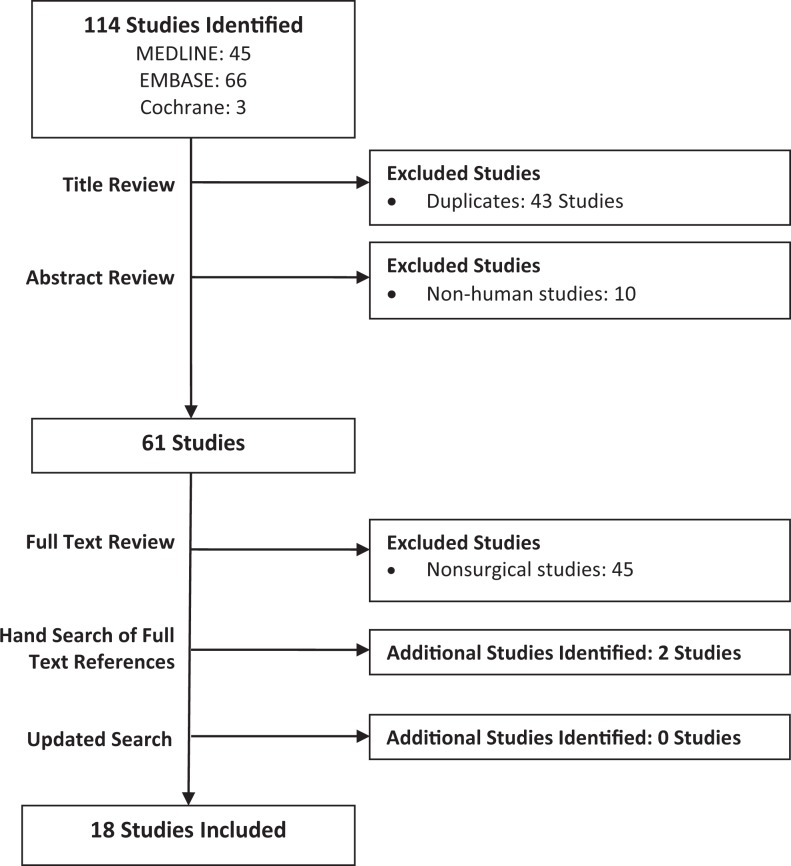
Two reviewers completed a comprehensive literature search of 3 online databases (MEDLINE, EMBASE, and Cochrane Library) from inception until May 25, 2016, using the keywords "humeral avulsion of the glenohumeral ligament" or "HAGL" to generate a broad search. Systematic screening of eligible studies was undertaken in duplicate. Abstracted data were organized in table format, with descriptive statistics presented.
After screening, 18 studies comprising 118 patients were found that described surgical intervention and outcomes for HAGL lesions. The mean patient was 22 years (range, 12-50 years), and 82% were male. Sports injuries represented 72% of all HAGL injuries. The main surgical indication was primary anterior instability, followed by pain and failed nonoperative management. Commonly associated injuries in patients with identified HAGL lesions included a Bankart lesion (15%), Hill-Sachs lesions (13%), and glenoid bone loss (7%). Reporting of outcome scores varied among the included studies. Meta-analysis was not possible, but all included studies reported significantly improved postoperative stability and function. There were no demonstrated differences in outcomes for patients treated with open versus arthroscopic surgical techniques. All but 2 patients undergoing operative management for HAGL lesions were able to return to sport at their previous levels; these included Olympians and professional athletes.
HAGL lesions typically occur in younger male patients and are often associated with Bankart lesions and bone loss. Open and arthroscopic management techniques are both effective in preventing recurrent instability.
肩胛下盂肱韧带是肩部最重要的静态前向稳定结构,在盂肱韧带肱骨撕脱(HAGL)损伤中会发生断裂。遗憾的是,HAGL损伤常常未被识别。在初次手术治疗前肩不稳时漏诊HAGL可能导致持续性不稳。目前,尚无大型研究描述HAGL损伤的手术修复指征或患者的治疗结果。
检索文献以确定HAGL损伤的手术治疗指征并讨论报告的治疗结果。
系统评价;证据等级,4级。
两名评价者使用关键词“盂肱韧带肱骨撕脱”或“HAGL”,对3个在线数据库(MEDLINE、EMBASE和Cochrane图书馆)从建库至2016年5月25日进行全面文献检索,以进行广泛搜索。对符合条件的研究进行系统的重复筛选。提取的数据以表格形式整理,并呈现描述性统计结果。
筛选后,发现18项研究共118例患者描述了HAGL损伤的手术干预及治疗结果。患者平均年龄22岁(范围12 - 50岁),82%为男性。运动损伤占所有HAGL损伤的72%。主要手术指征是原发性前肩不稳,其次是疼痛和非手术治疗失败。已确诊HAGL损伤患者常见的合并损伤包括Bankart损伤(15%)、Hill-Sachs损伤(13%)和肩胛盂骨缺损(7%)。纳入研究中对结果评分的报告各不相同。无法进行荟萃分析,但所有纳入研究均报告术后稳定性和功能有显著改善。开放手术与关节镜手术技术治疗患者的结果无明显差异。接受HAGL损伤手术治疗的患者中,除2例患者外,其余均能够恢复到之前的运动水平;其中包括奥运选手和职业运动员。
HAGL损伤通常发生在年轻男性患者中,且常与Bankart损伤和骨缺损相关。开放手术和关节镜手术技术在预防复发性不稳方面均有效。