Pappas Dimitrios A, Kremer Joel M, Griffith Jenny, Reed George, Salim Bob, Karki Chitra, Garg Vishvas
Columbia University, New York, NY, USA.
Corrona LLC, Southborough, MA, USA.
Rheumatol Ther. 2017 Dec;4(2):375-389. doi: 10.1007/s40744-017-0077-z. Epub 2017 Aug 24.
Current recommendations for the management of rheumatoid arthritis (RA) focus on a treat-to-target approach with the objective of maximizing long-term health-related quality-of-life in patients with RA. Published studies from randomized clinical trials have reported limited data regarding the long-term efficacy and safety of adalimumab in patients with RA. This study aims to evaluate the long-term (10+ years) persistency and effectiveness of adalimumab in patients with RA in a real-world setting.
Included in this study were biologic-naïve adults with RA initiating adalimumab during follow-up enrolled in the Corrona RA registry. More than 10 years of data on persistency of adalimumab and rheumatologist-supplied reasons for discontinuation were examined. Among patients who persisted on adalimumab over the years, clinical [e.g., clinical disease activity index scores (CDAI), physician global assessment, tender joint count, and swollen joint count] and patient-reported outcomes (PRO), such as physical function, pain, fatigue, and morning stiffness, were examined.
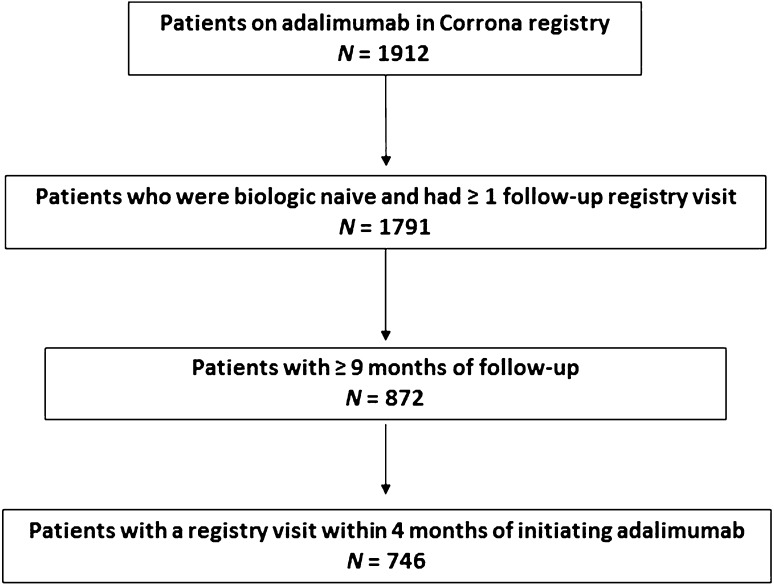
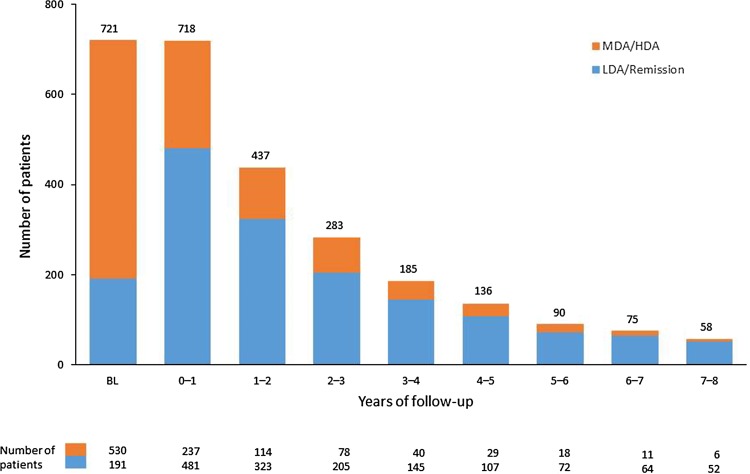
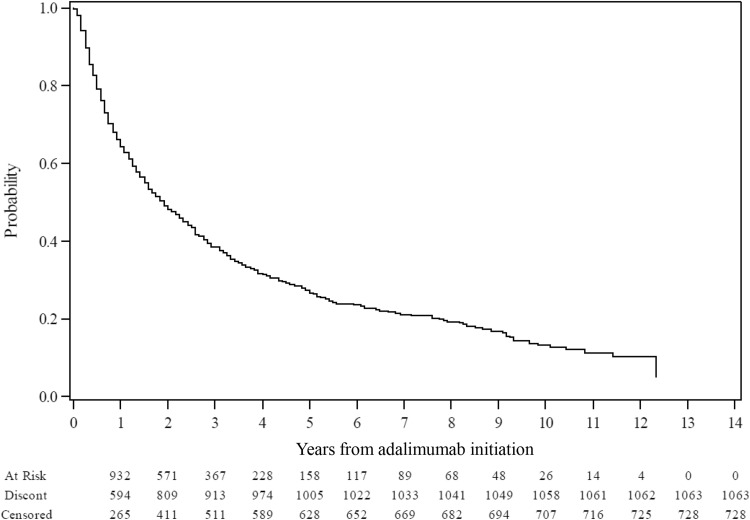
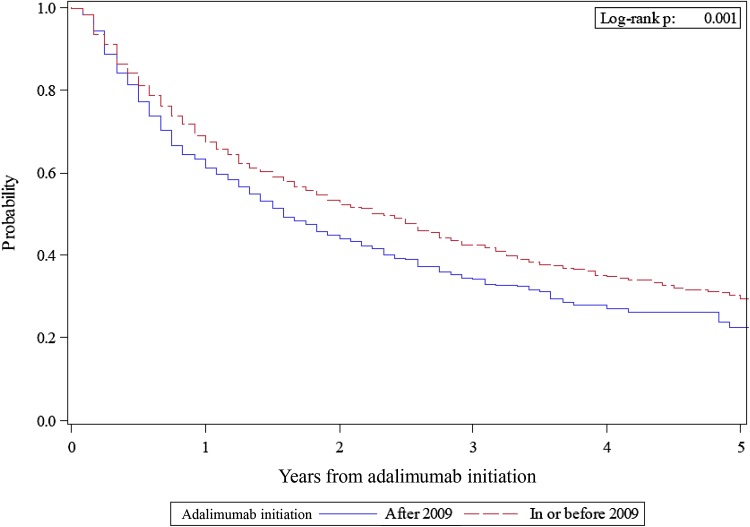
Of 1791 biologic-naive patients treated with adalimumab who had ≥1 follow-up registry visit, 64.1% were still on therapy at 1 year and 10.2% were still on therapy by the end of year 12. Among patients who persisted on adalimumab for at least 1 year (77.1% female, mean age 53.9 years), 67.0% were in low disease activity (LDA)/remission (CDAI ≤10) and had clinically meaningful improvements from baseline in all clinical assessments and PROs. Initial improvements in LDA/remission and in clinical and PRO assessments observed at year 1 were sustained in those patients who remained on adalimumab over 10 years of follow-up. Among patients who discontinued adalimumab, 61.6% were not in LDA/remission and 41.9% switched to another biologic within 12 months after discontinuing adalimumab.
Real-world data demonstrate a sustained effectiveness of adalimumab in the treatment of RA for patients who remained on therapy for 10 years.
Corrona, LLC and AbbVie.
目前类风湿关节炎(RA)管理的建议重点是采用达标治疗方法,目标是使RA患者的长期健康相关生活质量最大化。随机临床试验发表的研究报告了关于阿达木单抗在RA患者中的长期疗效和安全性的数据有限。本研究旨在评估在现实环境中阿达木单抗在RA患者中的长期(10年以上)持续性和有效性。
本研究纳入了在Corrona RA注册中心随访期间开始使用阿达木单抗的初治成年RA患者。检查了超过10年的阿达木单抗持续性数据以及风湿病学家提供的停药原因。在多年持续使用阿达木单抗的患者中,检查了临床指标[如临床疾病活动指数评分(CDAI)、医生整体评估、压痛关节计数和肿胀关节计数]以及患者报告的结局(PRO),如身体功能、疼痛、疲劳和晨僵。
在接受阿达木单抗治疗的1791例初治患者中,≥1次随访登记访视的患者中,64.1%在1年时仍在接受治疗,10.2%在第12年末仍在接受治疗。在持续使用阿达木单抗至少1年的患者中(77.1%为女性,平均年龄53.9岁),67.0%处于低疾病活动度(LDA)/缓解期(CDAI≤10),并且在所有临床评估和PRO中从基线有临床意义的改善。在1年时观察到的LDA/缓解期以及临床和PRO评估的初始改善在随访10年以上仍使用阿达木单抗的患者中得以维持。在停用阿达木单抗的患者中,61.6%未处于LDA/缓解期,41.9%在停用阿达木单抗后12个月内换用了另一种生物制剂。
真实世界数据表明,对于持续治疗10年的患者,阿达木单抗在治疗RA方面具有持续有效性。
Corrona有限责任公司和艾伯维公司。