Gong Xun, Hung Kuo-Hsiang, Ting Yu-Wei, Hsu Tsai-Wen, Malikova Lenka, Tran Huyen Trang, Huang Chao-Li, Liu Shih-Hui, Chiang Tzen-Yuh
Key Laboratory for Plant Diversity and Biogeography of East Asia, Kunming Institute of Botany, Chinese Academy of Sciences, Kunming, China.
Graduate Institute of Bioresources, National Pingtung University of Science and Technology, Pingtung, Taiwan.
PLoS One. 2017 Aug 25;12(8):e0183209. doi: 10.1371/journal.pone.0183209. eCollection 2017.
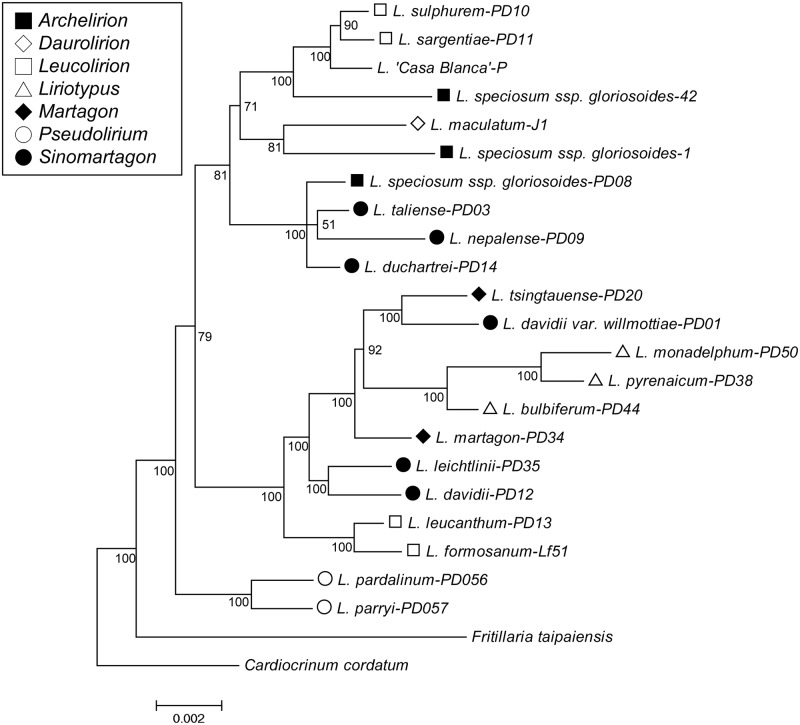
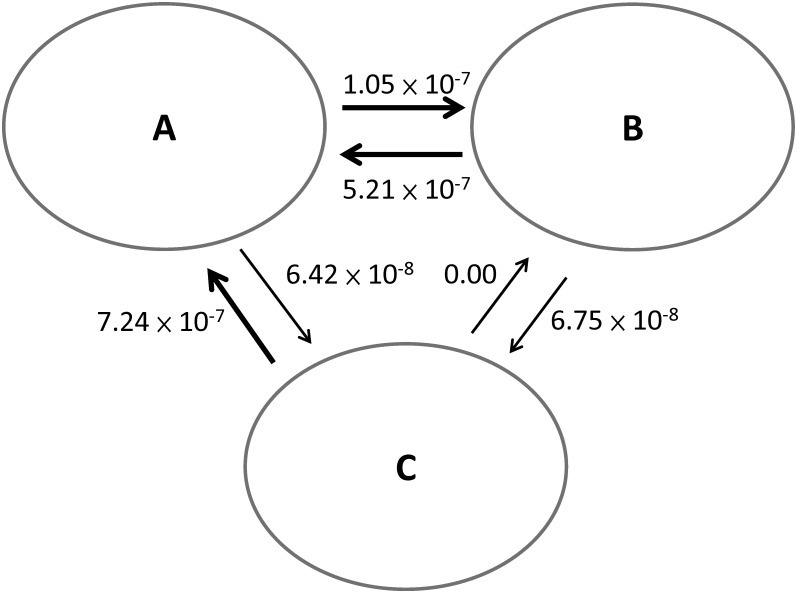
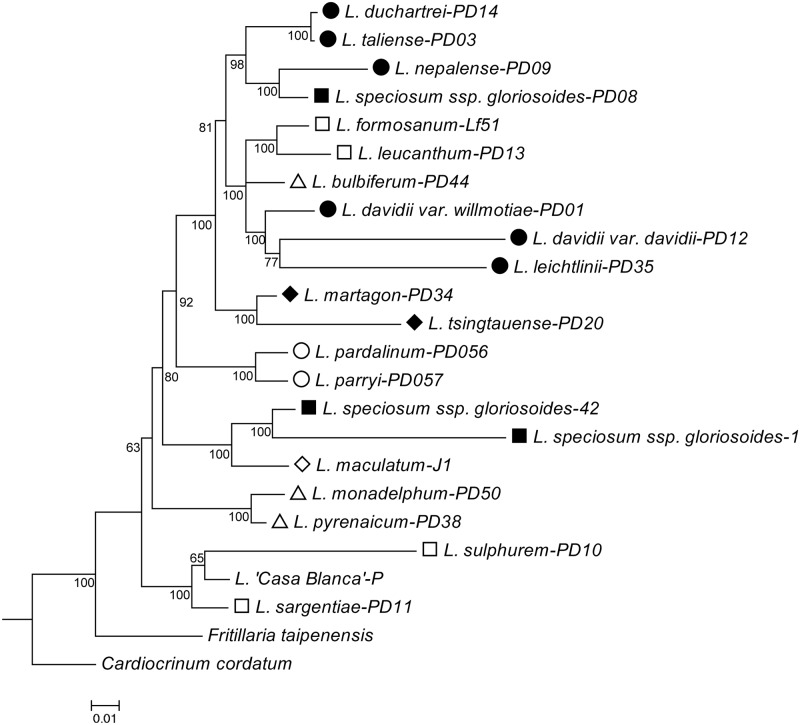
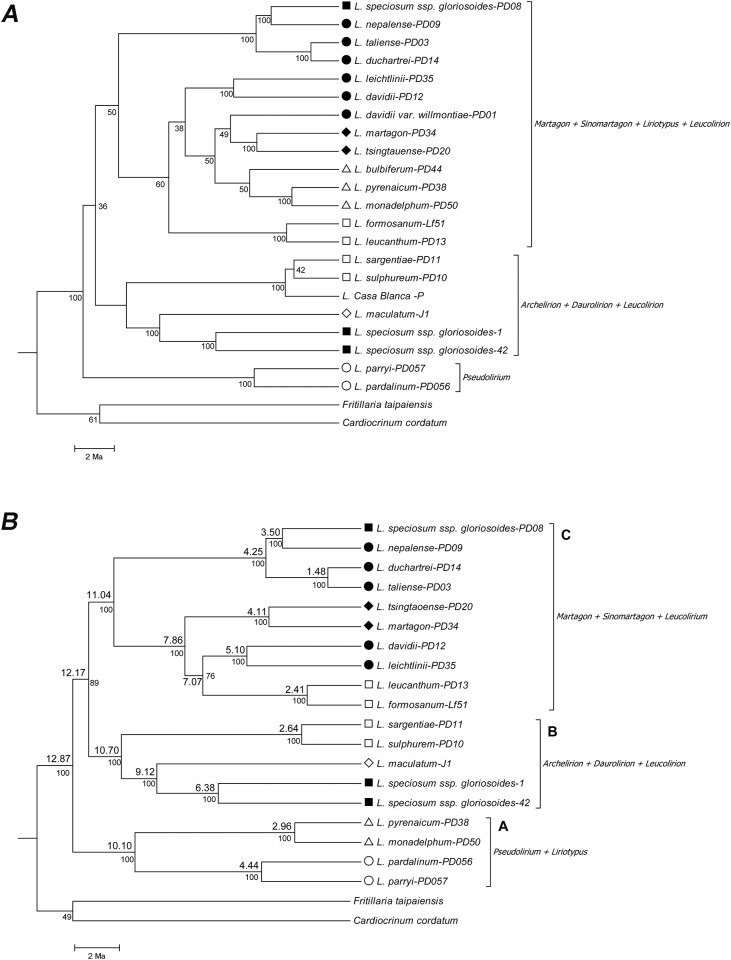
Gene flow between species may last a long time in plants. Reticulation inevitably causes difficulties in phylogenetic reconstruction. In this study, we looked into the genetic divergence and phylogeny of 20 Lilium species based on multilocus analyses of 8 genes of chloroplast DNA (cpDNA), the internally transcribed nuclear ribosomal DNA (nrITS) spacer and 20 loci extracted from the expressed sequence tag (EST) libraries of L. longiflorum Thunb. and L. formosanum Wallace. The phylogeny based on the combined data of the maternally inherited cpDNA and nrITS was largely consistent with the taxonomy of Lilium sections. This phylogeny was deemed the hypothetical species tree and uncovered three groups, i.e., Cluster A consisting of 4 taxa from the sections Pseudolirium and Liriotypus, Cluster B consisting of the 4 taxa from the sections Leucolirion, Archelirion and Daurolirion, and Cluster C comprising 10 taxa mostly from the sections Martagon and Sinomartagon. In contrast, systematic inconsistency occurred across the EST loci, with up to 19 genes (95%) displaying tree topologies deviating from the hypothetical species tree. The phylogenetic incongruence was likely attributable to the frequent genetic exchanges between species/sections, as indicated by the high levels of genetic recombination and the IMa analyses with the EST loci. Nevertheless, multilocus analysis could provide complementary information among the loci on the species split and the extent of gene flow between the species. In conclusion, this study not only detected frequent gene flow among Lilium sections that resulted in phylogenetic incongruence but also reconstructed a hypothetical species tree that gave insights into the nature of the complex relationships among Lilium species.
物种间的基因流动在植物中可能会持续很长时间。网状进化不可避免地给系统发育重建带来困难。在本研究中,我们基于对叶绿体DNA(cpDNA)的8个基因、核糖体DNA内转录间隔区(nrITS)以及从麝香百合(Lilium longiflorum Thunb.)和台湾百合(L. formosanum Wallace)的表达序列标签(EST)文库中提取的20个位点进行多位点分析,研究了20种百合的遗传分化和系统发育。基于母系遗传的cpDNA和nrITS的组合数据构建的系统发育在很大程度上与百合组的分类一致。这个系统发育被视为假设的物种树,它揭示了三个组,即由假百合组(Pseudolirium)和百合型组(Liriotypus)的4个分类单元组成的A簇,由白百合组(Leucolirion)、拱叶百合组(Archelirion)和顶花百合组(Daurolirion)的4个分类单元组成的B簇,以及主要由卷瓣组(Martagon)和中国卷瓣组(Sinomartagon)的10个分类单元组成的C簇。相比之下,EST位点之间出现了系统不一致,多达19个基因(95%)显示出与假设物种树不同的树形拓扑结构。系统发育不一致可能归因于物种/组之间频繁的基因交换,这从高水平的基因重组以及对EST位点的IMa分析中可以看出。然而,多位点分析可以在物种分裂和物种间基因流动程度的位点之间提供补充信息。总之,本研究不仅检测到百合组之间频繁的基因流动导致了系统发育不一致,还重建了一个假设的物种树,该树深入了解了百合物种间复杂关系的本质。