Oh Hyuntaek, Custead Rebecca, Wang Yingying, Barlow Steven
Department of Biological Systems Engineering, University of Nebraska, Lincoln, Nebraska, United States of America.
Center for Brain, Biology and Behavior, University of Nebraska, Lincoln, Nebraska, United States of America.
PLoS One. 2017 Aug 25;12(8):e0183532. doi: 10.1371/journal.pone.0183532. eCollection 2017.
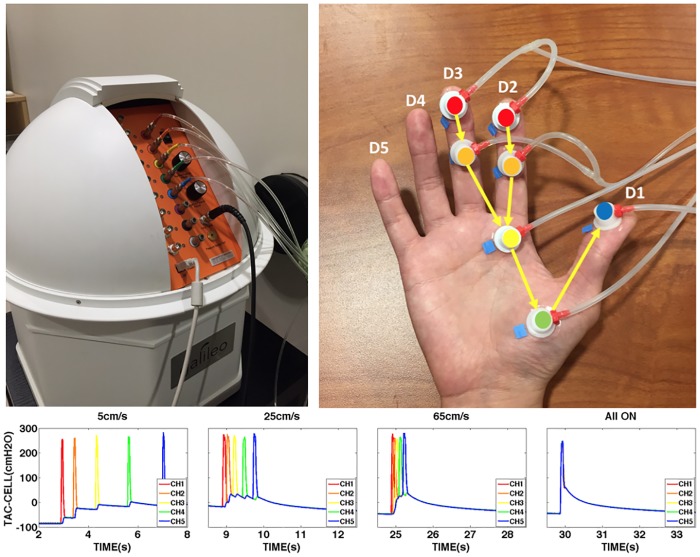
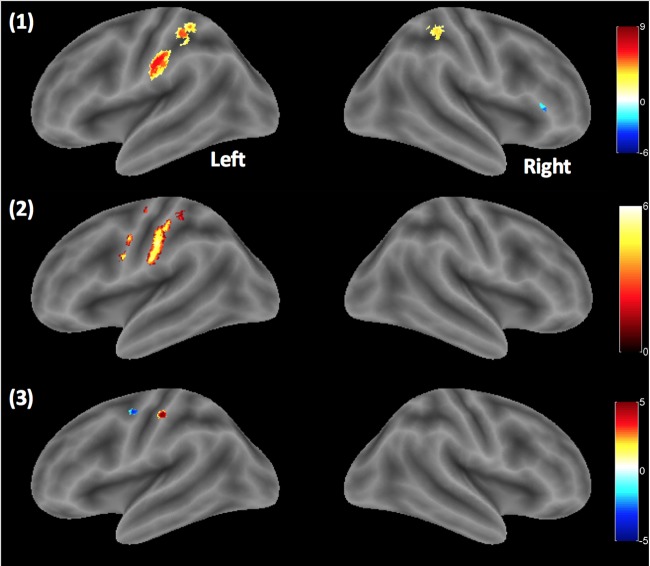
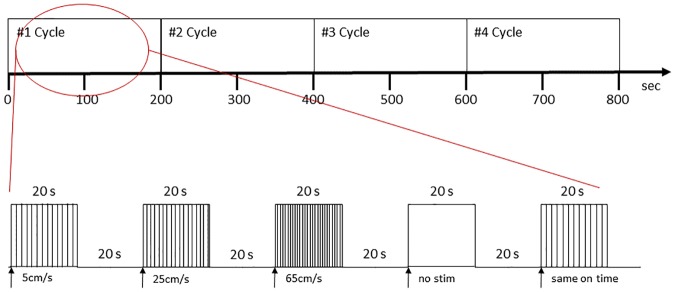
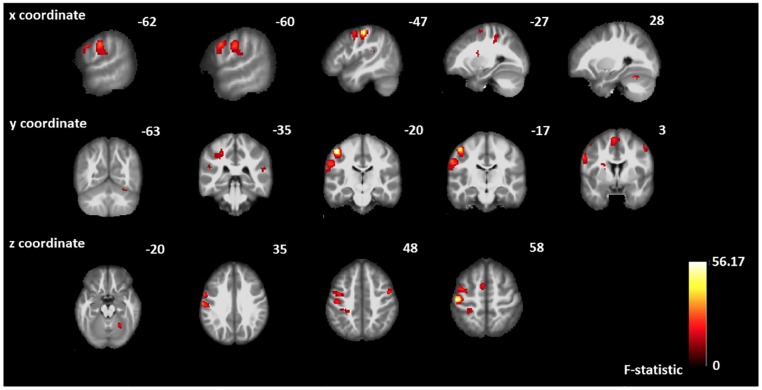
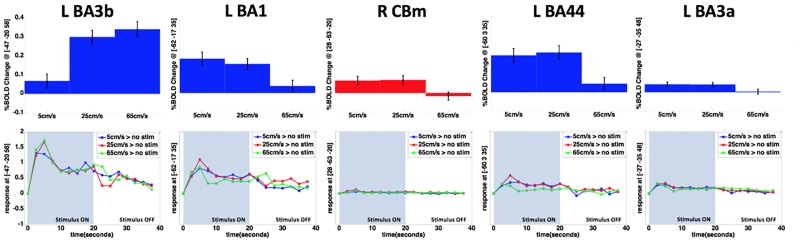
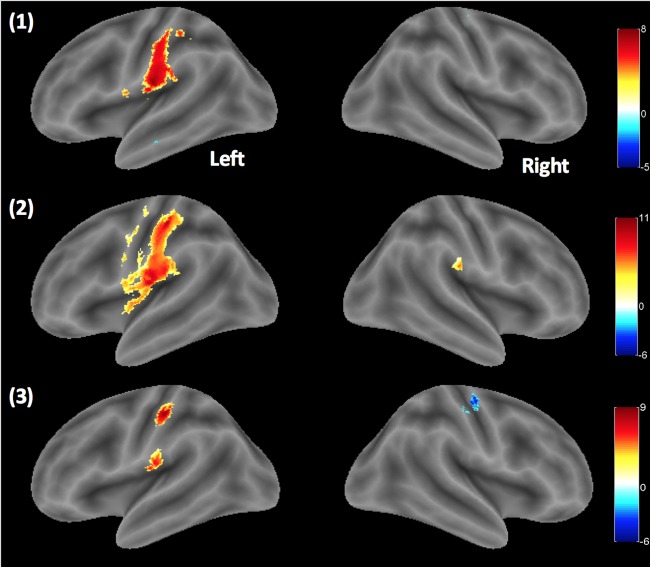
Neurons in the somatosensory cortex are exquisitely sensitive to mechanical stimulation of the skin surface. The location, velocity, direction, and adaptation of tactile stimuli on the skin's surface are discriminable features of somatosensory processing, however the representation and processing of dynamic tactile arrays in the human somatosensory cortex are poorly understood. The principal aim of this study was to map the relation between dynamic saltatory pneumatic stimuli at discrete traverse velocities on the glabrous hand and the resultant pattern of evoked BOLD response in the human brain. Moreover, we hypothesized that the hand representation in contralateral Brodmann Area (BA) 3b would show a significant dependence on stimulus velocity. Saltatory pneumatic pulses (60 ms duration, 9.5 ms rise/fall) were repetitively sequenced through a 7-channel TAC-Cell array at traverse velocities of 5, 25, and 65 cm/s on the glabrous hand initiated at the tips of D2 (index finger) and D3 (middle finger) and sequenced towards the D1 (thumb). The resulting hemodynamic response was sampled during 3 functional MRI scans (BOLD) in 20 neurotypical right-handed adults at 3T. Results from each subject were inserted to the one-way ANOVA within-subjects and one sample t-test to evaluate the group main effect of all three velocities stimuli and each of three different velocities, respectively. The stimulus evoked BOLD response revealed a dynamic representation of saltatory pneumotactile stimulus velocity in a network consisting of the contralateral primary hand somatosensory cortex (BA3b), associated primary motor cortex (BA4), posterior insula, and ipsilateral deep cerebellum. The spatial extent of this network was greatest at the 5 and 25 cm/s pneumotactile stimulus velocities.
体感皮层中的神经元对皮肤表面的机械刺激极为敏感。皮肤表面触觉刺激的位置、速度、方向和适应性是体感处理的可辨别特征,然而,人类体感皮层中动态触觉阵列的表征和处理却知之甚少。本研究的主要目的是描绘在无毛手部以离散的横向速度施加的动态跳跃式气动刺激与人类大脑中诱发的血氧水平依赖(BOLD)反应模式之间的关系。此外,我们假设对侧布罗德曼区(BA)3b中的手部表征将显示出对刺激速度的显著依赖性。跳跃式气动脉冲(持续时间60毫秒,上升/下降时间9.5毫秒)通过一个7通道TAC-Cell阵列,以5、25和65厘米/秒的横向速度在无毛手部从食指(D2)和中指(D3)指尖开始向拇指(D1)依次重复施加。在3T场强下,对20名右利手的神经典型成年人进行3次功能磁共振成像扫描(BOLD),期间采集由此产生的血液动力学反应。将每个受试者的结果分别代入受试者内单因素方差分析和单样本t检验,以评估所有三种速度刺激的组主效应以及三种不同速度中的每一种的效应。刺激诱发的BOLD反应揭示了在一个由对侧初级手部体感皮层(BA3b)、相关初级运动皮层(BA4)、后岛叶和同侧深部小脑组成的网络中,跳跃式气动触觉刺激速度的动态表征。这个网络的空间范围在气动触觉刺激速度为5和25厘米/秒时最大。