Sanai Faisal M, Farah Taha, Albeladi Khalid, Batwa Faisal, Dahlan Yaser, Babatin Mohammed A, Al-Ashgar Hamad, AlMana Hadeel, Alsaad Khaled S, AlSwat Khalid, Aljumah Abdulrahman, AlTraif Ibrahim H, Kailani Bahaa E, Bzeizi Khalid I
Liver Disease Research Center, King Saud University, Riyadh, Saudi Arabia.
Gastroenterology Unit, Department of Medicine, King Abdulaziz Medical City, PO Box: 9515, Jeddah, 21423, Saudi Arabia.
BMC Gastroenterol. 2017 Aug 25;17(1):101. doi: 10.1186/s12876-017-0658-x.
We evaluated the diagnostic accuracy of aspartate aminotransferase (AST)-to-platelet ratio index (APRI), fibrosis-4 index (FIB-4), AST/alanine aminotransferase (ALT) ratio (AAR), and age-platelet index (API) for significant fibrosis (Metavir F2-4) in low-replicative (HBV DNA <20,000 IU/mL) chronic hepatitis B virus (HBV) patients.
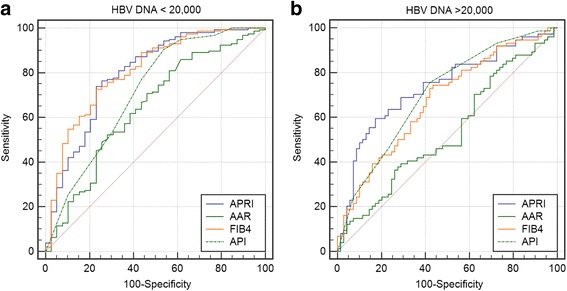
The sensitivity, specificity, and area under the receiver-operating characteristic curve (AUROC) of HBeAg-negative, low-replicative (n = 213) and high-replicative (HBV DNA ≥20,000 IU/mL, n = 153) patients was assessed.
Overall, 113 patients (30.9%) had F2-4 fibrosis. Of the low and high-replicative patients, 40 (18.8%) and 73 (47.7%) had F2-4, respectively (P < 0.0001). APRI ≥0.5 less frequently identified F2-4 fibrosis in low vs. high-replicative patients (48.7% vs. 69.6%, P = 0.032) and AAR identified it more frequently in low-replicative patients (37.5% vs. 19.4%, P = 0.037). FIB-4 and API were not different (P > 0.05) for identifying F2-4 fibrosis in low and high-replicative patients. Higher specificities were seen at the lowest cut-offs in low vs. high-replicative states for APRI (≥0.5, 98% vs. 68.9%), AAR (84.3% vs. 76.6%), FIB-4 (≥1.45, 97.5% vs. 87.8%) and API (>4, 94.8% vs. 93.8%). At ROC-defined thresholds, APRI (≥0.33), AAR (≥0.93), FIB-4 (≥0.70) and API (>2) showed greater AUROCs for F2-4 diagnosis in low replicative (0.80, 0.62, 0.81 and 0.71, respectively) vs. high-replicative patients (0.73, 0.52, 0.67 and 0.69, respectively).
All 4 biomarkers in both, low and high-replicative HBV demonstrate modest accuracy for fibrosis diagnosis at conventional cut-offs. Lowering the cut-offs may increase the diagnostic relevance of these biomarkers, particularly for APRI and FIB-4 in low-replicative disease.
我们评估了天冬氨酸氨基转移酶(AST)与血小板比值指数(APRI)、纤维化-4指数(FIB-4)、AST/丙氨酸氨基转移酶(ALT)比值(AAR)以及年龄-血小板指数(API)对低复制(HBV DNA<20,000 IU/mL)慢性乙型肝炎病毒(HBV)患者显著纤维化(Metavir F2-4)的诊断准确性。
评估了HBeAg阴性、低复制(n = 213)和高复制(HBV DNA≥20,000 IU/mL,n = 153)患者的敏感性、特异性以及受试者工作特征曲线下面积(AUROC)。
总体而言,113例患者(30.9%)存在F2-4级纤维化。在低复制和高复制患者中,分别有40例(18.8%)和73例(47.7%)存在F2-4级纤维化(P<0.0001)。APRI≥0.5在低复制患者中识别F2-4级纤维化的频率低于高复制患者(48.7%对69.6%,P = 0.032),而AAR在低复制患者中识别F2-4级纤维化的频率更高(37.5%对19.4%,P = 0.037)。FIB-4和API在低复制和高复制患者中识别F2-4级纤维化方面无差异(P>0.05)。对于APRI(≥0.5,98%对68.9%)、AAR(84.3%对76.6%)、FIB-4(≥1.