Ding Zheyuan, Wang Shuangqing, Li Junjie, Wu Haocheng, Lu Qinbao, Wang Xinyi, Fu Tianyin, Liu Kui, Wu Chen
Department of Public Health Surveillance and Advisory, Zhejiang Provincial Center for Disease Control and Prevention, Hangzhou, Zhejiang Province, China.
Department of Infectious Disease Control, Quzhou Center for Disease Control and Prevention, Quzhou, Zhejiang Province, China.
Front Public Health. 2025 Jul 7;13:1606491. doi: 10.3389/fpubh.2025.1606491. eCollection 2025.
Syphilis remains one of the serious public health challenges in China and worldwide. This study aims to assess the potential independent risks associated with age, period, and birth cohort for the reported incidence of syphilis in Eastern China.
Data on all syphilis cases from 2005 to 2024 in Zhejiang Province in Eastern China were collected from the China Information System for Disease Control and Prevention. The Age-Period-Cohort (APC) model was used to analyze the effect coefficients, which were then converted into relative risks (RRs).
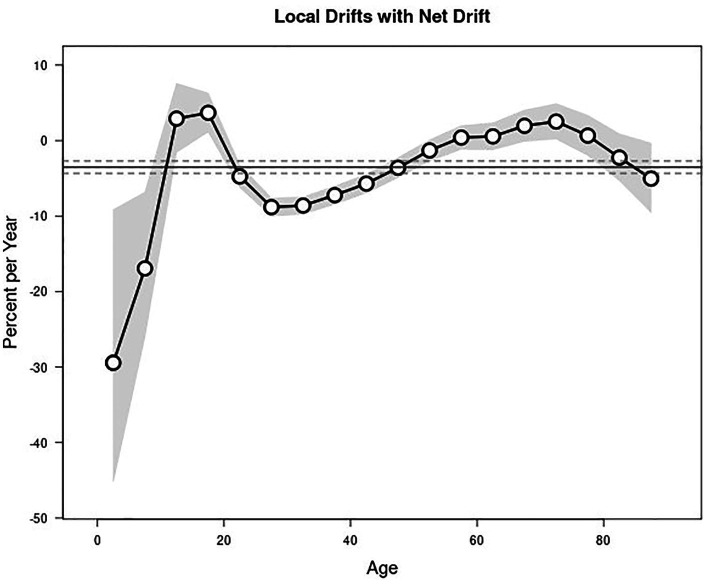
From 2005 to 2024, a total of 617,097 syphilis cases were reported in Zhejiang Province. The reported incidence of syphilis decreased by an average of -3.53% per year across all age groups (95% CI: -4.34, -2.70%). The age effect showed that the highest reported incidence was among individuals aged 20-24 years, with a relatively high rate also observed in those aged 60 years and above. The period effect indicated that compared with the reference group of 2010-2014 with the highest reported incidence risk, the risk in 2020-2024 was the lowest (RR = 0.48; 95% CI: 0.43, 0.54). The cohort effect shows that the risk decreased in later birth cohorts, with the highest reported incidence risk in the birth cohort of 1960-1964 (RR = 1.30; 95% CI: 1.08, 1.57) and the lowest risk in the birth cohort of 2020-2024 (RR = 0.00; 95% CI: 0.00, 0.18).
The reported incidence of syphilis in Zhejiang Province has shown an overall downward trend. The implementation of national syphilis control programs has achieved significant results. There is a need to strengthen the management of late-stage syphilis among older adults and enhance syphilis prevention and control efforts among adolescents.
梅毒在中国乃至全球仍然是严峻的公共卫生挑战之一。本研究旨在评估中国东部梅毒报告发病率与年龄、时期和出生队列相关的潜在独立风险。
从中国疾病预防控制信息系统收集了2005年至2024年中国东部浙江省所有梅毒病例的数据。采用年龄-时期-队列(APC)模型分析效应系数,然后将其转换为相对风险(RRs)。
2005年至2024年,浙江省共报告617,097例梅毒病例。所有年龄组的梅毒报告发病率平均每年下降-3.53%(95%CI:-4.34,-2.70%)。年龄效应表明,报告发病率最高的是20-24岁的人群,60岁及以上人群的发病率也相对较高。时期效应表明,与报告发病风险最高的2010-2014年参考组相比,2020-2024年的风险最低(RR = 0.48;95%CI:0.43,0.54)。队列效应表明,后期出生队列的风险降低,1960-1964年出生队列的报告发病风险最高(RR = 1.30;95%CI:1.08,1.57),2020-2024年出生队列的风险最低(RR = 0.00;95%CI:0.00,0.18)。
浙江省梅毒报告发病率总体呈下降趋势。国家梅毒控制项目的实施取得了显著成效。有必要加强对老年人晚期梅毒的管理,并加强青少年梅毒的防控工作。