Fischer Julius Clemens, Otten Vera, Kober Maike, Drees Christoph, Rosenbaum Marc, Schmickl Martina, Heidegger Simon, Beyaert Rudi, van Loo Geert, Li Xian Chang, Peschel Christian, Schmidt-Supprian Marc, Haas Tobias, Spoerl Silvia, Poeck Hendrik
Klinik und Poliklinik für Innere Medizin III, Klinikum rechts der Isar, Technische Universität, 81675 Munich, Germany.
Institut für Klinische Chemie und Pathobiochemie, Klinikum rechts der Isar, Technische Universität, 81675 Munich, Germany.
J Immunol. 2017 Oct 1;199(7):2356-2365. doi: 10.4049/jimmunol.1602102. Epub 2017 Aug 25.
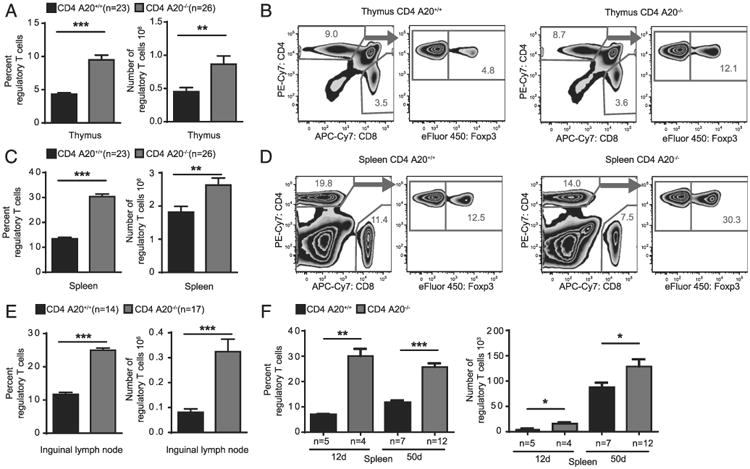
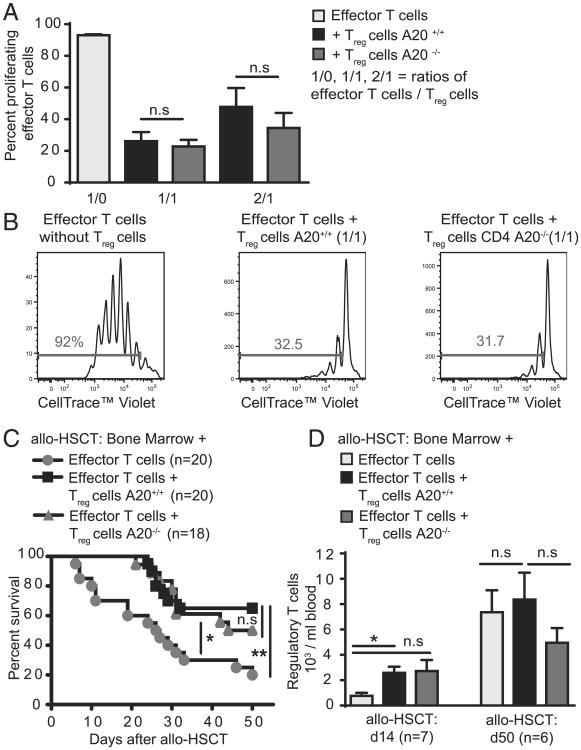
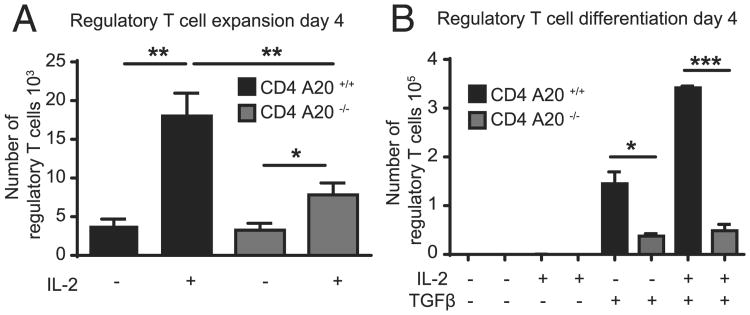
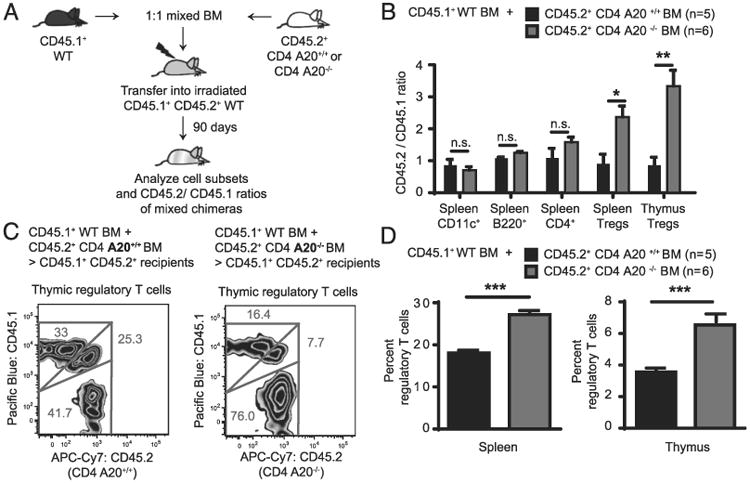
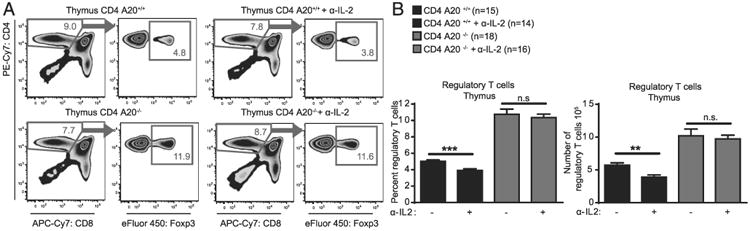
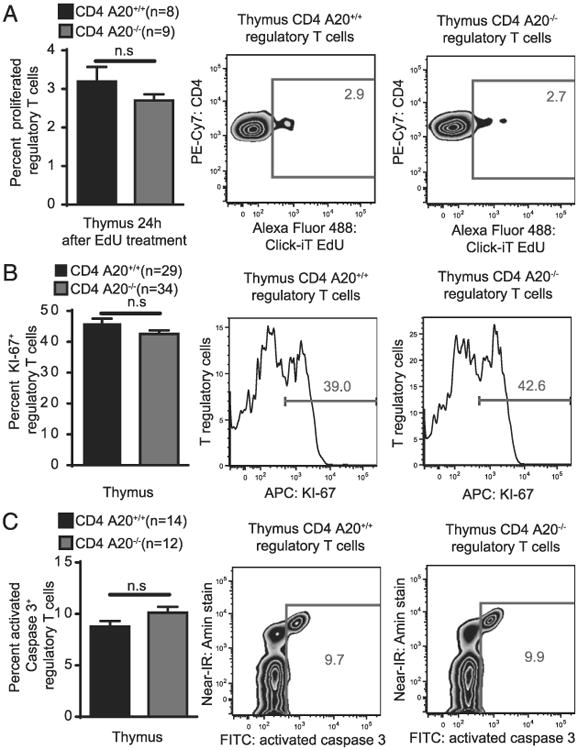
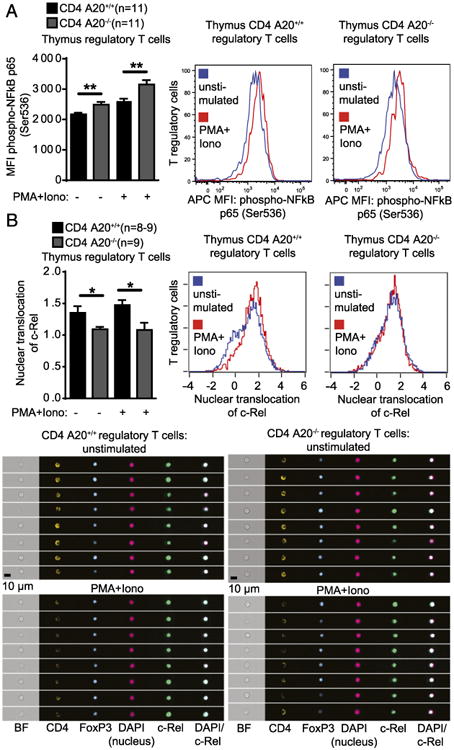
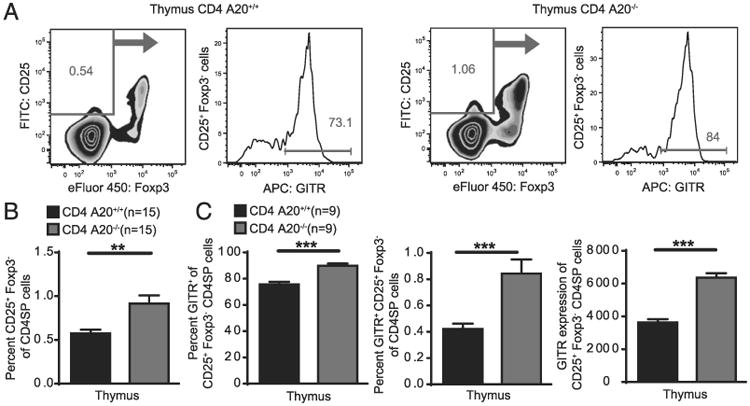
Maintaining immune tolerance requires the production of Foxp3-expressing regulatory T (T) cells in the thymus. Activation of NF-κB transcription factors is critically required for T cell development, partly via initiating Foxp3 expression. NF-κB activation is controlled by a negative feedback regulation through the ubiquitin editing enzyme A20, which reduces proinflammatory signaling in myeloid cells and B cells. In naive CD4 T cells, A20 prevents kinase RIPK3-dependent necroptosis. Using mice deficient for A20 in T lineage cells, we show that thymic and peripheral T cell compartments are quantitatively enlarged because of a cell-intrinsic developmental advantage of A20-deficient thymic T differentiation. A20-deficient thymic T cells exhibit reduced dependence on IL-2 but unchanged rates of proliferation and apoptosis. Activation of the NF-κB transcription factor RelA was enhanced, whereas nuclear translocation of c-Rel was decreased in A20-deficient thymic T cells. Furthermore, we found that the increase in T cells in T cell-specific A20-deficient mice was already observed in CD4 single-positive CD25 GITR Foxp3 thymic T cell progenitors. T cell precursors expressed high levels of the tumor necrosis factor receptor superfamily molecule GITR, whose stimulation is closely linked to thymic T cell development. A20-deficient T cells efficiently suppressed effector T cell-mediated graft-versus-host disease after allogeneic hematopoietic stem cell transplantation, suggesting normal suppressive function. Holding thymic production of natural T cells in check, A20 thus integrates T cell activity and increased effector T cell survival into an efficient CD4 T cell response.
维持免疫耐受需要在胸腺中产生表达叉头框蛋白3(Foxp3)的调节性T(Treg)细胞。核因子κB(NF-κB)转录因子的激活对于T细胞发育至关重要,部分是通过启动Foxp3表达来实现的。NF-κB的激活由泛素编辑酶A20通过负反馈调节来控制,A20可减少髓样细胞和B细胞中的促炎信号。在初始CD4 T细胞中,A20可防止激酶RIPK3依赖性坏死性凋亡。利用T细胞谱系中缺乏A20的小鼠,我们发现胸腺和外周T细胞区室在数量上有所扩大,这是因为A20缺陷的胸腺T细胞分化具有细胞内在的发育优势。A20缺陷的胸腺T细胞对白细胞介素-2的依赖性降低,但增殖和凋亡率不变。在A20缺陷的胸腺T细胞中,NF-κB转录因子RelA的激活增强,而c-Rel的核转位减少。此外,我们发现在CD4单阳性CD25 GITR Foxp3胸腺T细胞祖细胞中已经观察到T细胞特异性A20缺陷小鼠中T细胞的增加。T细胞前体表达高水平的肿瘤坏死因子受体超家族分子糖皮质激素诱导的肿瘤坏死因子受体(GITR),其刺激与胸腺T细胞发育密切相关。在异基因造血干细胞移植后,A20缺陷的T细胞能有效抑制效应T细胞介导的移植物抗宿主病,表明其具有正常的抑制功能。因此,A20通过控制胸腺中天然T细胞的产生,将T细胞活性和效应T细胞存活率的增加整合到有效的CD4 T细胞反应中。