Gelberg Lillian, Andersen Ronald M, Rico Melvin W, Vahidi Mani, Natera Rey Guillermina, Shoptaw Steve, Leake Barbara D, Serota Martin, Singleton Kyle, Baumeister Sebastian E
Department of Family Medicine, David Geffen School of Medicine at UCLA, Los Angeles, CA, United States; University of California Los Angeles, Fielding School of Public Health, Los Angeles, CA, United States.
University of California Los Angeles, Fielding School of Public Health, Los Angeles, CA, United States.
Drug Alcohol Depend. 2017 Oct 1;179:433-440. doi: 10.1016/j.drugalcdep.2017.04.022. Epub 2017 Jun 13.
QUIT is the only primary care-based brief intervention that has previously shown efficacy for reducing risky drug use in the United States (Gelberg et al., 2015). This pilot study replicated the QUIT protocol in one of the five original QUIT clinics primarily serving Latinos.
Single-blind, two-arm, randomized controlled trial of patients enrolled from March-October 2013 with 3-month follow-up.
Primary care waiting room of a federally qualified health center (FQHC) in East Los Angeles.
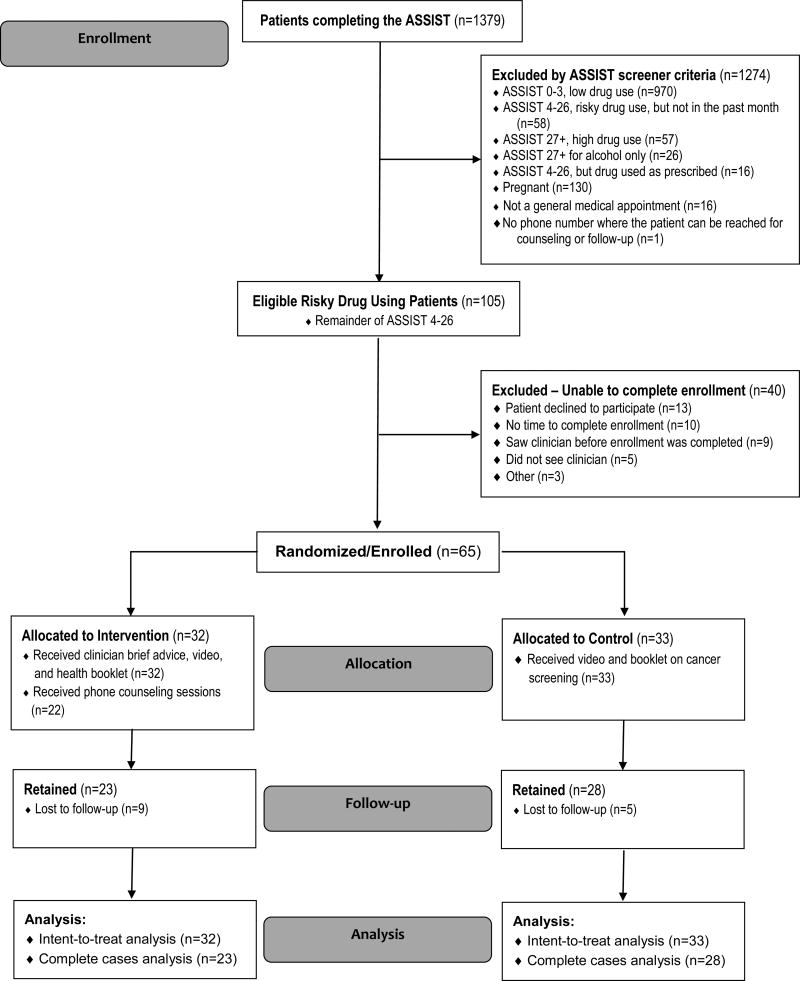
Adult patients with risky drug use (4-26 on the computerized WHO ASSIST): 65 patients (32 intervention, 33 control); 51 (78%) completed follow-up; mean age 30.8 years; 59% male; 94% Latino.
Intervention patients received: 1) brief (typically 3-4 minutes) clinician advice to quit/reduce their risky drug use, 2) video doctor message reinforcing the clinician's advice, 3) health education booklet, and 4) up to two 20-30 minute follow-up telephone drug use reduction coaching sessions. Control patients received usual care and cancer screening information. Primary outcome was reduction in number of days of drug use in past 30days of the highest scoring drug (HSD) on the baseline ASSIST, from baseline to 3-month follow-up.
Controls reported unchanged HSD use between baseline and 3-month follow-up whereas Intervention patients reported reducing their use by 40% (p<0.001). In an intent-to-treat linear regression analysis, intervention patients reduced past month HSD use by 4.5 more days than controls (p<0.042, 95% CI: 0.2, 8.7). Similar significant results were found using a complete sample regression analysis: 5.2 days (p<0.03, 95% CI: 0.5, 9.9). Additionally, on logistic regression analysis of test results from 47 urine samples at follow-up, intervention patients were less likely than controls to test HSD positive (p<0.05; OR: 0.10, 95% CI: 0.01, 0.99).
Findings support the efficacy of the QUIT brief intervention for reducing risky drug use.
QUIT是美国唯一一项基于初级保健的简短干预措施,此前已证明其在减少危险药物使用方面具有有效性(Gelberg等人,2015年)。这项试点研究在最初的五个主要服务于拉丁裔的QUIT诊所之一中重复了QUIT方案。
对2013年3月至10月招募的患者进行单盲、双臂随机对照试验,并进行3个月的随访。
东洛杉矶一家联邦合格健康中心(FQHC)的初级保健候诊室。
有危险药物使用行为的成年患者(计算机化的世界卫生组织药物滥用筛查工具评分为4 - 26):65名患者(32名干预组,33名对照组);51名(78%)完成随访;平均年龄30.8岁;59%为男性;94%为拉丁裔。
干预组患者接受:1)临床医生简短(通常3 - 4分钟)的戒烟/减少危险药物使用建议,2)强化临床医生建议的视频医生信息,3)健康教育手册,以及4)最多两次20 - 30分钟的随访电话药物使用减少指导课程。对照组患者接受常规护理和癌症筛查信息。主要结局是从基线到3个月随访期间,基线ASSIST上得分最高的药物(HSD)在过去30天内的药物使用天数减少。
对照组报告基线和3个月随访之间HSD使用情况未变,而干预组患者报告其使用量减少了40%(p<0.001)。在一项意向性分析线性回归中,干预组患者过去一个月的HSD使用天数比对照组减少了4.5天(p<0.042,95%置信区间:0.2,8.7)。使用完整样本回归分析也发现了类似的显著结果:5.2天(p<0.03,95%置信区间:0.5,9.9)。此外,在对随访时47份尿液样本检测结果的逻辑回归分析中,干预组患者检测HSD呈阳性的可能性低于对照组(p<0.05;比值比:0.10,95%置信区间:0.01,0.99)。
研究结果支持QUIT简短干预在减少危险药物使用方面的有效性。