Institute of Health & Society, Baddiley-Clark Building, Newcastle University, Richardson Road, Newcastle upon Tyne, NE2 4AX, UK.
Trials. 2012 Sep 24;13:174. doi: 10.1186/1745-6215-13-174.
Risky drinking in pregnancy by UK women is likely to result in many alcohol-exposed pregnancies. Studies from the USA suggest that brief intervention has promise for alcohol risk reduction in antenatal care. However, further research is needed to establish whether this evidence from the USA is applicable to the UK. This pilot study aims to investigate whether pregnant women can be recruited and retained in a randomized controlled trial of brief intervention aimed at reducing risky drinking in women receiving antenatal care.
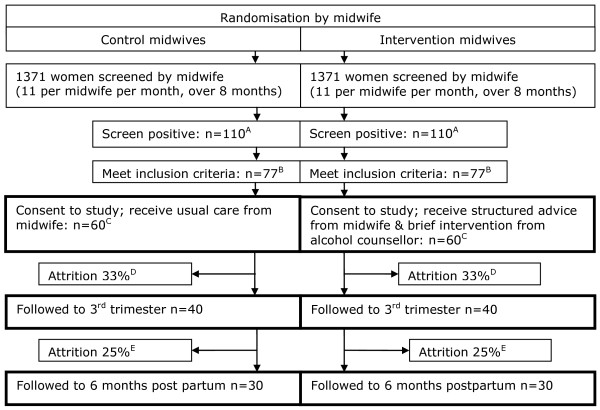
The trial will rehearse the parallel-group, non-blinded design and procedures of a subsequent definitive trial. Over 8 months, women aged 18 years and over (target number 2,742) attending their booking appointment with a community midwife (n = 31) in north-east England will be screened for alcohol consumption using the consumption questions of the Alcohol Use Disorders Identification Test (AUDIT-C). Those screening positive, without a history of substance use or alcohol dependence, with no pregnancy complication, and able to give informed consent, will be invited to participate in the trial (target number 120). Midwives will be randomized in a 1:1 ratio to deliver either treatment as usual (control) or structured brief advice and referral for a 20-minute motivational interviewing session with an alcohol health worker (intervention). As well as demographic and health information, baseline measures will include two 7-day time line follow-back questionnaires and the EuroQoL EQ-5D-3 L questionnaire. Measures will be repeated in telephone follow-ups in the third trimester and at 6 months post-partum, when a questionnaire on use of National Health Service and social care resources will also be completed. Information on pregnancy outcomes and stillbirths will be accessed from central health service records before the follow-ups. Primary outcomes will be rates of eligibility, recruitment, intervention delivery, and retention in the study population, to inform power calculations for a definitive trial. The health-economics component will establish how cost-effectiveness will be assessed, and examine which data on health service resource use should be collected in a main trial. Participants' views on instruments and procedures will be sought to confirm their acceptability.
The study will produce a full trial protocol with robust sample-size calculations to extend evidence on effectiveness of screening and brief intervention.
Current Controlled Trials ISRCTN43218782.
英国女性的孕期危险饮酒行为可能会导致许多酒精暴露的妊娠。来自美国的研究表明,在产前护理中,简短干预对减少酒精风险有一定作用。然而,需要进一步研究以确定美国的这一证据是否适用于英国。本研究旨在探讨在接受产前护理的孕妇中,是否可以招募和保留在一项针对减少危险饮酒的简短干预的随机对照试验中。
该试验将重复后续确定试验的平行组、非盲法设计和程序。在 8 个月的时间里,在英格兰东北部接受社区助产士预约检查的 18 岁及以上(目标人数 2742 人)的女性将使用酒精使用障碍识别测试(AUDIT-C)的饮酒量问题进行筛查。那些筛查阳性、无物质使用或酒精依赖史、无妊娠并发症且能够知情同意的女性将被邀请参加试验(目标人数 120 人)。助产士将以 1:1 的比例随机分配接受常规治疗(对照组)或结构化简短建议,并转介给酒精健康工作者进行 20 分钟的动机性访谈(干预组)。除了人口统计学和健康信息外,基线测量还包括两份 7 天时间线随访问卷和 EuroQoL EQ-5D-3 L 问卷。在第三个孕期和产后 6 个月的电话随访中,将重复测量这些指标,届时还将完成一份关于使用国民保健服务和社会保健资源的问卷。在随访之前,将从中央卫生服务记录中获取妊娠结局和死产的信息。主要结局将是研究人群的资格、招募、干预实施和保留率,为确定试验的功效计算提供信息。健康经济学部分将确定如何评估成本效益,并研究在主要试验中应收集哪些关于卫生服务资源使用的数据。将征求参与者对仪器和程序的意见,以确认其可接受性。
该研究将制定一份完整的试验方案,并进行稳健的样本量计算,以扩展关于筛查和简短干预效果的证据。
当前对照试验 ISRCTN43218782。