Dep. of Gastroenterology and Hepatology, Academic Medical Center, Amsterdam, The Netherlands; Dep. of Experimental Immunology, Academic Medical Center, Amsterdam, The Netherlands.
Dep. of Gastroenterology and Hepatology, Academic Medical Center, Amsterdam, The Netherlands.
Antiviral Res. 2017 Oct;146:139-145. doi: 10.1016/j.antiviral.2017.08.016. Epub 2017 Aug 24.
BACKGROUND&AIMS: With the introduction of DAA's, the majority of treated chronic hepatitis C patients (CHC) achieve a viral cure. The exact mechanisms by which the virus is cleared after successful therapy, is still unknown. The aim was to assess the role of the immune system and miRNA levels in acquiring a sustained virological response after DAA treatment in CHC patients with and without prior RG-101 (anti-miR-122) dosing.
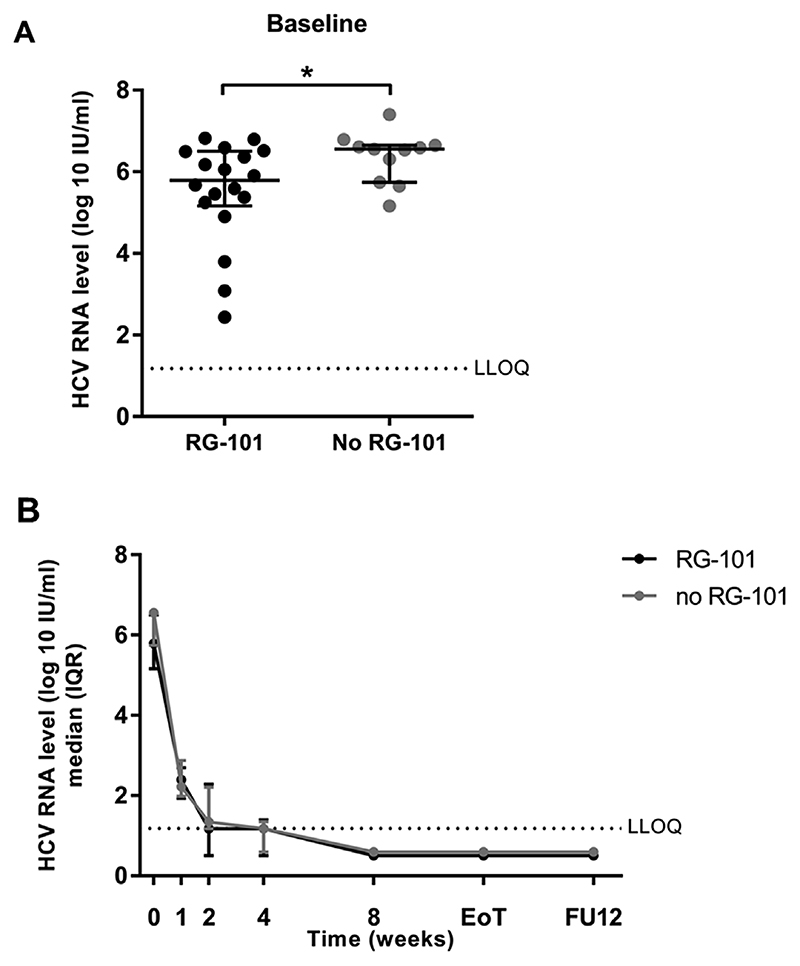
In this multicenter, investigator-initiated study, 29 patients with hepatitis C virus (HCV) genotype 1 (n = 11), 3 (n = 17), or 4 (n = 1) infection were treated with sofosbuvir and daclatasvir ± ribavirin. 18 patients were previously treated with RG-101. IP-10 levels were measured by ELISA. Ex vivo HCV-specific T cell responses were quantified in IFN-γ-ELISpot assays. Plasma levels of miR-122 were measured by qPCR.
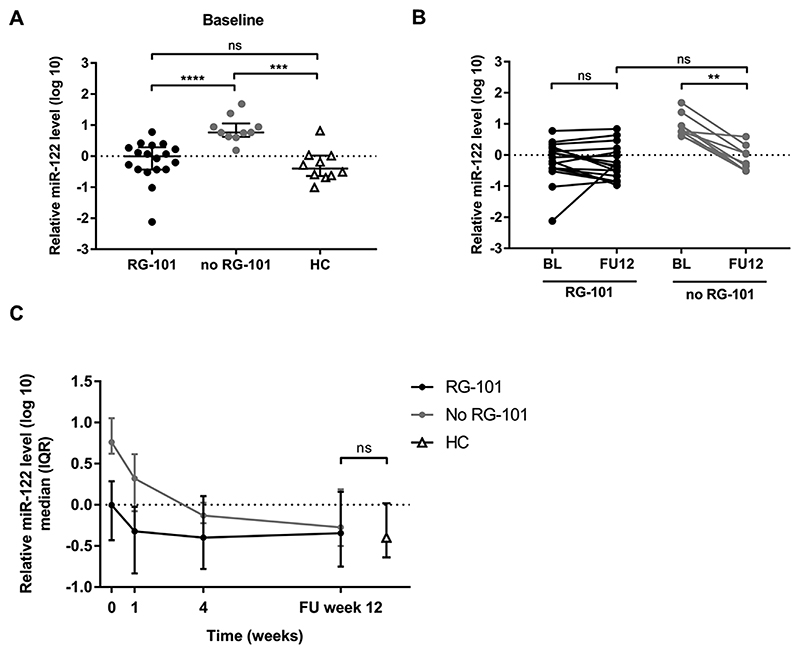
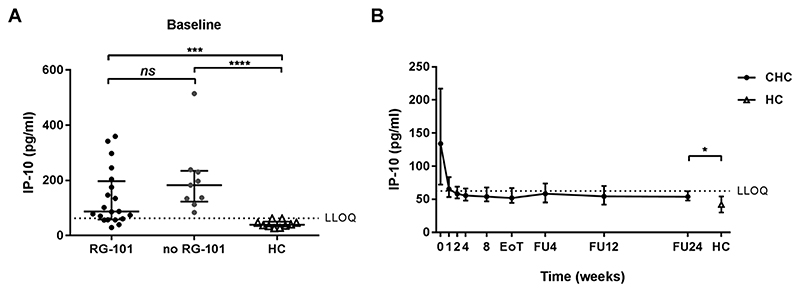
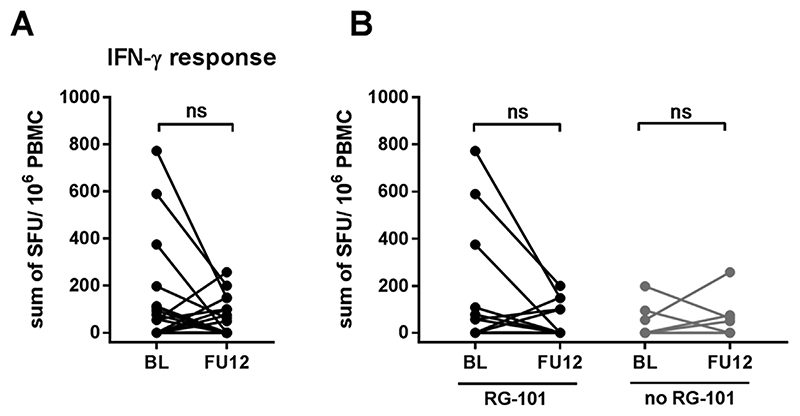
All patients had an SVR12. IP-10 levels rapidly declined during treatment, but were still elevated 24 weeks after treatment as compared to healthy controls (median 53.82 and 39.4 pg/mL, p = 0.02). Functional IFN-γ HCV-specific T cell responses did not change by week 12 of follow-up (77.5 versus 125 SFU/10 PBMC, p = 0.46). At follow-up week 12, there was no difference in plasma miR-122 levels between healthy controls and patients with and without prior RG-101 dosing.
Our data shows that successful treatment of CHC patients with and without prior RG-101 dosing results in reduction of broad immune activation, and normalisation of miR-122 levels (EudraCT: 2014-002808-25).
EudraCT: 2014-002808-25.
随着直接作用抗病毒药物(DAA)的引入,大多数接受慢性丙型肝炎(CHC)治疗的患者实现了病毒学治愈。然而,病毒在成功治疗后被清除的确切机制仍不清楚。本研究旨在评估免疫状态和 miRNA 水平在接受 DAA 治疗的 CHC 患者中获得持续病毒学应答(SVR12)的作用,这些患者之前是否接受过 RG-101(抗 miR-122)治疗。
在这项多中心、研究者发起的研究中,29 例丙型肝炎病毒(HCV)基因型 1(n=11)、3(n=17)或 4(n=1)感染患者接受了索磷布韦和达卡他韦联合或不联合利巴韦林治疗。18 例患者之前接受过 RG-101 治疗。通过 ELISA 法检测 IP-10 水平。通过 IFN-γ-ELISpot 测定定量检测 HCV 特异性 T 细胞反应。通过 qPCR 法检测血浆 miR-122 水平。
所有患者均获得 SVR12。治疗期间 IP-10 水平迅速下降,但治疗后 24 周仍高于健康对照组(中位数分别为 53.82 和 39.4 pg/mL,p=0.02)。随访 12 周时,IFN-γ HCV 特异性 T 细胞反应无变化(77.5 与 125 SFU/10 PBMC,p=0.46)。在随访 12 周时,与健康对照组相比,之前接受过 RG-101 治疗和未接受 RG-101 治疗的患者之间血浆 miR-122 水平无差异。
我们的数据表明,成功治疗接受和未接受 RG-101 治疗的 CHC 患者均导致广泛免疫激活减少,并使 miR-122 水平正常化(EudraCT:2014-002808-25)。
EudraCT:2014-002808-25。