Kim Ju-Wan, Kang Hee-Ju, Bae Kyung-Yeol, Kim Sung-Wan, Oh Hyun-Kyong, Kim Min-Gon, Kim Jae-Min
Department of Psychiatry, Chonnam National University Medical School, Advanced Photonics Research Institute, Gwangju Institute of Science & Technology (GIST), Gwangju, Republic of Korea.
Psychiatry Investig. 2017 Jul;14(4):513-517. doi: 10.4306/pi.2017.14.4.513. Epub 2017 Jul 11.
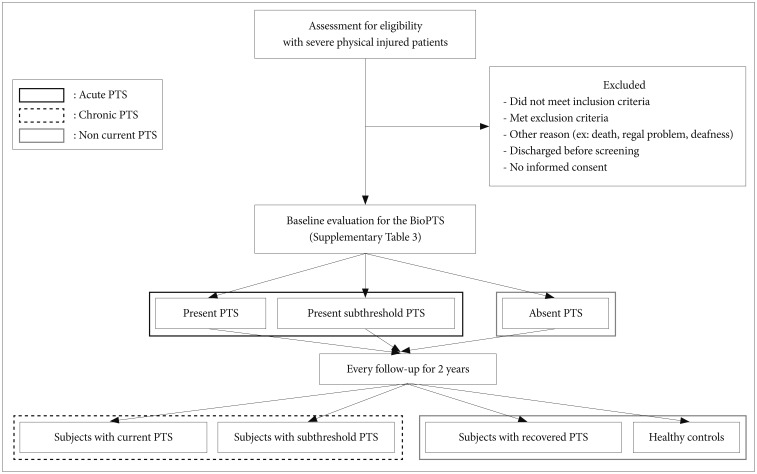
Severe physical injury is a leading cause of posttraumatic syndrome (PTS). This is to develop a biomarker-based diagnostic algorithm for posttraumatic syndrome (BioPTS) study. This is a 2-year longitudinal cohort study assessing patients who were hospitalized beginning in 2015 at Chonnam National University Hospital in Gwangju, Korea, after experiencing severe physical injuries. Baseline evaluations were made during the acute phase (within 1 month) of the physical injury and included extensive information on sociodemographic and clinical variables as well as a list of biomarkers. All participants will be followed up for 2 years, and the diagnostic and predictive validities of various biomarkers for PTS will be estimated. The BioPTS study will develop the most accurate models for the diagnosis and prediction of PTS, and will contribute to existing research regarding the complex relationships between severe physical injury and psychological issues.
严重身体损伤是创伤后综合征(PTS)的主要原因。本研究旨在开发一种基于生物标志物的创伤后综合征诊断算法(BioPTS)。这是一项为期2年的纵向队列研究,评估2015年起在韩国光州全南国立大学医院因严重身体损伤而住院的患者。在身体损伤的急性期(1个月内)进行基线评估,包括社会人口统计学和临床变量的广泛信息以及一份生物标志物清单。所有参与者将接受2年的随访,并评估各种生物标志物对PTS的诊断和预测效度。BioPTS研究将开发用于诊断和预测PTS的最准确模型,并将为有关严重身体损伤与心理问题之间复杂关系的现有研究做出贡献。