Zhang J W, Liu W W, McCaffrey Timothy A, He X Q, Liang W Y, Chen X H, Feng X R, Fu Sidney W, Liu M L
Department of Geriatrics, Peking University First Hospital, Beijing, China.
Department of Medicine, George Washington University Medical Center, Washington, DC, USA.
Clin Interv Aging. 2017 Aug 10;12:1271-1279. doi: 10.2147/CIA.S138592. eCollection 2017.
Previous studies have illustrated the link between high on-aspirin platelet reactivity (HAPR) with increasing thrombotic risks. The aim of our study was to investigate relative risk factors of HAPR in elderly patients with coronary artery disease.
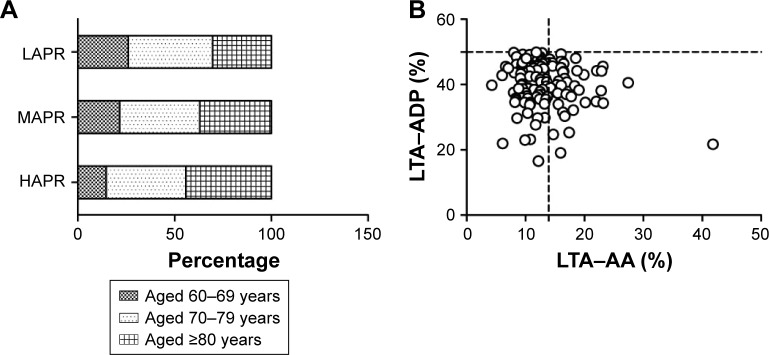
Elderly, hospitalized coronary artery disease patients on regular aspirin treatment were enrolled from January 2014 to September 2016. Medical records of each patient were collected, including demographic information, cardiovascular risk factors, concomitant drugs and routine biological parameters. Arachidonic acid (AA, 0.5 mg/mL) and adenosine diphosphate (ADP, 5 µmol/L) induced platelet aggregation were measured via light transmission assay (LTA) to evaluate antiplatelet responses, referred as LTA-AA and LTA-ADP.
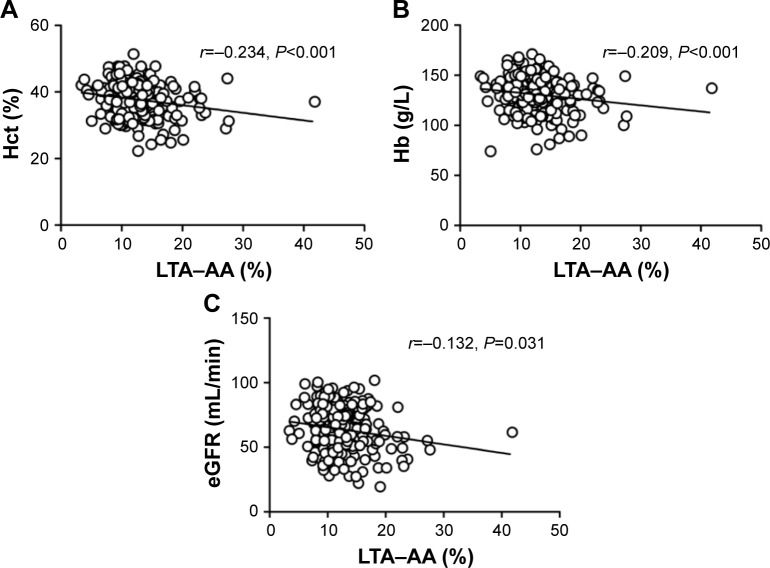
A total of 275 elderly patients were included, with mean age of 77.2±8.1 years, and males accounted for 81.8%. HAPR was defined as LTA-AA in the upper quartile of the enrolled population. HAPR patients tended to have lower renal function (=0.052). Higher serum uric acid (SUA) level, as well as lower platelet count, hemoglobin and hematocrit were observed in HAPR patients, with a higher proportion of diuretics use (<0.05). Multivariate analysis revealed that SUA (OR: 1.004, 95% CI: 1.000-1.007, =0.048), platelet count (OR: 0.994, 95% CI: 0.989-1.000, =0.045), hematocrit (OR: 0.921, 95% CI: 0.864-0.981, =0.011) and concomitant P2Y12 receptor inhibitors use (OR: 1.965, 95% CI: 1.075-3.592, =0.028) were correlated with HAPR. Spearman's correlation analysis demonstrated an inverse association of LTA-AA with hematocrit (=-0.234, <0.001), hemoglobin (=-0.209, <0.001) and estimated glomerular filtration rate (=-0.132, =0.031).
SUA, platelet count, hematocrit and P2Y12 receptor inhibitors use were independently correlated with HAPR. These parameters might provide novel therapeutic targets for optimizing antiplatelet therapy.
既往研究已阐明高阿司匹林血小板反应性(HAPR)与血栓形成风险增加之间的联系。我们研究的目的是调查老年冠心病患者中HAPR的相关危险因素。
选取2014年1月至2016年9月期间住院的接受常规阿司匹林治疗的老年冠心病患者。收集每位患者的病历,包括人口统计学信息、心血管危险因素、合并用药及常规生物学参数。通过光透射比浊法(LTA)测定花生四烯酸(AA,0.5mg/mL)和二磷酸腺苷(ADP,5μmol/L)诱导的血小板聚集,以评估抗血小板反应,分别记为LTA - AA和LTA - ADP。
共纳入275例老年患者,平均年龄77.2±8.1岁,男性占81.8%。HAPR定义为LTA - AA处于所纳入人群的上四分位数。HAPR患者的肾功能往往较低(P = 0.052)。HAPR患者的血清尿酸(SUA)水平较高,血小板计数、血红蛋白和血细胞比容较低,使用利尿剂的比例较高(P < 0.05)。多因素分析显示,SUA(比值比:1.004,95%置信区间:1.000 - 1.007,P = 0.048)、血小板计数(比值比:0.994,95%置信区间:0.989 - 1.000,P = 0.045)、血细胞比容(比值比:0.921,95%置信区间:0.864 - 0.981,P = 0.011)以及合并使用P2Y12受体抑制剂(比值比:1.965,95%置信区间:1.075 - 3.592,P = 0.028)与HAPR相关。Spearman相关性分析显示LTA - AA与血细胞比容(r = - 0.234,P < 0.001)、血红蛋白(r = - 0.209,P < 0.001)和估计肾小球滤过率(r = - 0.132,P = 0.031)呈负相关。
SUA、血小板计数、血细胞比容及P2Y12受体抑制剂的使用与HAPR独立相关。这些参数可能为优化抗血小板治疗提供新的治疗靶点。