Huang Bing, Zhu Huiwen, Zhou Yiming, Liu Xing, Ma Lan
The State Key Laboratory of Medical Neurobiology, School of Basic Medical Sciences and the Institutes of Brain Science, and Department of Translational Neuroscience, Shanghai Pudong Hospital, Fudan UniversityShanghai, China.
Front Neural Circuits. 2017 Aug 10;11:53. doi: 10.3389/fncir.2017.00053. eCollection 2017.
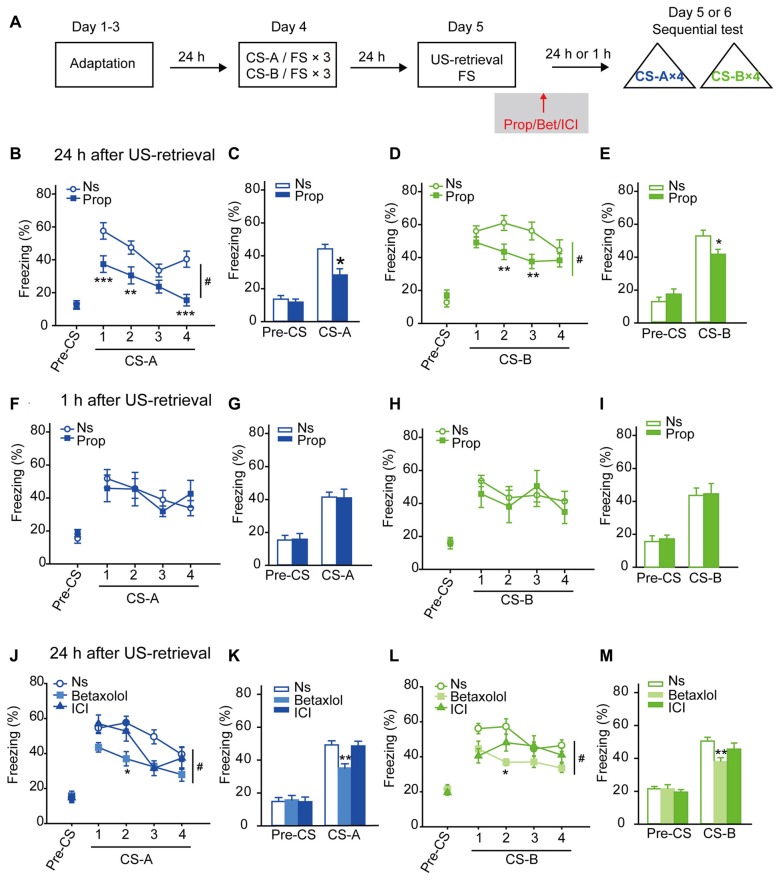
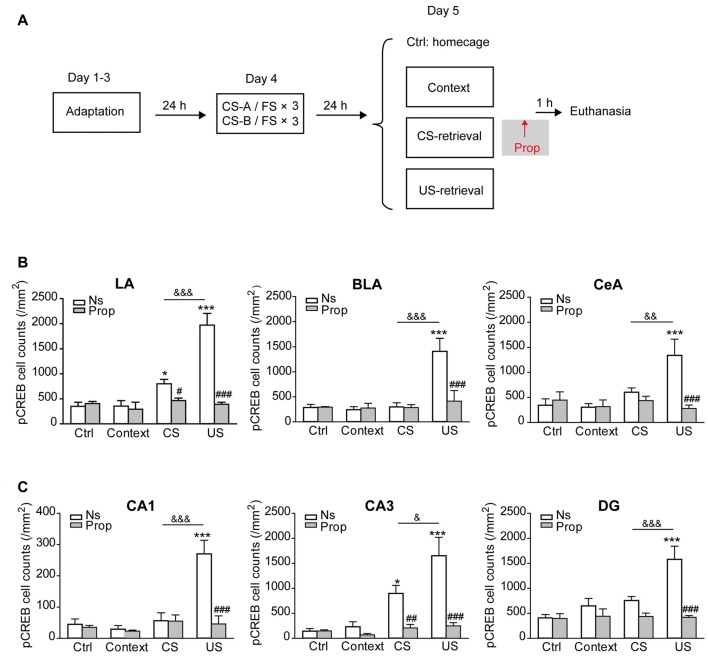
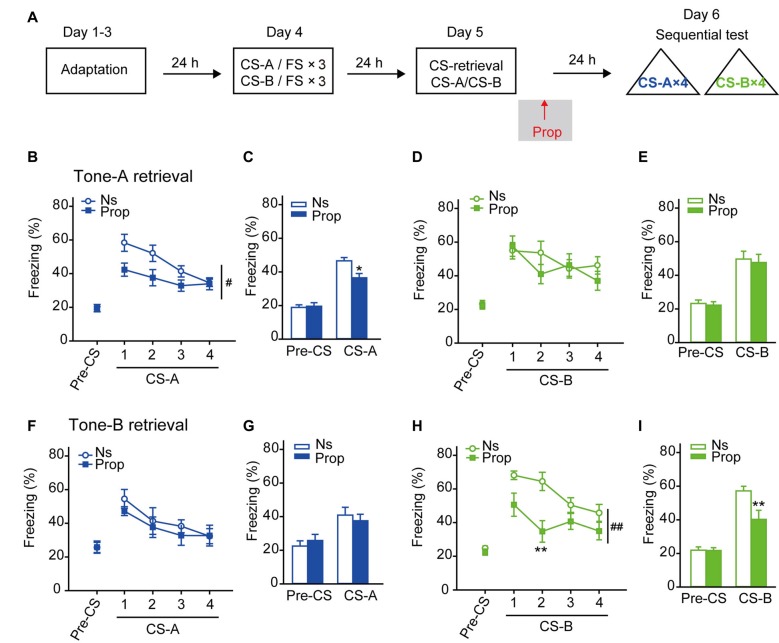
Consolidated long-term fear memories become labile and reconsolidated upon retrieval by the presentation of conditioned stimulus (CS) or unconditioned stimulus (US). Whether CS-retrieval or US-retrieval will trigger different memory reconsolidation processes is unknown. In this study, we introduced a sequential fear conditioning paradigm in which footshock (FS) was paired with two distinct sounds (CS-A and CS-B). The treatment with propranolol, a β-adrenergic receptor (β-AR) antagonist, after US (FS)-retrieval impaired freezing behavior evoked by either CS-A or CS-B. Betaxolol, a selective β1-AR antagonist, showed similar effects. However, propranolol treatment after retrieval by one CS (e.g., CS-A) only inhibited freezing behavior evoked by the same CS (i.e., CS-A), not the other CS (CS-B). These data suggest that β-AR is critically involved in reconsolidation of fear memory triggered by US- and CS-retrieval, whereas β-AR blockade after US-retrieval disrupts more CS-US associations than CS-retrieval does. Furthermore, significant CREB activation in almost the whole amygdala and hippocampus was observed after US-retrieval, but CS-retrieval only stimulated CREB activation in the lateral amygdala and the CA3 of hippocampus. In addition, propranolol treatment suppressed memory retrieval-induced CREB activation. These data indicate that US-retrieval activates more memory traces than CS-retrieval does, leading to memory reconsolidation of more CS-US associations.
通过呈现条件刺激(CS)或非条件刺激(US)进行检索时,巩固的长期恐惧记忆会变得不稳定并重新巩固。CS检索或US检索是否会触发不同的记忆重新巩固过程尚不清楚。在本研究中,我们引入了一种序列恐惧条件范式,其中足部电击(FS)与两种不同的声音(CS-A和CS-B)配对。在US(FS)检索后用β-肾上腺素能受体(β-AR)拮抗剂普萘洛尔治疗会损害由CS-A或CS-B诱发的僵住行为。选择性β1-AR拮抗剂倍他洛尔也显示出类似的效果。然而,仅在由一个CS(例如CS-A)检索后用普萘洛尔治疗只会抑制由相同CS(即CS-A)诱发的僵住行为,而不会抑制另一个CS(CS-B)诱发的僵住行为。这些数据表明,β-AR在由US检索和CS检索触发的恐惧记忆重新巩固中起关键作用,而US检索后β-AR阻断比CS检索破坏更多的CS-US关联。此外,在US检索后在几乎整个杏仁核和海马体中观察到显著的CREB激活,但CS检索仅刺激外侧杏仁核和海马体CA3中的CREB激活。此外,普萘洛尔治疗抑制了记忆检索诱导的CREB激活。这些数据表明,US检索比CS检索激活更多的记忆痕迹,导致更多CS-US关联的记忆重新巩固。