Riou Catherine, Berkowitz Natacha, Goliath Rene, Burgers Wendy A, Wilkinson Robert J
Division of Medical Virology, Faculty of Health Sciences, Department of Pathology, University of Cape Town, Cape Town, South Africa.
Institute of Infectious Disease and Molecular Medicine, University of Cape Town, Cape Town, South Africa.
Front Immunol. 2017 Aug 10;8:968. doi: 10.3389/fimmu.2017.00968. eCollection 2017.
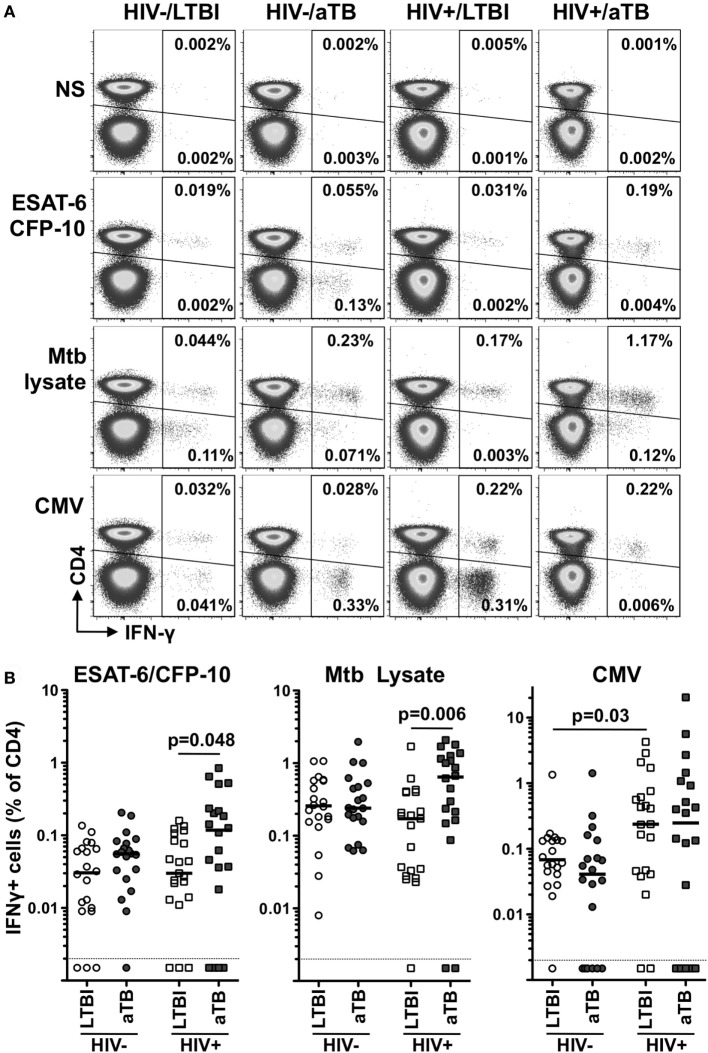
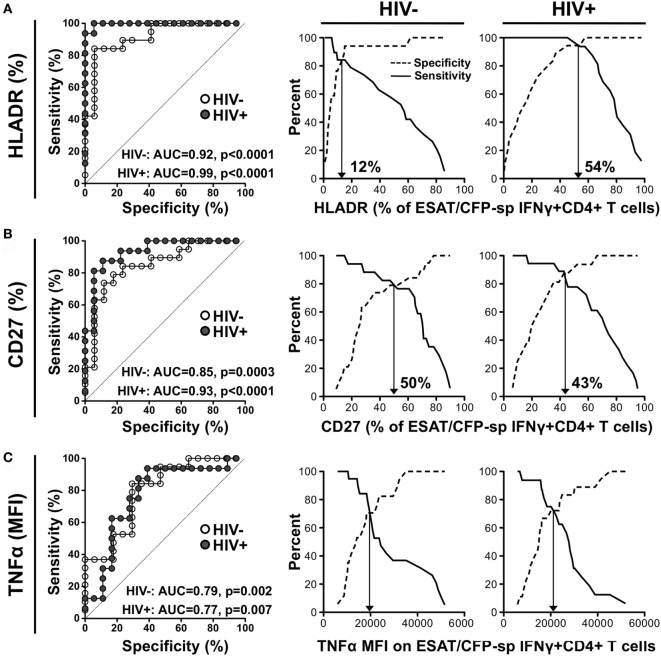
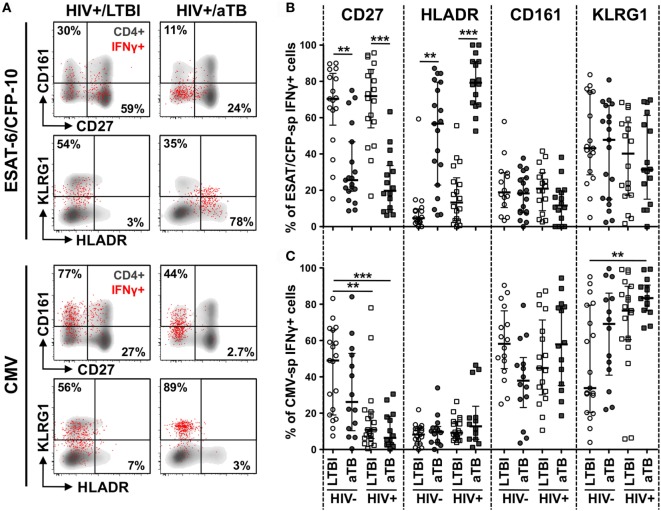
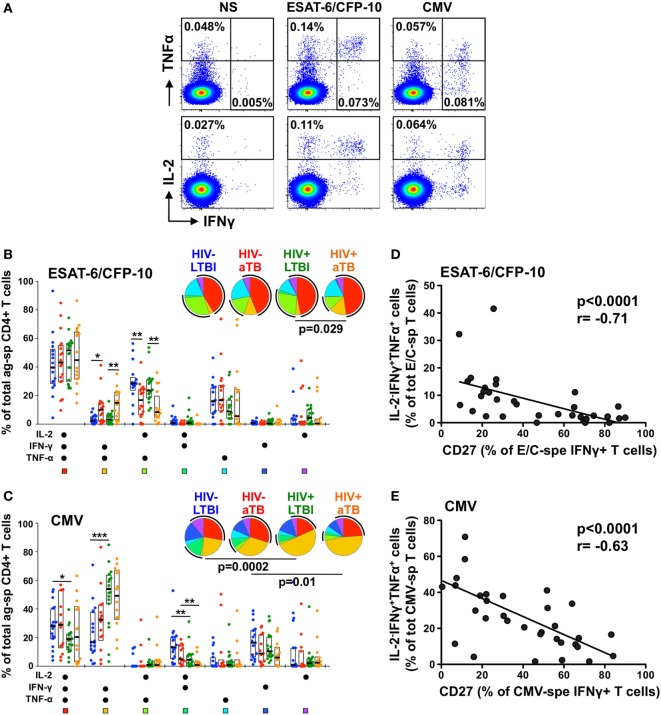
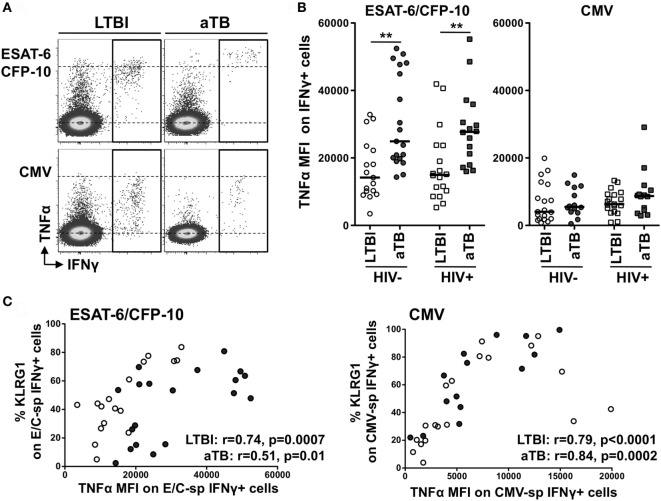
Several immune-based assays have been suggested to differentiate latent from active tuberculosis (TB). However, their relative performance as well as their efficacy in HIV-infected persons, a highly at-risk population, remains unclear. In a study of 81 individuals, divided into four groups based on their HIV-1 status and TB disease activity, we compared the differentiation (CD27 and KLRG1), activation (HLA-DR), homing potential (CCR4, CCR6, CXCR3, and CD161) and functional profiles (IFNγ, IL-2, and TNFα) of (Mtb)-specific CD4+ T cells using flow cytometry. Active TB disease induced major changes within the Mtb-responding CD4+ T cell population, promoting memory maturation, elevated activation and increased inflammatory potential when compared to individuals with latent TB infection. Moreover, the functional profile of Mtb-specific CD4+ T cells appeared to be inherently related to their degree of differentiation. While these specific cell features were all capable of discriminating latent from active TB, irrespective of HIV status, HLA-DR expression showed the best performance for TB diagnosis [area-under-the-curve (AUC) = 0.92, 95% CI: 0.82-1.01, specificity: 82%, sensitivity: 84% for HIV- and AUC = 0.99, 95% CI: 0.98-1.01, specificity: 94%, sensitivity: 93% for HIV+]. In conclusion, these data support the idea that analysis of T cell phenotype can be diagnostically useful in TB.
已经提出了几种基于免疫的检测方法来区分潜伏性结核和活动性结核。然而,它们在高危人群——艾滋病毒感染者中的相对性能及其有效性仍不清楚。在一项对81名个体的研究中,根据他们的HIV-1状态和结核病活动情况分为四组,我们使用流式细胞术比较了结核分枝杆菌(Mtb)特异性CD4+T细胞的分化(CD27和KLRG1)、活化(HLA-DR)、归巢潜能(CCR4、CCR6、CXCR3和CD161)和功能谱(IFNγ、IL-2和TNFα)。与潜伏性结核感染个体相比,活动性结核病在Mtb反应性CD4+T细胞群体中引起了重大变化,促进了记忆成熟、活化升高和炎症潜能增加。此外,Mtb特异性CD4+T细胞的功能谱似乎与其分化程度内在相关。虽然这些特定的细胞特征都能够区分潜伏性结核和活动性结核,而与HIV状态无关,但HLA-DR表达在结核病诊断中表现最佳[曲线下面积(AUC)=0.92,95%CI:0.82-1.01,特异性:82%,敏感性:84%(HIV阴性)和AUC=0.99,95%CI:0.98-1.01,特异性:94%,敏感性:93%(HIV阳性)]。总之,这些数据支持了T细胞表型分析在结核病诊断中可能有用的观点。